Business study · Updated June 2026
How to Learn Corporate Finance and Master DCF Valuation Models With AI Safely
Learn how to use AI safely to master corporate finance formulas, calculate WACC, and build discounted cash flow (DCF) models conceptually.
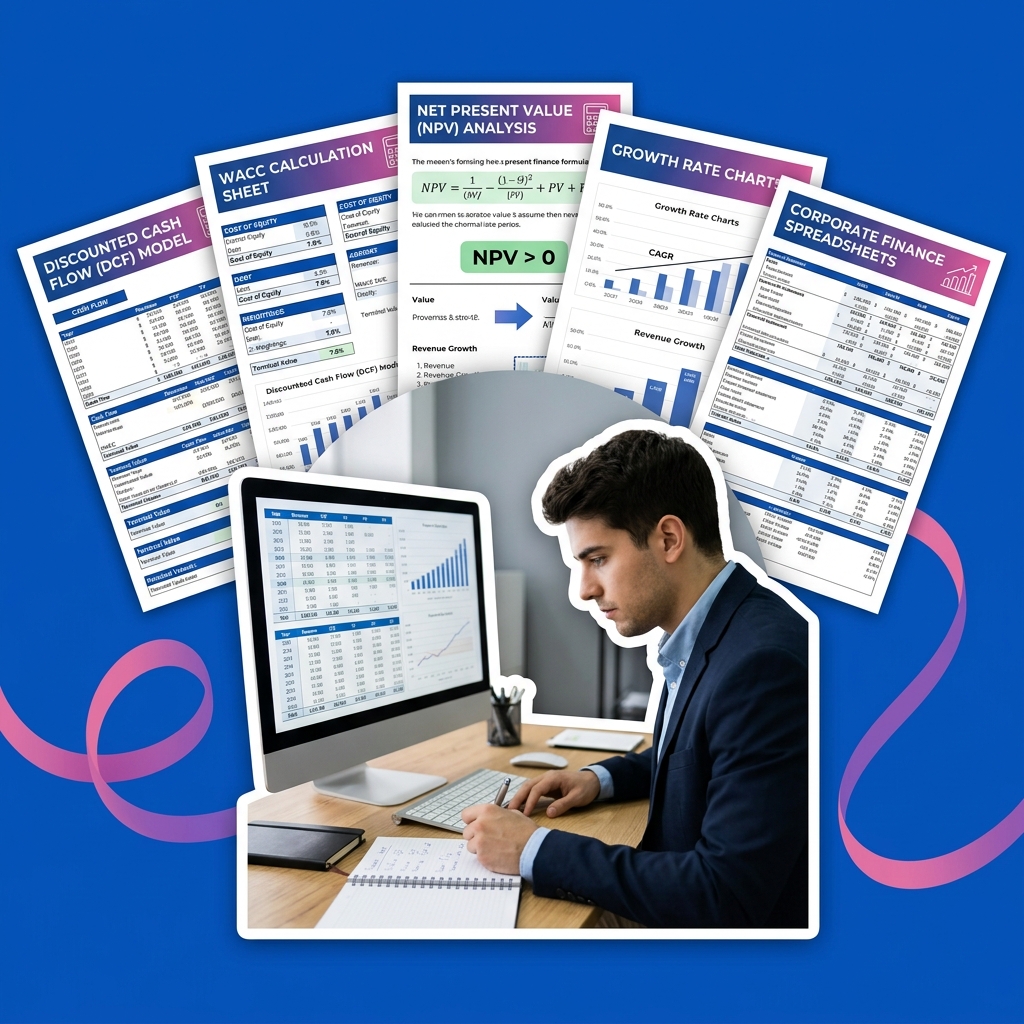
Corporate finance is a challenging core course for finance, business administration, and MBA students. Unlike basic accounting, which deals with recording past financial events, corporate finance focuses on the future: valuing assets, deciding which capital projects to invest in, and determining how to fund operations.
The curriculum is heavily quantitative. Students must master the Time Value of Money (TVM), calculate the Weighted Average Cost of Capital (WACC), and build Discounted Cash Flow (DCF) models to find the Net Present Value (NPV) of a company or project.
A common pitfall is pasting finance homework problems into an AI and asking for the final cash flow or valuation. AI models are prone to arithmetic errors, especially when dealing with compound interest formulas, discounting exponents, and complex summation equations.
Instead of relying on AI for calculations, use it to build your conceptual understanding of valuation variables, practice Socratic formula setups, and troubleshoot your spreadsheets.
A Safe, Analytical Corporate Finance Study Workflow
To learn corporate finance conceptually without violating academic integrity, follow this three-step study workflow:
1. Conceptual Formula Breakdown
Before you start plugging numbers into a calculator or Excel, you must understand the "why" behind the formulas. For example, why do we discount future cash flows, and how does the discount rate relate to risk? Ask the AI to explain the economic logic of formulas in plain terms.
2. Socratic Spreadsheet Auditing
Instead of asking the AI to build your DCF spreadsheet, build it yourself. If your model output doesn't match your textbook's answer, describe your spreadsheet's logical structure (e.g., "I am discounting free cash flows using WACC, but my terminal value is showing a massive discrepancy. Here is my formula: ..."). Ask the AI to identify potential errors in your discounting logic.
3. Case Study Scenario Variation
Corporate finance is taught through case studies (e.g., valuing a real company like Nike or Coca-Cola). Once you understand the case, ask the AI to generate a similar hypothetical scenario with changed variables (like higher inflation or lower growth rates) to practice adapting your financial models.
---
Corporate Finance Prompts You Can Copy
Use these targeted templates to interact with AI as a corporate finance tutor:
For Visualizing the Time Value of Money (TVM)
I am studying corporate finance. Can you explain the difference between Net Present Value (NPV) and Internal Rate of Return (IRR)? Under what project conditions can these two metrics lead to conflicting investment decisions, and why? Explain the concepts clearly.For Getting a WACC Setup Hint
I need to calculate the Weighted Average Cost of Capital (WACC) for a firm. I have the cost of equity, the cost of debt, the tax rate, and the debt-to-equity ratio. I want to solve this myself. Please explain the mathematical structure of the WACC formula and how the tax shield affects the cost of debt. Do not calculate the final WACC.For Scenario Practice
I am practicing Discounted Cash Flow (DCF) models. Can you generate a practice problem involving a hypothetical manufacturing company with three years of projected free cash flows, a perpetual growth rate, and a discount rate? Do not provide the solution; just write the problem statement.---
Common Corporate Finance Study Mistakes to Avoid
* Trusting AI for Exponentiation: Exponentiation is key in finance (e.g., discounting cash flows using $(1 + r)^t$). LLMs are notorious for failing at exact calculations with non-integer exponents. Always use financial calculators or Excel for the actual math.
Confusing Cash Flow with Profit: Corporate finance values projects based on Free Cash Flow (FCF)*, not accounting net income. Do not let AI summarize a project's viability using net income unless you first adjust for non-cash expenses (like depreciation) and capital expenditures.
* Underestimating the Terminal Value: In a DCF model, the terminal value (the value of the firm beyond the projection period) often accounts for 60% to 80% of the total value. Ask the AI to explain the sensitivity of terminal value to changes in the terminal growth rate vs. WACC.
---

A Mind for Numbers: How to Excel at Math and Science
Dr. Barbara Oakley's actionable guide to unlocking analytical thinking. Perfect for students tackling STEM classes who want to beat procrastination and master complex formulas.
AI Study Pilot receives a small commission from qualifying Amazon purchases at no extra cost to you.FAQ
What is the Weighted Average Cost of Capital (WACC)?
WACC is the average rate a company expects to pay to finance its assets, weighted according to its proportion of debt and equity. It acts as the minimum acceptable hurdle rate for new capital investments.
Why is interest expense multiplied by (1 - Tax Rate) in corporate finance?
Interest expense is tax-deductible in most jurisdictions. Because paying interest reduces the company's taxable income, the government effectively subsidizes a portion of the interest, creating a "tax shield" that lowers the effective cost of debt.
How do I use AI to study portfolio theory?
Explain the Capital Asset Pricing Model (CAPM) formula: $E(Ri) = Rf + \betai (E(Rm) - R_f)$. Ask the AI: "Explain the concept of Beta ($\beta$) and how it measures systemic risk relative to the market. Give examples of low-beta vs. high-beta industries."
Disclosure: AI Study Pilot may add affiliate links later. We recommend free-first tools where possible and never promise guaranteed grades or outcomes.