Computer science & math · Updated June 2026
Learn Cryptography & RSA Algorithm with AI Safely
Master asymmetric encryption, prime number generation, and modular exponentiation using Socratic AI coaching to map RSA cryptography calculations and understand security protocols safely.
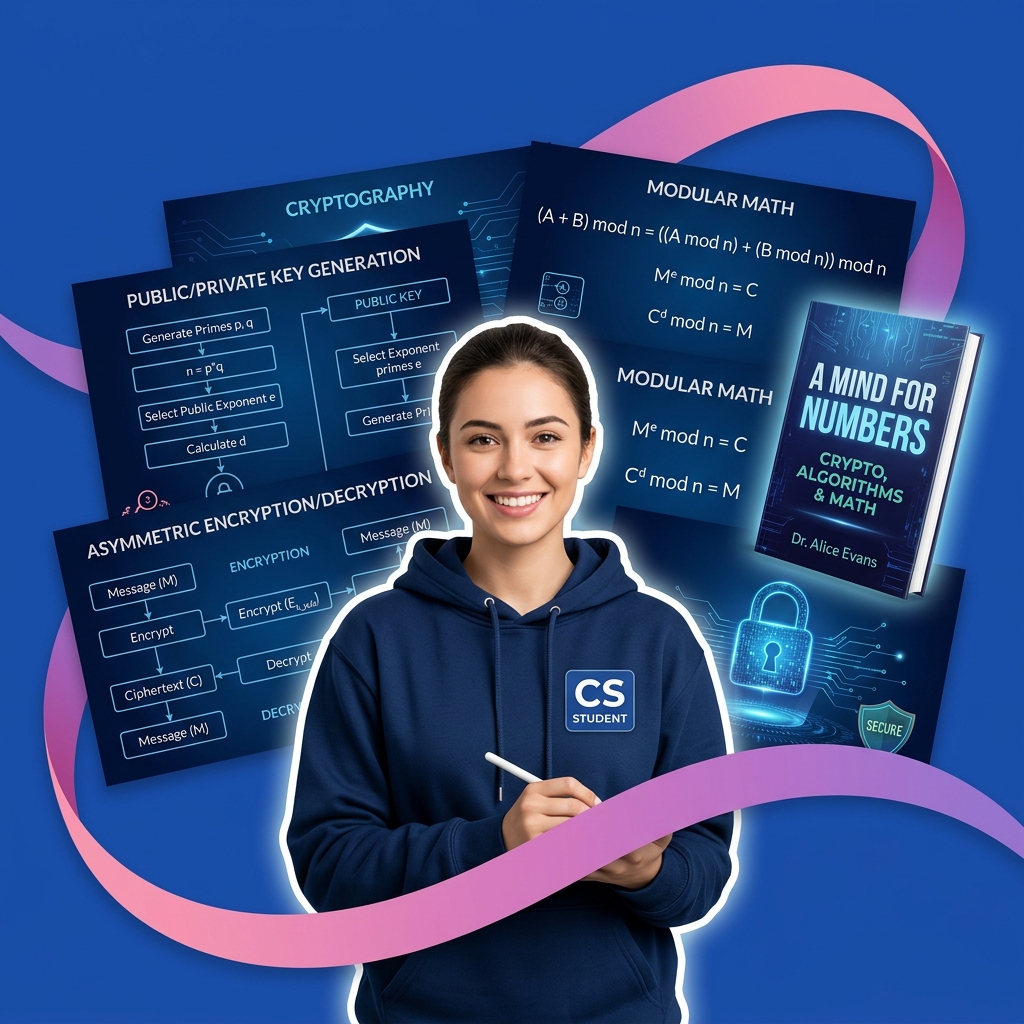
In computer science, cybersecurity, and discrete mathematics, cryptography is the foundation of digital security. It secures everything from online bank transactions to encrypted messaging apps. The most famous and widely used asymmetric (public-key) cryptosystem is the RSA algorithm, named after Rivest, Shamir, and Adleman. Unlike symmetric cryptography where the same key encrypts and decrypts information, RSA uses a public key to encrypt data and a mathematically linked private key to decrypt it. Tracing this algorithm requires an understanding of number theory, including prime factorization, Euler's totient function, and modular arithmetic.
Because calculating private keys (finding the modular multiplicative inverse using the Extended Euclidean Algorithm) and performing modular exponentiation can be mathematically intense, students often paste their cryptography problem sets directly into AI tools. However, letting AI calculate \(d\) or encrypt messages for you prevents you from developing the mathematical intuition needed to design secure network protocols, write secure code, or pass discrete math and security exams. This guide outlines a safe, active-learning study workflow to use AI as a Socratic cryptography tutor.
Step 1: Navigating RSA Key Generation
The security of RSA rests on the fact that multiplying two large prime numbers is easy, but factoring their product back into primes is computationally infeasible for large numbers. The key generation process involves:
- Selecting two distinct prime numbers, \(p\) and \(q\).
- Computing $n = pq$, which is the modulus for both the public and private keys.
- Calculating Euler's totient function, \(\phi(n) = (p-1)(q-1)\).
- Choosing an integer \(e\) (the public exponent) such that \(1 < e < \phi(n)\) and \(\gcd(e, \phi(n)) = 1\) (coprime).
- Calculating \(d\) (the private exponent) to satisfy the congruence relation \(ed \equiv 1 \pmod{\phi(n)}\).
Use this prompt to review your key generation steps Socraticly:
I am generating a small-scale RSA key pair using primes p = 61 and q = 53. I have calculated n = 3233 and totient phi(n) = 3120. I want to choose e = 17. Act as a Socratic cryptography tutor. Do not calculate the private key d or use the Extended Euclidean Algorithm for me. Ask me to verify why e = 17 is a valid choice compared to phi(n), explain what equation d must satisfy, and evaluate my step-by-step calculations. Guide me.Step 2: Tracing Encryption and Decryption
Once keys are generated, the public key is $(e, n)$ and the private key is $(d, n)$. To encrypt a plaintext message integer \(M\) (where $M < n$), you calculate the ciphertext \(C\) using:
\[C \equiv M^e \pmod n\]
To decrypt the ciphertext \(C\) back into the original message \(M\), you calculate:
\[M \equiv C^d \pmod n\]
Because \(M^e\) can grow extremely large, you must use modular arithmetic properties (like the binary exponentiation algorithm or modular reduction at each multiplication step) rather than standard calculators.
Practice modular exponentiation logic Socraticly with this prompt:
I am encrypting a message M = 65 using the public key (e=17, n=3233). I want to calculate C = 65^17 mod 3233. Act as a Socratic discrete math coach. Do not compute the modular exponentiation for me. Ask me to explain how the method of repeated squaring (binary exponentiation) works, have me write out the binary representation of the exponent 17, and guide me through the first few squaring steps.Step 3: Understanding Asymmetric Security Margins
To understand why RSA is secure, you must understand how an attacker would attempt to break it. If an eavesdropper knows the public key $(e, n)$, they must find the private key \(d\). To find \(d\), they must solve \(ed \equiv 1 \pmod{\phi(n)}\), which requires knowing \(\phi(n) = (p-1)(q-1)\). Finding \(p\) and \(q\) requires factoring \(n\).
Analyze cryptographic security margins Socraticly with this prompt:
I am studying why factoring n is the primary attack vector against the RSA algorithm. Act as a Socratic cybersecurity instructor. Do not explain the math directly. Ask me to contrast what information an eavesdropper has versus what a key owner has, explain why knowing n does not immediately give away phi(n), and ask what computational complexity class prime factorization belongs to. Guide me.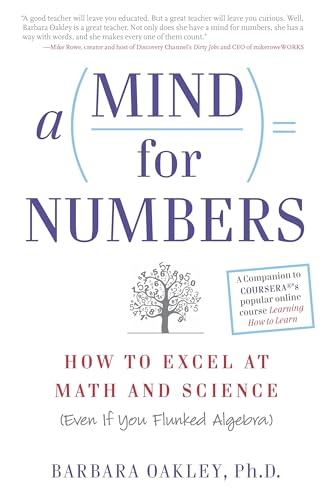
A Mind for Numbers: How to Excel at Math and Science
Dr. Barbara Oakley's actionable guide to unlocking analytical thinking. Perfect for students tackling STEM classes who want to beat procrastination and master complex formulas.
AI Study Pilot receives a small commission from qualifying Amazon purchases at no extra cost to you.Common mistakes
Keep these typical cryptography pitfalls in mind:
- Using \(\phi(n)\) instead of \(n\) as the modulus: A common student mistake is trying to encrypt or decrypt messages using \(\phi(n)\) as the modulo divisor (e.g., \(M^e \pmod{\phi(n)}\)). The modulus for transmission is always \(n\); \(\phi(n)\) is only used during key generation to compute \(d\).
- Selecting non-coprime exponents: Choosing a public exponent \(e\) that shares factors with \(\phi(n)\) makes it impossible to compute a multiplicative inverse \(d\). AI tools sometimes suggest arbitrary values for \(e\) without verifying the greatest common divisor.
- Underestimating key sizes: While textbooks use small primes (like 3 and 11) for demonstration, real-world RSA requires key lengths of 2048 or 4096 bits to prevent modern computers from factoring \(n\) in a reasonable timeframe.
FAQ
- What is the Extended Euclidean Algorithm? It is an extension of the Euclidean algorithm that finds the greatest common divisor of two integers, and also computes the coefficients (Bézout's identity) that express the GCD as a linear combination of the integers. In RSA, it is used to find the multiplicative inverse \(d\). Prompt: "Socraticly quiz me on how to set up the backward substitution steps in the Extended Euclidean Algorithm to solve for d when e and phi(n) are given."
- Why is RSA slower than symmetric encryption? RSA relies on high-power modular math on huge numbers, which requires substantial CPU cycles. In practice, RSA is used only to securely share a temporary symmetric key (like an AES key), which is then used to encrypt the actual bulk data quickly. Prompt: "Socraticly quiz me on the concept of hybrid cryptosystems and why they combine asymmetric and symmetric algorithms."
- What is padding in RSA? Plain RSA (without padding) is deterministic, meaning the same plaintext always produces the same ciphertext. To prevent mathematical analysis and chosen-ciphertext attacks, padding schemes (like OAEP - Optimal Asymmetric Encryption Padding) add randomized data to the message before encrypting. Prompt: "Socraticly quiz me on the security vulnerabilities of 'textbook' RSA and how padding introduces randomness."
Final recommendation
Cryptography is math applied to security. Do not rely on AI calculators to do your modular exponentiations or find key inverses. Instead, trace the Extended Euclidean steps on paper, map key variables carefully, and use Socratic AI checkpoints to audit your coprime validations, modular math, and mathematical proofs.
Disclosure: AI Study Pilot may add affiliate links later. We recommend free-first tools where possible and never promise guaranteed grades or outcomes.