Computer science · Updated June 2026
How to Learn SQL and Master Relational Database Normalization With AI Safely
Learn how to use AI safely to master SQL query writing, understand relational databases, and learn table normalization concepts step-by-step.
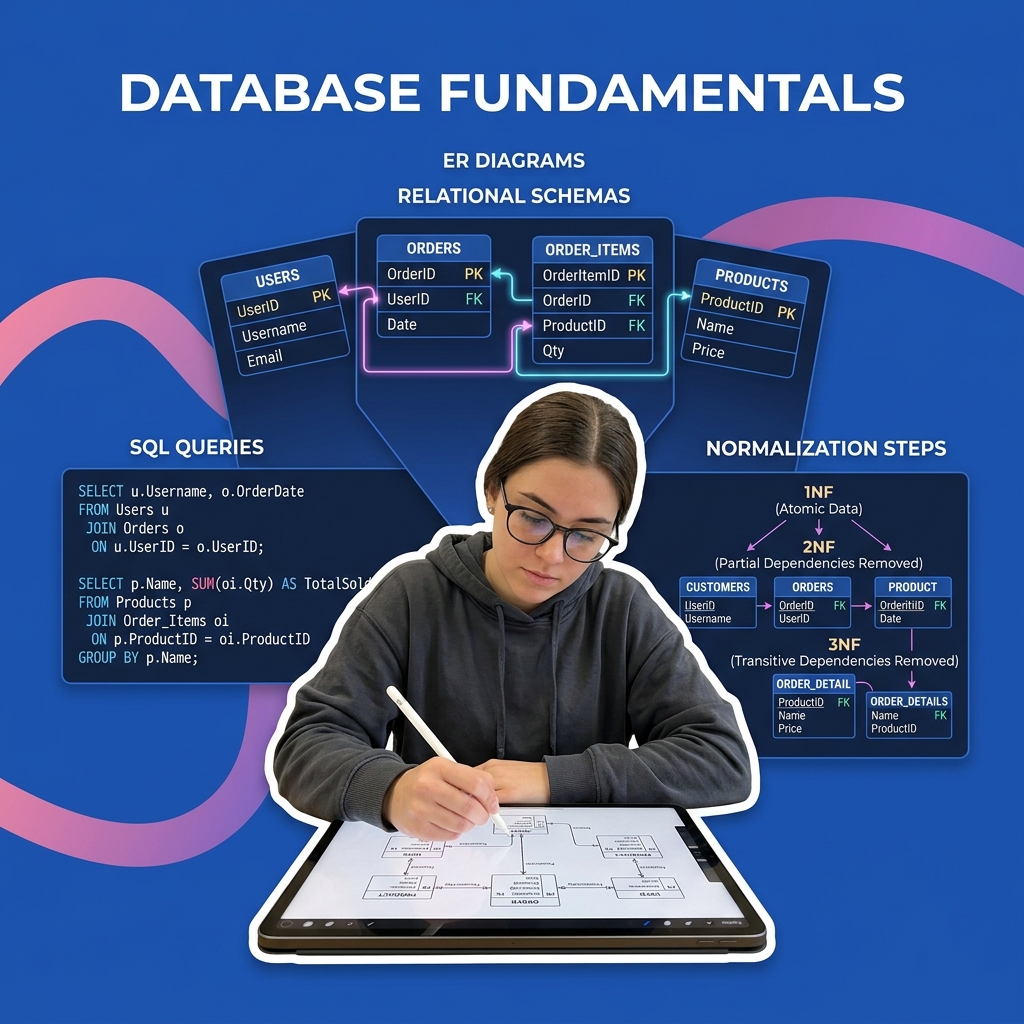
Relational database design and SQL (Structured Query Language) are fundamental skills for computer science, data science, and business information systems majors. However, students often face two major hurdles: understanding the abstract mathematics behind database normalization (moving from unnormalized data to 1NF, 2NF, and 3NF) and writing complex SQL queries containing joins, subqueries, and aggregations.
A common mistake is asking AI to write entire SQL schemas or query homework assignments. Rushing to copy-paste generated SQL prevents you from learning how to troubleshoot syntax errors, optimize joins, or identify normalization anomalies under exam conditions.
AI assistants can be used safely to build your schema-design intuition, explain relational algebra, and tutor you through SQL query construction step-by-step.
A Safe, Step-by-Step Database Study Workflow
To learn SQL and database design conceptually while maintaining academic integrity, follow this three-step study workflow:
1. Socratic Database Normalization Walkthroughs
Database normalization prevents data redundancy. Instead of asking AI to normalize your homework tables, paste a mock table structure and ask the model to explain why it violates a specific Normal Form (like 2NF or 3NF), and what the resulting decomposition schema looks like.
2. Socratic SQL Query Construction
If you are struggling to write a query involving multiple tables, describe your table schemas and the target data you want to retrieve. Ask the AI to guide you through the query construction—starting with the FROM and JOIN clauses before adding filtering and grouping logic.
3. Entity-Relationship (ER) Diagram Verification
When designing database schemas, sketch your Entity-Relationship Diagrams (ERDs) on paper or a smart notebook first. Describe your entity tables, primary keys, and foreign key relationships to the AI, and ask it to audit your cardinality (e.g., 1-to-many vs. many-to-many relationships) for logical gaps.
---
SQL and Database Prompts You Can Copy
Use these optimized prompt templates to turn AI into a database tutor:
For Understanding Normal Forms (1NF, 2NF, 3NF)
I am learning database normalization. I have a mock table with these fields: [Insert fields, e.g., StudentID, StudentName, CourseID, CourseName, Grade]. The primary key is a composite key (StudentID, CourseID). Can you explain step-by-step why this table violates Second Normal Form (2NF) and how to decompose it into 2NF tables? Explain the concepts clearly.For Writing SQL Queries Step-by-Step
I need to write a SQL query to find students who scored above average in a course. Here are my tables: Students (id, name), Enrolments (student_id, course_id, grade). I want to write this query myself. Please give me a step-by-step hint of how to structure the subquery for the average grade, and how to connect it to the main query using a JOIN. Do not write the full query.For Auditing Cardinality
I am designing a database schema for a library. I have two entities: 'Books' and 'Authors'. An author can write multiple books, and a book can have multiple authors. Can you explain how this many-to-many relationship should be represented in a relational database using a junction table? Explain the primary and foreign keys needed.---
Common Database Study Mistakes to Avoid
* Trusting AI SQL Dialects Blindly: SQL has different dialects (PostgreSQL, MySQL, SQLite, SQL Server, Oracle). A query that runs perfectly in PostgreSQL might fail in MySQL due to differences in syntax or functions. Always tell the AI which specific SQL engine you are using.
* Skipping Relational Algebra: Many database courses test relational algebra (select, project, join operators) before writing SQL. Do not rely on AI to translate queries to relational algebra unless you first try to write the mathematical notation yourself.
* Neglecting Indexes and Performance: Rushing to write nested subqueries is often inefficient. Ask the AI to compare the performance of a subquery vs. a CTE (Common Table Expression) or JOIN so you learn how database query planners work.
---

Rocketbook Smart Reusable Notebook
Eco-friendly, reusable physical notebook that digitizes and syncs your hand-written diagrams and notes directly to your favorite cloud storage for AI-assisted study.
AI Study Pilot receives a small commission from qualifying Amazon purchases at no extra cost to you.FAQ
What is the difference between 2NF and 3NF?
A table is in 2NF if it is in 1NF and contains no partial dependencies (every non-key attribute must depend on the entire primary key, not just part of it). A table is in 3NF if it is in 2NF and contains no transitive dependencies (non-key attributes cannot depend on other non-key attributes).
How do I prompt AI to explain complex SQL execution order?
You can ask: "Explain the logical execution order of a SQL SELECT query. Why does the FROM clause execute before WHERE, and why does SELECT execute after HAVING?" This helps you understand why column aliases created in SELECT cannot be used in WHERE.
What are foreign keys and why are they important?
A foreign key is a column or group of columns in one table that points to the primary key of another table. It enforces referential integrity, ensuring that you cannot add a record with a non-existent relationship, or delete a record that other tables depend on.
Disclosure: AI Study Pilot may add affiliate links later. We recommend free-first tools where possible and never promise guaranteed grades or outcomes.