Chemistry & pre-med · Updated June 2026
Learn Electrophilic Aromatic Substitution with AI Safely
Master benzene reactivity, directing effects, and multi-step synthesis design using Socratic AI coaching to learn organic chemistry mechanisms safely.
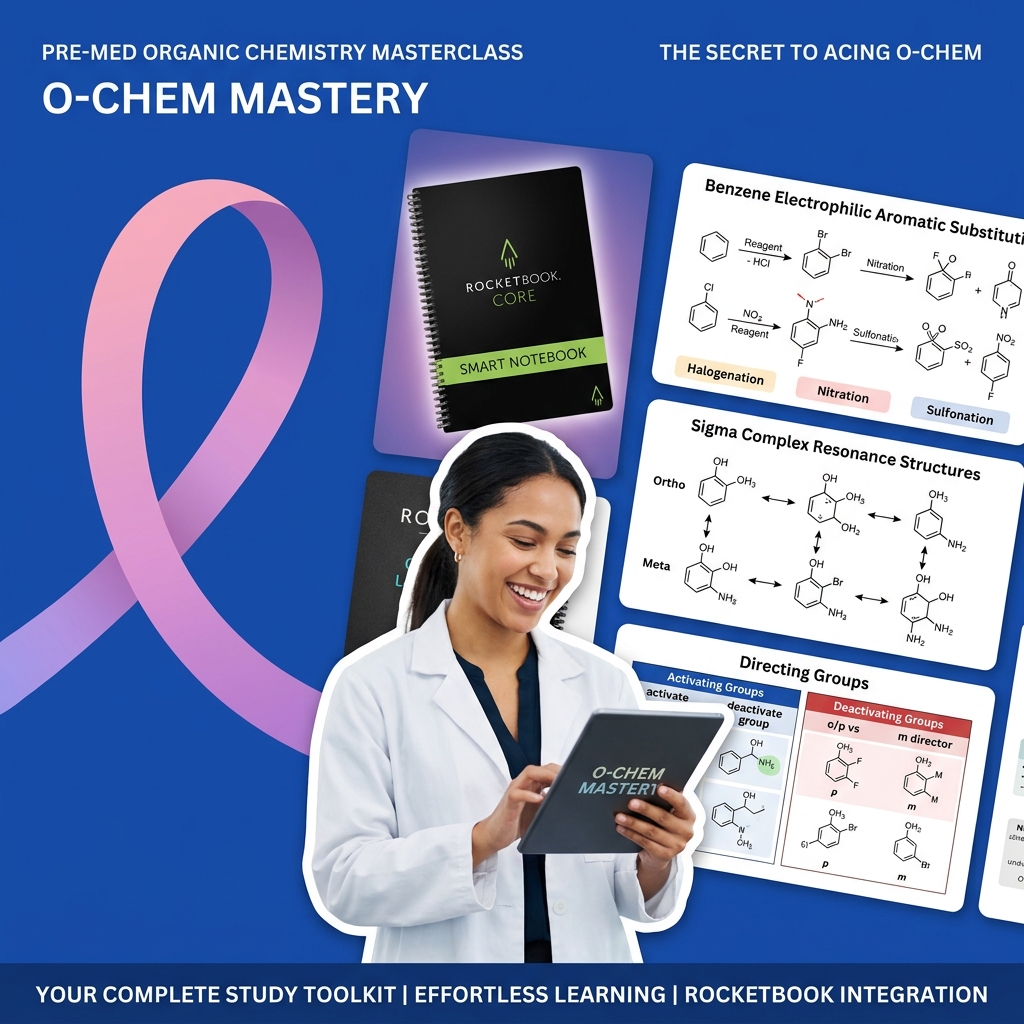
In organic chemistry, Electrophilic Aromatic Substitution (EAS) is a fundamental class of reactions where an electrophile replaces a hydrogen atom on an aromatic ring. Although benzene is exceptionally stable due to its aromatic resonance energy ($152\text{ kJ/mol}$), it will react with highly reactive electrophiles to undergo substitution rather than addition, preserving the stable aromatic system. Key EAS reactions include halogenation, nitration, sulfonation, and Friedel-Crafts alkylation and acylation.
Because drawing out curved arrow mechanisms, constructing resonance structures for intermediates (sigma complexes), and planning multi-step synthesis sequences is mentally demanding, students frequently ask AI to draw their mechanisms, predict their product mixtures, or solve synthesis pathways. While using AI to quickly check structural details can be helpful, relying on it to write out mechanisms or sequence synthesis steps bypasses the logical resonance analysis necessary to succeed in organic chemistry courses and on standardized exams like the MCAT. This guide outlines a Socratic workflow to utilize AI as an organic chemistry coach to master EAS mechanisms and directing effects safely.
Step 1: Understanding Benzene Reactivity & EAS Steps Socraticly
Every EAS reaction follows a two-step mechanism. First, the aromatic ring acts as a nucleophile, using its $\pi$ electrons to attack a generated strong electrophile. This breaks the aromaticity, forming a resonance-stabilized carbocation intermediate called a sigma complex (or arenium ion). Second, a weak base deprotonates the sigma complex, restoring the aromatic ring stability. Instead of asking AI to draw the mechanism or provide the products, use it to check your curved arrow logic and resonance stabilization steps.
Use this prompt to master the basic EAS steps Socraticly:
I am learning the mechanism for the bromination of benzene using Br2 and FeBr3. Act as a Socratic organic chemistry tutor. Do not draw the mechanism or write the final structures. Ask me how the electrophile is generated first, prompt me to explain what happens to the ring's hybridization when it attacks the electrophile, and guide me through explaining the three resonance structures of the sigma complex. Guide me.Step 2: Analyzing Directing and Activating Effects Socraticly
When benzene already has a substituent, that group influences both the rate of subsequent substitutions (activating vs. deactivating) and the position of the incoming electrophile (ortho/para-directing vs. meta-directing). Activators (like $-\text{OH}$ or $-\text{NH}2$) donate electron density through resonance or induction, making the ring more nucleophilic and directing incoming groups to the ortho and para positions. Deactivators (like $-\text{NO}2$ or $-\text{C}\equiv\text{N}$) withdraw electron density, directing to the meta position. Halogens are unique: they are deactivating but ortho/para-directing due to competing induction and resonance. Instead of asking AI to predict the products, use it to prompt your resonance drawings to understand why directing effects occur.
Use this prompt to master directing effects Socraticly:
I am analyzing the nitration of toluene (methylbenzene). I want to understand why the methyl group is an activating, ortho/para director. Act as a Socratic organic chemistry coach. Do not tell me the product distribution or draw structures. Ask me to explain how the methyl group donates electron density, and prompt me to draw the resonance structures for ortho, meta, and para attack to identify where the carbocation is most stabilized. Guide me.Step 3: Designing Multi-Step Synthesis Socraticly
In multi-step aromatic synthesis, the order in which reactions are performed is critical. For example, if you want to synthesize m-bromonitrobenzene from benzene, you must perform nitration first (to introduce the meta-directing $-\text{NO}_2$ group) followed by bromination. If you swap the order, you will get a mixture of ortho- and para-bromonitrobenzene. Additionally, some groups are incompatible with certain reactions (e.g., Friedel-Crafts reactions do not work on strongly deactivated rings). Using AI to write your synthesis pathways prevents you from learning these directing-group conflicts.
Use this prompt to master synthesis design Socraticly:
I am planning the synthesis of p-nitrobenzoic acid from toluene. Act as a Socratic organic chemistry tutor. Do not give me the reagents, reactions, or the final sequence. Ask me about the directing effects of the methyl group versus the carboxylic acid group, prompt me to identify the reaction needed to convert a methyl group to a carboxylic acid, and guide me to determine the correct sequence of steps to avoid directing conflicts. Guide me.
Rocketbook Smart Reusable Notebook
Eco-friendly, reusable physical notebook that digitizes and syncs your hand-written diagrams and notes directly to your favorite cloud storage for AI-assisted study.
AI Study Pilot receives a small commission from qualifying Amazon purchases at no extra cost to you.Common mistakes
Keep an eye out for these classic traps when studying electrophilic aromatic substitution:
- Drawing addition instead of substitution: Students frequently draw nucleophilic addition (similar to alkene reactions) and forget the deprotonation step that restores aromaticity. Aromatic rings undergo substitution to preserve resonance stability. Quiz yourself by asking AI: "Quiz me Socraticly on the energy profiles of addition vs. substitution in benzene. Guide me."
- Friedel-Crafts rearrangement traps: Friedel-Crafts alkylation involves carbocation intermediates, which can undergo hydride or alkyl shifts to form a more stable carbocation. For example, reacting benzene with 1-chloropropane yields isopropylbenzene (cumene) rather than propylbenzene. Ask AI: "Prompt me Socraticly to analyze why Friedel-Crafts alkylations are prone to rearrangements and how Friedel-Crafts acylation avoids this problem. Guide me."
- Attempting Friedel-Crafts on deactivated rings: Friedel-Crafts reactions fail on rings containing moderate or strong deactivators (like $-\text{NO}2$, $-\text{SO}3\text{H}$, or $-\text{COOH}$). Forgetting this limitation is a very common exam mistake.
FAQ
- Why are halogens deactivating but ortho/para-directing? Halogens are highly electronegative and withdraw electron density inductively through the $\sigma$ bond (deactivating the ring). However, they have lone pairs that can donate electron density through resonance, stabilizing the ortho and para sigma complex carbocations. Prompt: "Socraticly quiz me on the competing inductive and resonance effects of chlorobenzene during nitration. Guide me."
- What is the difference between alkylation and acylation? Alkylation introduces an alkyl group ($\text{R}-$), which is activating and can lead to over-alkylation. Acylation introduces an acyl group ($\text{R-C=O}-$), which is deactivating, preventing over-acylation and carbocation rearrangements. Prompt: "Act as a Socratic tutor. Quiz me on the advantages and disadvantages of Friedel-Crafts alkylation vs. acylation. Guide me."
- How does sulfonation serve as a blocking group? Sulfonation ($-\text{SO}_3\text{H}$) is reversible. It can be added to block the para position, force an incoming group to the ortho position, and then be removed with dilute acid (desulfonation). Prompt: "Socraticly quiz me on using the sulfonyl group as a blocking agent in synthesis. Guide me."
Final recommendation
Electrophilic aromatic substitution requires a strong grasp of resonance and stability. Avoid letting AI solve your synthesis pathways or draw your intermediates. Instead, sketch your resonance structures on a physical page, identify directing conflicts, and leverage Socratic AI sessions to audit your curved-arrow logic and reaction sequences.
Disclosure: AI Study Pilot may add affiliate links later. We recommend free-first tools where possible and never promise guaranteed grades or outcomes.