Language study · Updated June 2026
How to Learn Foreign Language Grammar and Master Verb Conjugations With AI Safely
Learn how to use AI safely to master foreign language verb conjugations, understand grammar rules, and practice active conjugation drills conceptually.
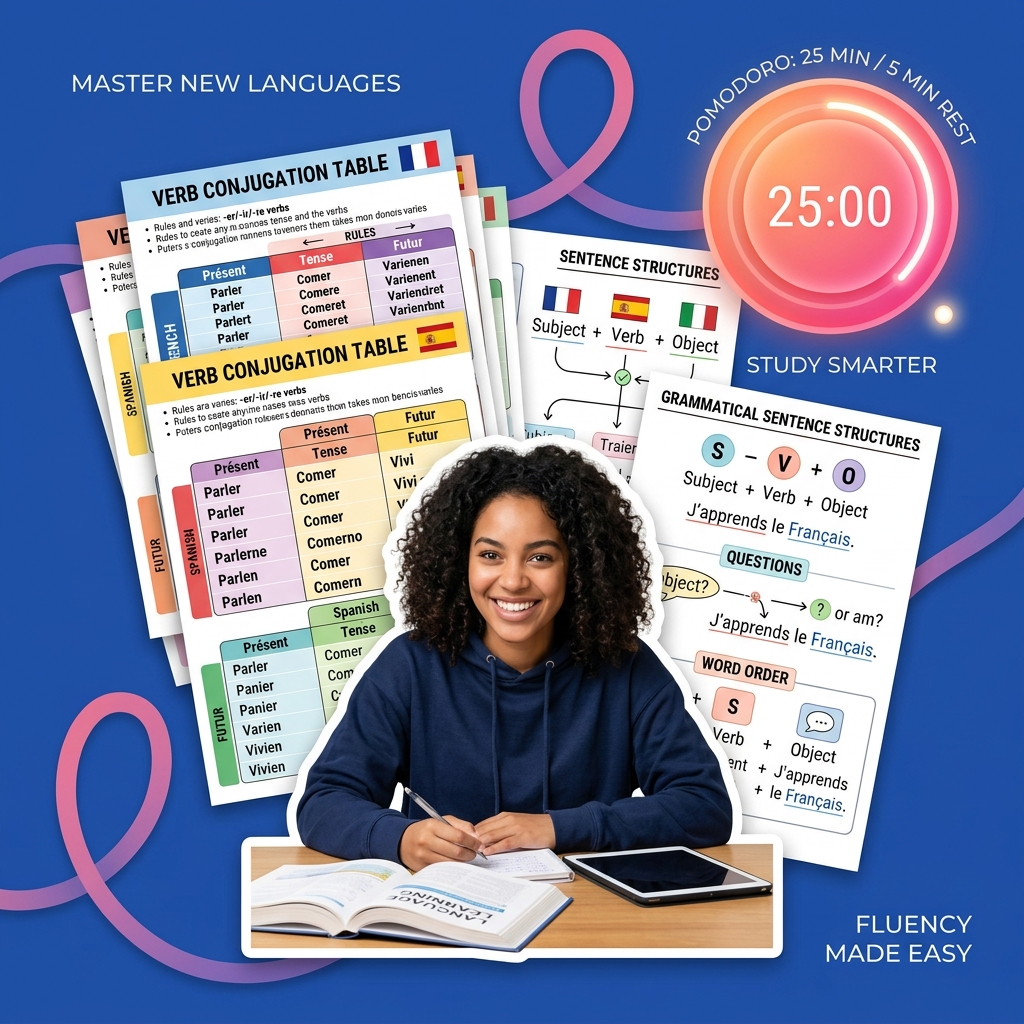
Foreign language requirements—such as college-level Spanish, French, German, or Japanese—are standard graduation requirements for many liberal arts and science majors. However, many students struggle with the transition from simple vocabulary matching to complex grammatical structures. The biggest hurdle is usually mastering verb conjugation tables and understanding subtle syntax rules (such as indicative vs. subjunctive moods, or preterite vs. imperfect past tenses).
Staring at massive conjugation grids in a textbook is a highly passive study method. You might feel like you know the endings while looking at the chart, but when you have to write a sentence from scratch or speak during an oral exam, your brain fails to retrieve the correct form.
AI models are highly effective interactive language coaches. You can use an AI to explain grammar rules conceptually, generate targeted contextual conjugation drills, and provide instant correction feedback on your sentence structure.
However, using an AI to translate your essays, write your class assignments, or generate speech scripts for your oral exams is a violation of academic integrity. The key is to use the AI as a conversational practice partner and tutor to build your skills, while doing your own writing and speaking.
Conceptual grammar workflow with AI
- Understand the conceptual rules: Learn when and why to use specific tenses or moods before drilling conjugations.
- Perform active conjugation drills: Practice conjugating verbs within complete, contextual sentences rather than in isolated lists.
- Seek real-time correction feedback: Write sentences from scratch and ask the AI to identify and explain grammatical errors.
- Time-box your study sessions: Keep drills high-intensity and short to maintain mental focus.
Gamifying Verb Drills with Time-Boxing
Memorizing conjugation endings and syntax structures is highly repetitive. If you try to study conjugation charts for hours, your brain will quickly experience fatigue, leading to passive scanning and zero retention.
To study grammar effectively, you must keep your retrieval practice active and high-intensity.
Using a physical visual study timer (like a Pomodoro gravity cube) is an excellent way to gamify your practice. Set a timer for 15 minutes and commit to a high-intensity, distraction-free conjugation drill. Ask the AI to generate a rapid-fire translation quiz, and try to translate as many sentences as possible before the timer runs out. When the timer rings, take a 5-minute break. This short, intense time-boxing keeps your attention sharp and prevents the brain-fog that usually accompanies repetitive language drilling.
The Grammar Conjugation Prompt
To practice conjugating verbs in context and understand the syntax rules, use this structured prompt:
Act as a language instructor for [insert language, e.g., French]. Explain the differences between [insert tenses, e.g., Passe Compose and Imparfait] conceptually.

Please generate a study guide:
1. Explain the conceptual rules for when to use each tense.
2. Provide a list of 5 key "trigger words" that indicate which tense to use.
3. Create a 5-question fill-in-the-blank conjugation quiz in complete, contextual sentences. Do not show the answers.
4. Ask me to reply with my answers, and you will evaluate my conjugation and spelling, explaining any errors.
Step-by-Step Language Review
Step 1 — Master subjunctive triggers
The subjunctive mood is notoriously difficult because it depends on specific triggers. Ask the AI to help you identify these triggers:
In [e.g., Spanish], what are the core triggers for the subjunctive mood (e.g., WEIRDOS acronym)? Provide a simple sentence example for each trigger category.Step 2 — Practice differential translation
Test your ability to choose the correct tense based on context. Ask the AI:
Generate 3 English sentences that look similar but require different past tenses in [e.g., German]. Explain why the German translations differ based on the type of action described.Step 3 — Run a real-time correction loop
Write a paragraph in your target language and ask the AI to audit it, without rewriting it completely:
Audit this paragraph I wrote in [target language] for grammatical errors (verb conjugation, gender agreement, and word order). Do not translate it. List each error, explain why it is incorrect, and provide the correct grammatical rule.
Visual Pomodoro Study Cube Timer
A physical, gravity-sensing study block timer that triggers timed active recall intervals automatically. Perfect for staying locked in during focused sprints.
AI Study Pilot receives a small commission from qualifying Amazon purchases at no extra cost to you.Common mistakes
* Memorizing verb stems in isolation: Always practice conjugating verbs inside complete sentences. This builds the structural memory of how verbs link with subjects, prepositions, and objects.
* Using AI as a translator: If you paste your English thoughts and ask AI to translate them, you learn nothing. Write the target language sentences yourself, and use AI strictly to audit your grammar and identify errors.
* Ignoring pronunciation: Grammar is only half the battle. Speak your conjugation drills out loud. Multimodal learning (writing, seeing, and speaking) dramatically improves cognitive retention.
Disclosure: AI Study Pilot may add affiliate links later. We recommend free-first tools where possible and never promise guaranteed grades or outcomes.