Machine Learning & CS · Updated June 2026
Learn Neural Network Backpropagation and Master the Calculus With AI Safely
Master the multivariable calculus chain rule, feedforward networks, gradient descent, weight updates, and loss gradients using Socratic AI coaching to build deep learning intuition safely.
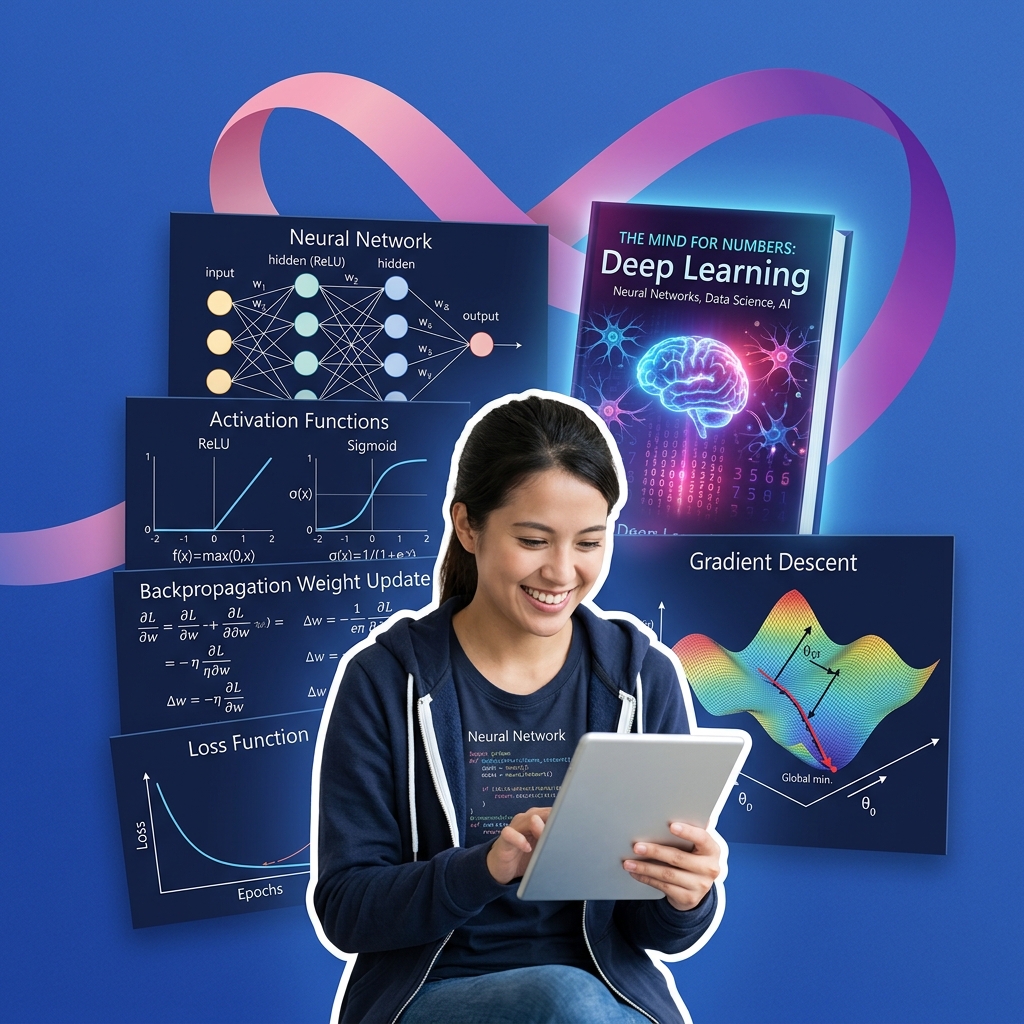
In machine learning and deep learning, backpropagation (backward propagation of errors) is the fundamental algorithm used to train artificial neural networks. Working in tandem with an optimization algorithm like Gradient Descent, backpropagation calculates the gradient of the loss function with respect to each weight in the network. These gradients tell us how to adjust the weights to minimize the network's prediction error.
The mathematical engine of backpropagation is the chain rule from multivariable calculus. For a simple feedforward network, the process follows these main phases:
- Feedforward: Input values \(x\) are multiplied by weights \(w\), summed with biases \(b\) to form net inputs \(z\), and passed through an activation function \(a = \sigma(z)\) (like Sigmoid or ReLU) to generate layer outputs. This repeats until the final predicted output \(\hat{y}\) is produced.
- Loss Calculation: The network compares \(\hat{y}\) to the target label \(y\) using a loss function \(L\) (like Mean Squared Error or Cross-Entropy).
- Backward Pass: Beginning at the output layer, the algorithm works backward to calculate the partial derivatives of the loss with respect to each weight: \(\frac{\partial L}{\partial w_{ij}^{(l)}} = \frac{\partial L}{\partial a_j^{(l)}} \cdot \frac{\partial a_j^{(l)}}{\partial z_j^{(l)}} \cdot \frac{\partial z_j^{(l)}}{\partial w_{ij}^{(l)}}\).
- Weight Update: Adjust weights in the opposite direction of the gradient: \(w_{ij}^{(l)} \leftarrow w_{ij}^{(l)} - \eta \frac{\partial L}{\partial w_{ij}^{(l)}}\), where \(\eta\) is the learning rate.
Because backpropagation involves nested derivatives and matrix calculus, students frequently ask AI to derive the gradient formulas or write the PyTorch/NumPy training loops from scratch. However, letting AI derive these equations bypasses the mathematical logic of error attribution and gradient flow, which is crucial for diagnosing vanishing or exploding gradients in real-world models. This guide outlines a Socratic workflow to utilize AI as a deep learning math coach.
Step 1: Mapping the Computational Graph & Derivatives Socraticly
A computational graph decomposes complex mathematical functions into a sequence of simple operations. To calculate the derivative of the loss with respect to a weight in the first layer, you must trace the path from the weight, through the intermediate layer activations, to the final loss.
Use this Socratic prompt to audit your computational graph logic:
I am designing a 3-layer feedforward neural network (input, one hidden layer with sigmoid activation, output layer with MSE loss). Act as a Socratic machine learning tutor. Do not derive the gradients or write weight update formulas. Ask me to draw the computational graph from the weight w_ij^(1) to the final loss L, and prompt me to write the chain rule expansion for dL/dw_ij^(1) in terms of partial derivatives. Guide me.Step 2: Deriving Activation Function Gradients Socraticly
Activation functions add non-linearity to neural networks, allowing them to learn complex patterns. When performing backpropagation, you must compute the derivative of the activation function with respect to its net input, \(\sigma'(z)\). For example, the derivative of the Sigmoid function \(\sigma(z) = \frac{1}{1 + e^{-z}}\) can be expressed elegantly in terms of its output: \(\sigma'(z) = \sigma(z)(1 - \sigma(z))\).
Using AI to look up these derivatives or write them in Python limits your understanding of how different activation functions behave during training.
Use this prompt to master activation derivatives Socraticly:
I need to derive the derivative of the sigmoid activation function and the ReLU activation function for backpropagation. Act as a Socratic deep learning math coach. Do not write out the derivatives or the proofs. Ask me to apply the quotient rule to sigmoid and show my steps, and have me explain why the derivative of ReLU is zero for negative inputs and how that affects weight updates during backpropagation. Guide me.Step 3: Auditing Weight Updates & Gradient Descent Socraticly
Once you have computed \(\frac{\partial L}{\partial w}\), you update the weights. If you choose a learning rate \(\eta\) that is too large, the loss will oscillate or diverge; if it is too small, training will be painfully slow.
Use this Socratic prompt to audit your training parameters and gradient computations:
I am writing a basic neural network training loop in NumPy. Act as a Socratic machine learning coach. Do not write or correct code. Ask me to explain the physical meaning of the gradient vector in high-dimensional space and why we subtract it from our weight vector. Then, prompt me to describe the visual symptoms of choosing a learning rate that is too high versus too low. Guide me.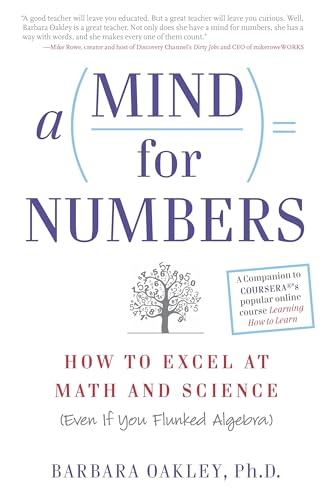
A Mind for Numbers: How to Excel at Math and Science
Dr. Barbara Oakley's actionable guide to unlocking analytical thinking. Perfect for students tackling STEM classes who want to beat procrastination and master complex formulas.
AI Study Pilot receives a small commission from qualifying Amazon purchases at no extra cost to you.Common mistakes
Keep an eye out for these classic pitfalls when studying backpropagation:
- Transposing matrices incorrectly in vector form: In multi-dimensional layers, weights and inputs are matrices. When applying the chain rule, you must transpose the matrices (e.g., \(X^T\)) to ensure the dimensions align for matrix multiplication. AI models often output mathematically invalid matrix multiplication sizes.
- Vanishing gradients with sigmoid activations: The maximum value of the Sigmoid derivative is \(0.25\). When chain-multiplying these small fractions across many layers (deep networks), the gradients become extremely small, preventing early layers from updating their weights. Prompt: "Socraticly quiz me on why deep networks suffer from the vanishing gradient problem when using Sigmoid versus ReLU. Guide me."
- Forgetting the bias gradients: Biases are updated similarly to weights, but their activation derivative term \(\frac{\partial z}{\partial b}\) is always \(1\). Students often forget to update biases entirely or apply incorrect matrix operations. Ask AI: "Quiz me Socraticly on the difference between computing derivatives for weights versus biases in a fully connected layer. Guide me."
FAQ
- What is the difference between backpropagation and gradient descent? Backpropagation calculates the partial derivatives (gradients) of the loss function with respect to the weights. Gradient descent is the optimization algorithm that uses these gradients to update the weights. Prompt: "Socraticly quiz me on the difference between the gradient computation step and the parameter optimization step. Guide me."
- Why is Cross-Entropy loss preferred over MSE for classification? Cross-Entropy coupled with Softmax avoids the "learning slowdown" caused by small gradients at the output layer when predictions are highly confident but wrong. Prompt: "Act as a Socratic tutor. Quiz me on why Cross-Entropy derivative calculations cancel out sigmoid/softmax saturation terms. Guide me."
- What is "backpropagation through time" (BPTT)? BPTT is the version of backpropagation used for Recurrent Neural Networks (RNNs), where the computational graph is unrolled across time steps, causing gradients to flow backward through sequential inputs. Prompt: "Socraticly quiz me on how BPTT handles sequential dependencies and why it is prone to exploding gradients. Guide me."
Final recommendation
Backpropagation is the mathematical engine of modern artificial intelligence. Do not let AI derive the calculus or write your neural network math. Sketch your computational graph, trace the partial derivatives layer-by-layer, perform single-node manual checks, and leverage Socratic AI sessions to audit your matrix transposes, activation derivatives, and learning rates.
Disclosure: AI Study Pilot may add affiliate links later. We recommend free-first tools where possible and never promise guaranteed grades or outcomes.