Chemistry & STEM · Updated June 2026
Learn VSEPR Theory & Molecular Geometry with AI Safely
Master Lewis structures, steric numbers, molecular geometries (bent, tetrahedral, octahedral), and orbital hybridizations using Socratic AI prompting to learn chemistry safely.
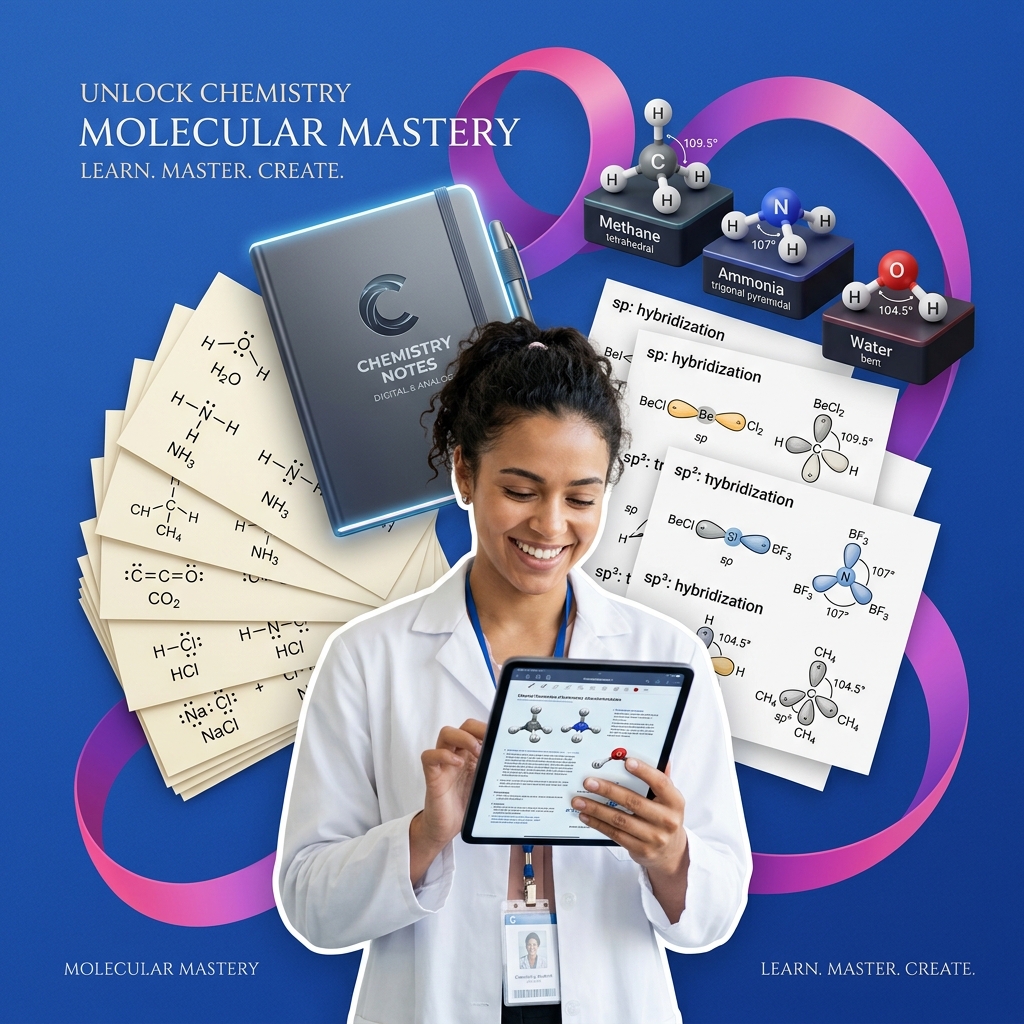
In general, inorganic, and organic chemistry, visualizing the three-dimensional structures of molecules is critical to understanding their physical and chemical properties (like boiling point, solubility, and reactivity). To predict these 3D shapes, chemists rely on VSEPR (Valence Shell Electron Pair Repulsion) Theory, which states that electron pairs around a central atom will arrange themselves to minimize repulsion by maximizing the distance between them. In tandem, Valence Bond Theory explains the corresponding atomic orbital mixing, or hybridization, that occurs to allow these geometries.
Because drawing Lewis dot structures, predicting molecular shapes, and assigning hybridization types involve spatial reasoning and rule-based steps, students often type chemical formulas (like \(SF_4\) or \(CO_3^{2-}\)) into AI models and ask them to draw the Lewis structure or state the molecular geometry. However, letting AI do this visual translation for you prevents you from developing the spatial reasoning skills necessary for chemistry lab work and exams. This guide outlines a safe, Socratic study workflow to use AI as a VSEPR theory and hybridization coach.
Step 1: Drawing Valid Lewis Dot Structures Socraticly
A Lewis structure is a simplified representation of the valence shell electrons in a molecule. To draw one:
- Count the total number of valence electrons.
- Arrange the atoms, placing the least electronegative element in the center (never hydrogen).
- Connect atoms with single bonds (each representing two electrons).
- Distribute the remaining electrons as lone pairs to satisfy the octet rule (or duet rule for hydrogen) starting with outer atoms.
- If the central atom lacks an octet, form double or triple bonds by sharing lone pairs from outer atoms.
Use this prompt to practice drawing Lewis structures Socraticly:
I am drawing the Lewis structure for the carbonate ion (CO3^2-). Act as a Socratic general chemistry tutor. Do not draw the structure or give me the answer. Ask me to calculate the total number of valence electrons (accounting for the negative charge), ask which atom should be central, and guide me through distributing electrons and forming multiple bonds to satisfy the octet rule.Step 2: Calculating Steric Number and Predicting Geometry (VSEPR)
Once the Lewis structure is drawn, you calculate the Steric Number (SN) of the central atom:
\[\text{Steric Number} = \text{Number of atoms bonded to the central atom} + \text{Number of lone pairs on the central atom}\]
The steric number determines the Electron Geometry (how all electron pairs are arranged). The actual Molecular Geometry (the shape of the atoms) depends on the ratio of bonding pairs to lone pairs. For example, a molecule with a steric number of \(4\) has a tetrahedral electron geometry, but if it has one lone pair (like \(NH_3\)), its molecular geometry is trigonal pyramidal.
Use this prompt to predict molecular geometries Socraticly:
I am predicting the molecular geometry of sulfur tetrafluoride (SF4). I have drawn the Lewis structure and identified that sulfur has 4 bonding pairs and 1 lone pair. Act as a Socratic chemistry coach. Do not name the molecular shape. Ask me to calculate the steric number, ask what electron geometry corresponds to this steric number, and guide me to identify where the lone pair prefers to sit (equatorial vs. axial) to minimize repulsion.Step 3: Determining Orbital Hybridization
To form the hybrid orbitals that match VSEPR geometries, atomic orbitals mix (hybridize). You can determine the hybridization of a central atom directly from its steric number:
- \(\text{SN} = 2 \implies sp\) (Linear, \(180^\circ\) bond angle)
- \(\text{SN} = 3 \implies sp^2\) (Trigonal Planar, \(120^\circ\) bond angle)
- \(\text{SN} = 4 \implies sp^3\) (Tetrahedral, \(109.5^\circ\) bond angle)
- \(\text{SN} = 5 \implies sp^3d\) (Trigonal Bipyramidal, \(90^\circ/120^\circ\) bond angles)
- \(\text{SN} = 6 \implies sp^3d^2\) (Octahedral, \(90^\circ\) bond angle)
In addition, single bonds are always sigma (\(\sigma\)) bonds, whereas double/triple bonds consist of one \(\sigma\) bond and one or two pi (\(\pi\)) bonds (formed by unhybridized \(p\) orbitals).
Use this prompt to master orbital hybridization Socraticly:
I want to determine the hybridization and count the sigma and pi bonds for carbon dioxide (CO2). I know that carbon forms double bonds with both oxygen atoms. Act as a Socratic valence bond coach. Do not write out the hybridization or count the bonds. Ask me to find the steric number of the carbon atom, ask which hybrid orbital set corresponds to this steric number, and have me explain how double bonds are constructed in terms of sigma and pi orbitals.
Rocketbook Smart Reusable Notebook
Eco-friendly, reusable physical notebook that digitizes and syncs your hand-written diagrams and notes directly to your favorite cloud storage for AI-assisted study.
AI Study Pilot receives a small commission from qualifying Amazon purchases at no extra cost to you.Common mistakes
Keep these typical VSEPR and hybridization pitfalls in mind:
- Confusing Electron Geometry and Molecular Geometry: Students often state that water (\(H_2 O\)) is tetrahedral because its steric number is 4. However, while its electron geometry is tetrahedral, its molecular geometry (the arrangement of the atoms) is bent due to the two lone pairs on oxygen.
- Ignoring Formal Charges in Resonance: When multiple Lewis structures can be drawn, the best structure minimizes formal charges and places negative charges on the more electronegative atoms.
- Relying on AI Text Descriptions: Because molecular geometry is inherently 3D, relying on text output from AI is less effective than drawing the structures. Sketch the geometries on paper using wedges (pointing toward you) and dashes (pointing away) to develop your spatial reasoning.
FAQ
- Why do lone pairs compress bond angles? Non-bonding lone pairs are held close to a single nucleus and occupy more space than bonding pairs, which are stretched between two nuclei. This extra volume repels adjacent bonding pairs, compressing the bond angles (e.g., the bond angle in methane is \(109.5^\circ\), but ammonia is \(107^\circ\), and water is \(104.5^\circ\)).
Prompt: "Socraticly quiz me on electron-pair repulsion strengths (lone-lone vs lone-bond vs bond-bond) and explain how this impacts bond angle deviations in molecules."
- What are expanded octets? Elements in period 3 or below have empty \(d\) orbitals in their valence shell, allowing them to hold more than 8 electrons (e.g., \(PCl_5\) has 10 electrons around phosphorus).
Prompt: "Socraticly quiz me on why carbon cannot expand its octet but sulfur can, and guide me through drawing a Lewis structure with an expanded octet. Guide me."
- How does geometry relate to molecular polarity? A molecule is polar if it has polar bonds and its molecular geometry is asymmetric, preventing the bond dipoles from canceling out (e.g., \(CO_2\) is linear and nonpolar, while \(H_2 O\) is bent and polar).
Prompt: "Socraticly quiz me on how molecular symmetry dictates whether a molecule is polar or nonpolar, and give me examples to classify. Guide me."
Final recommendation
Chemistry is a spatial science. Do not let AI models draw your Lewis structures or solve your hybridizations. Instead, count your valence electrons, sketch the structural skeletons on paper, and leverage Socratic AI prompt sessions to audit your steric calculations, formal charges, and sigma/pi bond counts.
Disclosure: AI Study Pilot may add affiliate links later. We recommend free-first tools where possible and never promise guaranteed grades or outcomes.