STEM study · Updated June 2026
How to Learn Cellular Biology and Memorize Metabolic Pathways With AI Safely
Learn how to use AI safely to master cellular biology, understand metabolic pathways, and practice active recall of biochemical steps.

Cellular biology and biochemistry are notorious "weed-out" requirements for pre-meds, biology majors, nursing students, and agricultural sciences. The primary source of dread is the massive volume of metabolic pathways you must memorize—such as glycolysis, the citric acid cycle (Krebs cycle), the electron transport chain, and photosynthesis.
Many students study these pathways passively: they stare at the colorful diagrams in their textbook, highlight the names of the enzymes, and hope they will remember the intermediates on exam day. This creates a severe illusion of competence. On the exam, when presented with a blank flowchart or asked how a specific enzyme inhibitor affects ATP yield, passive familiarity fails.
AI assistants can act as interactive biochemistry tutors. You can use an AI to break down complex molecular steps conceptually, generate creative mnemonics to memorize intermediates, and simulate the effects of metabolic toxins to test your functional understanding.
However, copying lab reports or using AI to generate analysis for your biology worksheets is a violation of academic integrity. The key is to use the AI to generate active recall quizzes and conceptual explanations, while doing the memorization and diagramming work yourself.
Conceptual biology workflow with AI
- Track the carbon flow: Understand how carbon structures change (e.g., 6-carbon glucose splitting into 3-carbon pyruvate) before memorizing names.
- Deconstruct the energy yields: Use AI to track exactly where ATP, NADH, and FADH2 are consumed or produced.
- Connect pathway steps to physiological context: Understand why a reaction occurs (e.g., phosphorylation to trap glucose in the cell).
- Practice effortful active recall: Test your recall of intermediates using progressive hint-based quizzes.
The Power of Effortful Retrieval Practice
Staring at a metabolic map is passive. To make memory durable, your brain must perform the effortful work of retrieving the information from within.
In Make It Stick: The Science of Successful Learning, cognitive scientists outline that retrieval practice—recalling facts or concepts from memory—is far more effective for long-term retention than re-reading.
To study biology pathways effectively, combine a visual pomodoro study block with active sketching. Spend 20 minutes drawing a metabolic pathway from memory on a blank sheet. Then, use an AI assistant to verify your drawing by asking specific questions about the steps or intermediates. The effort of trying to recall the steps before checking the answer strengthens the neural pathways associated with that information, ensuring you can recall it under exam pressure.
The Metabolic Pathway Tutor Prompt
To break down a complex metabolic cycle and create conceptual review drills, use this prompt:
Act as a college biochemistry professor. Explain the pathway of [e.g., the Citric Acid Cycle] conceptually.

Please generate a study guide:
1. Explain the biological purpose and location of this pathway.
2. Provide a step-by-step conceptual breakdown of the key stages.
3. Share a memorable mnemonic to help me memorize the intermediates in order.
4. Provide 3 conceptual questions about what happens to the cycle if a specific enzyme (e.g., isocitrate dehydrogenase) is inhibited by a toxin. Do not give the answers immediately.
Step-by-Step Biology Review
Step 1 — Map the inputs and outputs
Before memorizing individual reactions, understand the big picture. Ask the AI:
For [e.g., Glycolysis], what are the net inputs and net outputs (in terms of ATP, electron carriers, and carbons) for one molecule of glucose? Explain why the preparatory phase requires ATP.Step 2 — Trace reaction types
Many metabolic steps share similar reaction types (like dehydrogenation or phosphorylation). Ask the AI to identify patterns:
What is the role of a dehydrogenase enzyme in metabolic pathways? How does it relate to the generation of NADH and FADH2?Step 3 — Run a metabolic perturbation quiz
Exams often test your logic by asking what happens when a pathway is blocked. Prompt the AI:
Act as a biology instructor. Describe a scenario where a metabolic toxin blocks [e.g., Complex III of the Electron Transport Chain]. Ask me 3 questions about how this affects oxygen consumption, ATP production, and the accumulation of upstream carriers.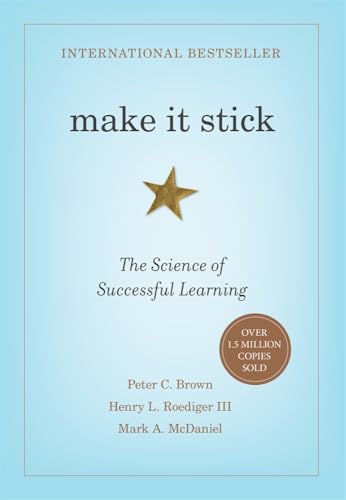
Make It Stick: The Science of Successful Learning
The gold standard for cognitive science learning. Learn how active recall, spaced repetition, retrieval practice, and varied study schedules dramatically improve retention over passive re-reading.
AI Study Pilot receives a small commission from qualifying Amazon purchases at no extra cost to you.Common mistakes
* Memorizing names without tracking energy: Never forget to note where energy is consumed or generated. High-yielding steps are prime targets for exam questions.
* Studying pathways in isolation: AI can help you understand how pathways connect (e.g., how glycolysis intermediates feed into lipid synthesis). Look for overlap points between cycles.
* Skipping the drawing step: You cannot study biology by typing. Sketch the molecular steps and flowcharts by hand. Use AI to guide your sketching framework, but make the lines yourself.
Disclosure: AI Study Pilot may add affiliate links later. We recommend free-first tools where possible and never promise guaranteed grades or outcomes.