Chemistry & pre-med · Updated June 2026
How to Learn Chemical Thermodynamics and Master Gibbs Free Energy calculations with AI Safely
Master chemical thermodynamics and Gibbs Free Energy calculations using Socratic AI coaching to map enthalpy, entropy, temperature changes, and reaction spontaneity safely.
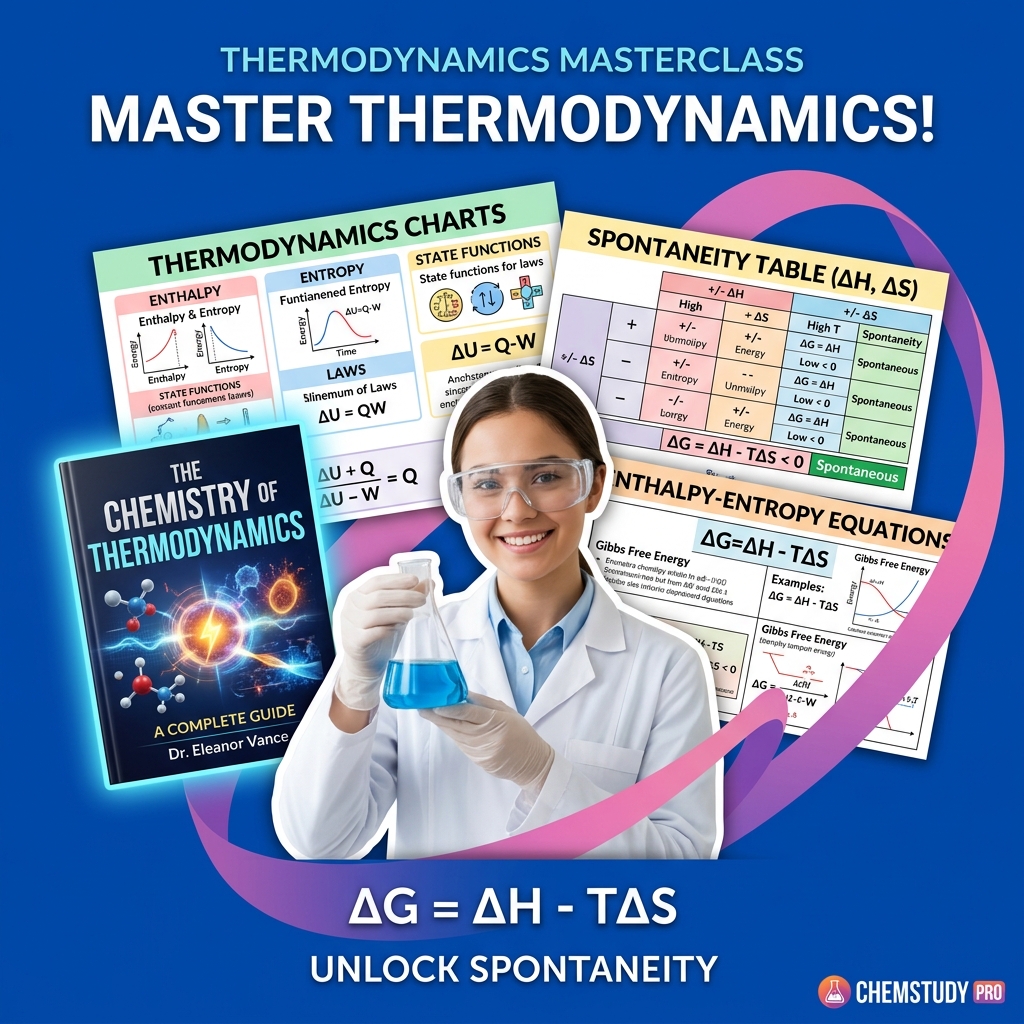
In chemical thermodynamics, the spontaneity of a reaction is governed by the Second Law of Thermodynamics. To predict whether a process occurs without external intervention, scientists rely on Gibbs Free Energy ($\Delta G$). The change in Gibbs Free Energy at a constant temperature and pressure is calculated using the fundamental equation: $\Delta G = \Delta H - T\Delta S$, where $\Delta H$ is the change in enthalpy, $T$ is the absolute temperature in Kelvin, and $\Delta S$ is the change in entropy. Interpreting the signs (+ or -) of these variables is crucial for understanding whether a reaction is exergonic (spontaneous, negative $\Delta G$) or endergonic (non-spontaneous, positive $\Delta G$).
To solve homework worksheets or lab calculations quickly, students often paste thermodynamic values directly into AI engines to get the final $\Delta G$ value. However, outsourcing these calculations prevents you from building the physical intuition needed for general chemistry, physical chemistry, biochemistry, and standardized exams like the MCAT. Understanding how entropy and enthalpy balance to drive reactions is critical. This guide provides a safe, active-learning study workflow to use AI as a Socratic thermodynamics coach.
Step 1: Mapping Spontaneity Logic Socraticly
The sign combination of $\Delta H$ (enthalpy) and $\Delta S$ (entropy) determines whether a reaction is spontaneous under all conditions, no conditions, or depending on the temperature. Many students struggle to memorize these combinations. Instead of asking AI to provide a spontaneity lookup table, use it to check your conceptual understanding.
Prompt the AI to check your conceptual spontaneity mappings using this template:
I am practicing mapping spontaneity conditions for chemical reactions based on enthalpy (delta H) and entropy (delta S) changes. Act as a Socratic chemistry tutor. Do not list the spontaneity table or solve equations directly. Ask me to describe what happens to the sign of delta G when:
1. Enthalpy is negative and entropy is positive
2. Enthalpy is positive and entropy is negative
Evaluate my answers and guide me with conceptual hints about how the terms balance in the equation delta G = delta H - T * delta S.
Step 2: Solving Temperature-Dependent Spontaneity
When $\Delta H$ and $\Delta S$ have the same sign, the spontaneity of the reaction depends on the temperature. For example, if both $\Delta H$ and $\Delta S$ are positive, the reaction is spontaneous only at high temperatures (where the entropy term dominates). If both are negative, the reaction is spontaneous only at low temperatures.
Practice tracing temperature boundaries Socraticly with this prompt:
I am analyzing a reaction where delta H is positive (endothermic) and delta S is positive (increasing disorder). I want to explain why this reaction is non-spontaneous at low temperatures but becomes spontaneous at high temperatures. Act as a Socratic chemistry coach. Do not state the final spontaneity. Ask me to describe how the absolute temperature (T) affects the relative size of the T * delta S term, and prompt me to explain what inequality must be satisfied for delta G to be negative. Guide me.Step 3: Calculating Gibbs Free Energy from Standard Values
Standard Gibbs Free Energy changes ($\Delta G^\circ$) can be calculated using standard enthalpies of formation ($\Delta H^\circf$) and standard entropies ($S^\circ$), or using standard free energies of formation ($\Delta G^\circf$). Performing these calculations involves careful tracking of units (enthalpy is usually in kJ/mol, while entropy is in J/mol·K).
Check your unit conversion and calculation setup using this prompt:
I am setting up a calculation to find delta G standard for a reaction at 298 K. My delta H is -92.2 kJ/mol and my delta S is -198.3 J/mol·K. Act as a Socratic chemistry coach. Do not perform the math for me. Ask me to verify my unit conversions between joules and kilojoules, explain how to set up the equation, and evaluate my calculation steps. Guide me step-by-step to the final answer.
A Mind for Numbers: How to Excel at Math and Science
Dr. Barbara Oakley's actionable guide to unlocking analytical thinking. Perfect for students tackling STEM classes who want to beat procrastination and master complex formulas.
AI Study Pilot receives a small commission from qualifying Amazon purchases at no extra cost to you.Common mistakes
Keep these pitfalls in mind when studying thermodynamics:
- Spontaneous does not mean fast: A reaction with a highly negative $\Delta G$ is thermodynamically spontaneous, but it can be extremely slow (kinetically inert). For example, the conversion of diamond to graphite is spontaneous ($\Delta G < 0$), but the activation energy barrier is so high that the reaction rate is practically zero. AI models often use "spontaneous" and "fast" interchangeably. Ask AI to check your understanding of thermodynamics vs. kinetics: "Socraticly quiz me on the difference between thermodynamic stability and kinetic stability. Guide me."
- Mixing up signs and temperature units: Always ensure temperature is in Kelvin ($K = ^\circ\text{C} + 273.15$). Also, remember to convert entropy ($\Delta S$) units to match enthalpy ($\Delta H$) units (typically dividing J by 1000 to get kJ).
- Misinterpreting the standard state symbol: The circle superscript ($^\circ$) in $\Delta G^\circ$ indicates standard state conditions ($1\text{ atm}$, $298\text{ K}$, $1\text{ M}$ concentrations). If concentrations change, the free energy changes according to $\Delta G = \Delta G^\circ + RT\ln(Q)$. Use Socratic prompts to explore how changing the reaction quotient ($Q$) shifts free energy.
FAQ
- How is Gibbs Free Energy related to the equilibrium constant (K)? At equilibrium, $\Delta G = 0$ and the reaction quotient $Q = K$. This gives the fundamental relation: $\Delta G^\circ = -RT\ln(K)$. Ask the AI: "Walk me Socraticly through deriving the relationship between standard free energy and equilibrium. Ask me to explain what K > 1 implies about delta G standard."
- Can AI help me understand coupled reactions? Yes. Endergonic reactions ($\Delta G > 0$) can be driven by coupling them to highly exergonic reactions ($\Delta G < 0$), such as ATP hydrolysis. Prompt: "Socraticly quiz me on how cells use ATP coupling to drive non-spontaneous reactions, and ask me to calculate a net delta G from two coupled reaction steps."
- What is the difference between delta G and delta G standard? $\Delta G^\circ$ is standard free energy change under standard state conditions. $\Delta G$ is the actual free energy change at any given instant. Prompt: "Socraticly quiz me on how delta G shifts as a reaction approaches equilibrium, and what value delta G takes at equilibrium."
Final recommendation
Chemical thermodynamics requires strict bookkeeping of signs and units. Avoid relying on AI to compute your chemistry worksheets. Instead, sketch sign combinations on paper, convert all energy values to kilojoules, and utilize Socratic AI checkpoints to audit your spontaneity logic, temperature boundary calculations, and unit conversions.
Disclosure: AI Study Pilot may add affiliate links later. We recommend free-first tools where possible and never promise guaranteed grades or outcomes.