General & Physical Chemistry · Updated June 2026
Learn Gas Laws and Real Gas Behaviors with AI Safely
Master Boyle's, Charles's, and Avogadro's laws alongside the ideal gas equation and van der Waals parameters using Socratic AI coaching to build chemistry intuition safely.
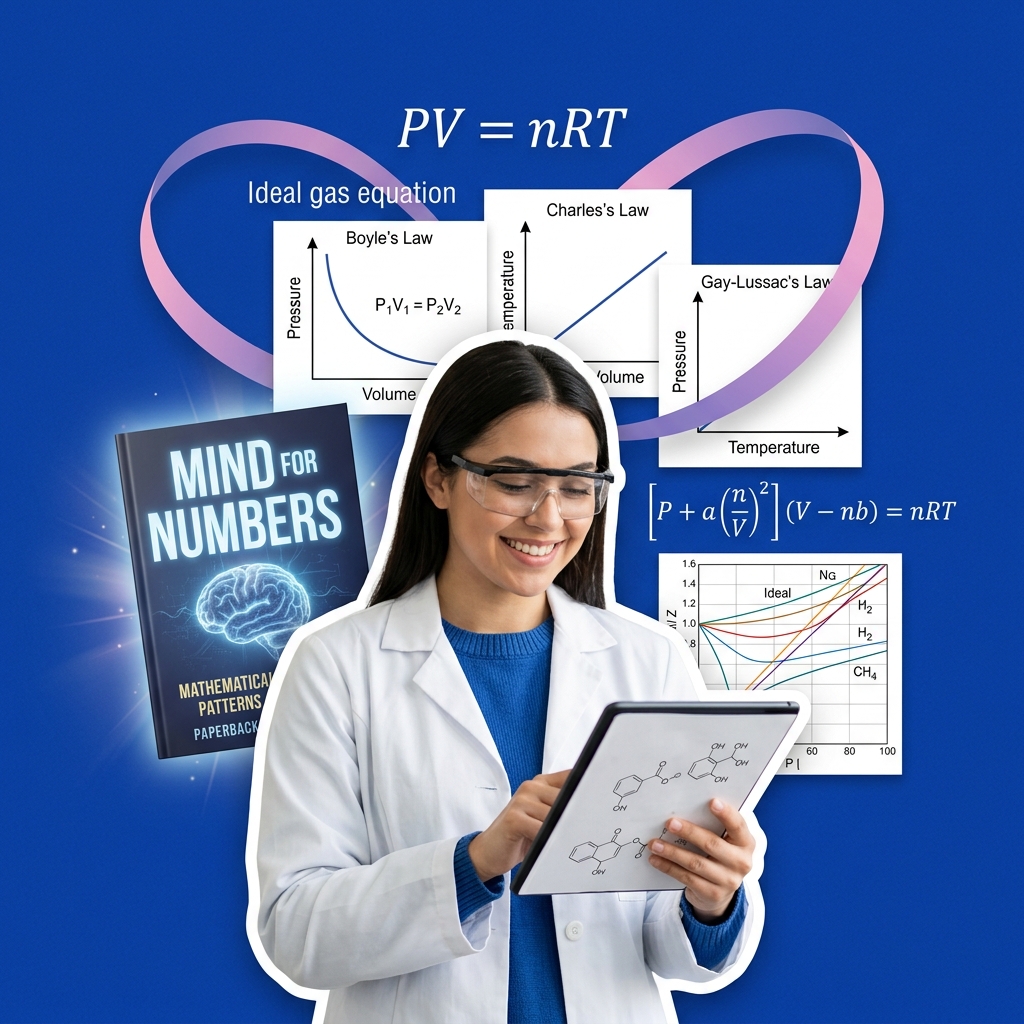
In chemistry and thermodynamics, describing the behavior of gases is one of the oldest and most fundamental areas of physical science. Under moderate temperatures and low pressures, most gases behave predictably, adhering to the Ideal Gas Law:
\[PV = nRT\]
where \(P\) is pressure, \(V\) is volume, \(n\) is the number of moles, \(T\) is temperature (in Kelvin), and \(R\) is the universal gas constant (\(0.08206\text{ L}\cdot\text{atm}/(\text{mol}\cdot\text{K})\) or \(8.314\text{ J}/(\text{mol}\cdot\text{K})\)).
This equation is a combination of three empirical gas laws:
- Boyle's Law: Volume is inversely proportional to pressure at constant temperature (\(P_1V_1 = P_2V_2\)).
- Charles's Law: Volume is directly proportional to temperature at constant pressure (\(V_1/T_1 = V_2/T_2\)).
- Avogadro's Law: Volume is directly proportional to the number of moles at constant temperature and pressure (\(V_1/n_1 = V_2/n_2\)).
However, at high pressures and low temperatures, real gases deviate significantly from ideal behavior because gas molecules do have volume and do exert intermolecular forces on one another. To correct for these non-ideal behaviors, Johannes van der Waals derived the van der Waals equation:
\[\left(P + \frac{an^2}{V^2}\right)(V - nb) = nRT\]
where \(a\) accounts for intermolecular attractive forces and \(b\) accounts for the finite volume occupied by the gas molecules.
Because calculating gas properties and adjusting for van der Waals coefficients involves long algebraic calculations, students frequently ask AI to solve their gas law problems or write out final numbers. However, outsourcing this math to AI prevents you from learning how pressure and volume trade off dynamically. This guide outlines a Socratic workflow to utilize AI as a chemistry coach to master gas behaviors.
Step 1: Navigating the Ideal Gas Laws Socraticly
The ideal gas model assumes that gas molecules are in constant, random motion, occupy zero volume themselves, and experience no intermolecular forces. To apply the Ideal Gas Law correctly, the temperature must be in Kelvin (\(T_{\text{K}} = T_{^\circ\text{C}} + 273.15\)), and the units of \(R\) must match the units used for pressure and volume.
Use this Socratic prompt to check your ideal gas law understanding:
I am learning to solve ideal gas law problems. Act as a Socratic chemistry tutor. Do not solve any equations or state the conversions. Ask me to state the standard units for pressure, volume, and temperature when using R = 0.08206 L*atm/(mol*K), and have me explain why temperature must always be converted to Kelvin rather than Celsius. Guide me.Step 2: Transitioning to Real Gas Equations Socraticly
To identify when a gas deviates from ideal behavior, physical chemists use the compressibility factor (\(Z\)):
\[Z = \frac{PV}{nRT}\]
For an ideal gas, $Z = 1$ under all conditions. For real gases, \(Z\) deviates from \(1\):
- $Z < 1$ indicates that intermolecular attraction dominates (making the gas easier to compress).
- $Z > 1$ indicates that molecular volume effects dominate (making the gas harder to compress).
The van der Waals constants (\(a\) and \(b\)) are unique to each gas species.
Use this prompt to check your real gas understanding Socraticly:
I am studying the differences between ideal and real gases. Act as a Socratic physical chemistry coach. Do not write down the van der Waals equation or values. Ask me to explain how the 'a' parameter corrects for intermolecular forces and how the 'b' parameter corrects for molecular volume, and have me predict whether real gases behave more ideally under high or low pressure. Guide me.Step 3: Solving Stoichiometry Problems with Gas Laws Socraticly
Gases frequently participate in chemical reactions. To solve gas stoichiometry problems, you combine stoichiometry mole ratios with the Ideal Gas Law (e.g., finding the volume of carbon dioxide gas produced from a given mass of reactant at a specific pressure and temperature). Let AI audit your molar conversions rather than calculating final volumes.
Use this Socratic prompt to check your gas stoichiometry setup:
I am solving a reaction stoichiometry problem: calculating the volume of oxygen gas produced at 298 K and 1.0 atm from the decomposition of 10 grams of hydrogen peroxide (H2O2). Act as a Socratic chemistry tutor. Do not balance the equation or calculate the volume. Walk me through writing the balanced equation, converting mass to moles, and setting up the ideal gas equation to solve for volume. Guide me.
A Mind for Numbers: How to Excel at Math and Science
Dr. Barbara Oakley's actionable guide to unlocking analytical thinking. Perfect for students tackling STEM classes who want to beat procrastination and master complex formulas.
AI Study Pilot receives a small commission from qualifying Amazon purchases at no extra cost to you.Common mistakes
Keep an eye out for these classic pitfalls when studying gases:
- Forgetting to convert temperature to Kelvin: Using Celsius in $PV = nRT$ is the single most common math error in general chemistry. Since Celsius can be zero or negative, it leads to physically impossible volumes or pressures.
- Using the wrong R constant: If pressure is in Pascals and volume is in cubic meters (\(m^3\)), you must use \(R = 8.314\text{ J}/(\text{mol}\cdot\text{K})\). If pressure is in atmospheres and volume is in Liters, you must use \(R = 0.08206\text{ L}\cdot\text{atm}/(\text{mol}\cdot\text{K})\).
- Assuming ideal behavior at low temperatures: As a gas cools, the kinetic energy of its molecules decreases, allowing intermolecular attractions to pull the molecules together. Eventually, the gas condenses into a liquid, where ideal gas assumptions fail completely. Ask AI: "Quiz me Socraticly on why real gases deviate from ideal behavior at extremely low temperatures. Guide me."
FAQ
- What is STP (Standard Temperature and Pressure)? STP is defined as \(273.15\text{ K}\) (\(0^\circ\text{C}\)) and \(1\text{ atm}\) (\(10^5\text{ Pa}\) or \(1\text{ bar}\)). At STP, one mole of an ideal gas occupies exactly \(22.414\text{ L}\) (molar volume). Prompt: "Socraticly quiz me on how to calculate the density of a gas at STP using its molar mass and molar volume. Guide me."
- What is Dalton's Law of Partial Pressures? Dalton's Law states that the total pressure of a mixture of non-reacting gases is equal to the sum of the partial pressures of the individual gases: \(P_{\text{total}} = P_1 + P_2 + \dots\). The partial pressure is proportional to the mole fraction: \(P_i = X_i P_{\text{total}}\). Prompt: "Act as a Socratic tutor. Quiz me on how to calculate the mole fraction of a gas in a mixture and how it relates to partial pressure. Guide me."
- What is Graham's Law of Effusion? Graham's Law states that the rate of effusion of a gas is inversely proportional to the square root of its molar mass: \(\text{Rate}_1 / \text{Rate}_2 = \sqrt{M_2 / M_1}\). Lighter gases effuse faster. Prompt: "Socraticly quiz me on the kinetic molecular theory explanation for Graham's law of effusion. Guide me."
Final recommendation
Gas behavior represents the bridge between micro-level molecular movements and macroscopic pressure/volume measurements. Do not let AI convert your units or solve your gas equations. Instead, list your variables, convert your temperatures to Kelvin, double-check your gas constant units on paper, and leverage Socratic AI sessions to audit your compressibility limits and reaction yields.
Disclosure: AI Study Pilot may add affiliate links later. We recommend free-first tools where possible and never promise guaranteed grades or outcomes.