Learning science · Updated June 2026
How to Learn Cognitive Science and Master Memory Curves With AI Safely
Master cognitive science models, active recall retention checkpoints, and spacing intervals with Socratic AI feedback and structured learning checks.

Memory is transient. Ebbinghaus's classic "forgetting curve" demonstrates that without active review, humans lose over 50% of newly acquired information within days. To combat this decay, cognitive science points to spaced repetition and active recall as the most effective methods for long-term retention.
However, many students default to using AI to write summaries or generate basic flashcards without understanding the cognitive mechanisms behind spacing. This guide outlines a safe, conceptual study workflow to use AI as a Socratic learning coach to understand memory models and design your own spaced repetition intervals.
Step 1: Mapping the Forgetting Curve Socraticly
The forgetting curve models how memory retention declines over time if no effort is made to retain it. Instead of asking AI to create your calendar, use it to understand how factors like sleep, complexity, and retrieval strength alter the decay slope.
Set up a conceptual memory science check with this prompt:
I am studying Ebbinghaus's forgetting curve and the dual-store model of memory. Act as a Socratic cognitive science professor. Ask me one question at a time to test my understanding of how sensory, short-term, and long-term memory interact. Ask me to explain how active retrieval practices shift the forgetting curve over time. Evaluate my logic and guide me with hints.Step 2: Designing Spaced Repetition Intervals
Spaced repetition involves reviewing material at expanding intervals (e.g., 1 day, 3 days, 7 days, 14 days). Rather than relying blindly on automated flashcard algorithms, use AI to help you determine how to categorize the difficulty of different concepts and adjust review sessions manually.
Practice optimizing review intervals with this prompt:
I want to design a manual spaced repetition schedule for a highly complex subject (such as neurobiology). Act as a Socratic learning science consultant. Ask me questions about my current familiarity with the topics, the density of the concepts, and the time until my exam. Use my answers to guide me with hints to design my own customized, conceptual review schedule.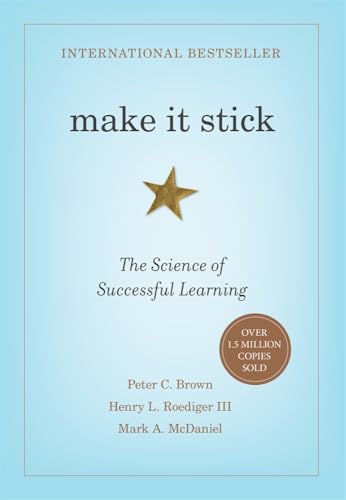
Make It Stick: The Science of Successful Learning
The gold standard for cognitive science learning. Learn how active recall, spaced repetition, retrieval practice, and varied study schedules dramatically improve retention over passive re-reading.
AI Study Pilot receives a small commission from qualifying Amazon purchases at no extra cost to you.Common mistakes
Keep these memory study traps in mind when leveraging AI:
- Focusing on recognition over retrieval: Reading an AI-generated explanation and thinking "that makes sense" is recognition, not retrieval. Always force your brain to recall and write out the explanation first before comparing it with the AI's output.
- Over-relying on automated Anki decks: Using pre-made decks created by someone else (or an AI tool) bypasses the encoding phase of memory. The act of creating and editing your own flashcards is a critical step in long-term retention.
- Cramming in single blocks: Massive study blocks without rest degrade consolidation. Memory consolidation occurs during sleep. Spacing your review blocks over several days is mathematically and biologically superior.
FAQ
- How can I use AI to study encoding techniques? Explain a complex term (e.g., action potential) to AI using a metaphor or analogy, and ask: "Is this metaphor conceptually accurate, or does it introduce misconceptions about the biological mechanism?"
- Can AI help me study interleaving? Yes! Interleaving involves mixing different topics during study. Paste your weekly study topics and ask: "How can I interleave these math, chemistry, and biology topics to maximize contextual interference and improve my retention?"
Final recommendation
Long-term memory is built on retrieval effort and consolidation time. Ground your learning in proven cognitive science research, use physical flashcards or notebooks alongside digital planners, and leverage Socratic AI checkpoints to audit your recall logic.
Disclosure: AI Study Pilot may add affiliate links later. We recommend free-first tools where possible and never promise guaranteed grades or outcomes.