STEM study · Updated June 2026
How to Learn College Calculus and Master Derivatives and Integrals With AI Safely
Learn how to use AI safely to master college calculus, understand derivatives and integrals, and visualize complex graphs conceptually.

Calculus is one of the most notorious "weed-out" courses for engineering, computer science, economics, and business majors. The sudden jump from algebraic manipulation to the dynamic concepts of limits, rates of change (derivatives), and accumulation (integrals) can be overwhelming.
Many students make the mistake of studying calculus by trying to memorize formulas and procedure checklists. But calculus is deeply geometric; if you cannot visualize how a tangent line relates to a derivative, or how the area under a curve relates to an integral, you will struggle with non-standard word problems and applications.
AI tools can act as highly effective Socratic tutors for calculus. Instead of asking them to solve your homework, you can use them to build your conceptual intuition, get hints when you are stuck, and practice step-by-step problem-solving.
The Safe Socratic Calculus Study Workflow
To learn calculus conceptually without violating academic integrity rules, follow this three-step study workflow:
1. Conceptual Graph Visualization
Before you start calculating derivatives, you must understand what they represent. Use AI to translate abstract formulas into physical and geometric descriptions. Ask the model to explain the relationship between a function and its derivatives in terms of rate, velocity, or graphical slopes.
2. Socratic Hint-Based Tutoring
If you get stuck on a difficult limit or optimization problem, do not paste the problem and ask for the final answer. Instead, ask the AI to identify your next algebraic or conceptual step. Treat the AI like a teaching assistant sitting next to you.
3. Practice Set Variation
Once you solve a textbook problem, ask the AI to generate a similar problem with different constants or physical applications (e.g., changing a volume-minimization cylinder problem into a cost-minimization box problem). This tests whether you understand the underlying integration or differentiation steps or if you just memorized the specific numbers.
---
Calculus Study Prompts You Can Copy
Use these optimized prompt templates to turn AI into a safe study helper:
For Visualizing Integrals and Derivatives
I am studying Calculus and trying to build geometric intuition. Can you explain what an integral represents in plain English? Use the analogy of a car's speedometer and odometer, and explain how the area under a curve represents accumulation. Do not write any code, just explain the graphical intuition.For Getting a Socratic Hint
Here is a calculus problem I am working on: [Insert Problem, e.g., Find the limit of (x^2 - 9)/(x - 3) as x approaches 3]. I want to solve it myself. Please review my current step: [Insert Your Current Work, e.g., I tried to plug in x = 3 directly but got 0/0]. What algebraic factoring or technique should I try next? Give me a hint, not the solution.For Creating Practice Scenarios
I just solved an optimization problem where I minimized the surface area of a cylindrical can with a fixed volume. Can you generate a similar calculus optimization problem for me to practice? Make it about minimizing material costs for a rectangular box instead of a cylinder. Do not show the solution yet; just give me the problem statement.---
Common Mistakes to Avoid
* Treating AI as a Calculator: Asking an AI model to calculate limits or derivatives directly often leads to arithmetic mistakes, especially with complex algebraic fractions. Use AI for explanations and hints, and use dedicated calculators (like Symbolab or Desmos) to check your math.
* Skipping the Algebra: The actual calculus (taking a derivative) is often just one line; the remaining 90% of the problem is algebra. Do not let AI do the algebraic simplification for you, as algebraic speed is critical for exam success.
* Uploading Graded Assessments: Never upload graded exams, quizzes, or active homework sets to an AI tool. Use practice problems from your textbook or lecture slides.
---
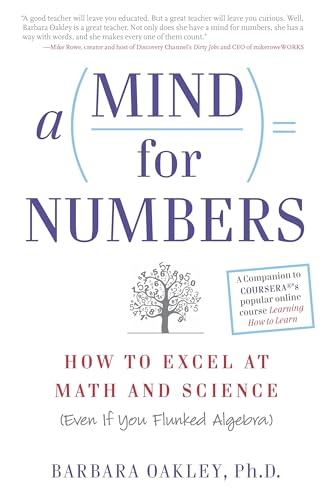
A Mind for Numbers: How to Excel at Math and Science
Dr. Barbara Oakley's actionable guide to unlocking analytical thinking. Perfect for students tackling STEM classes who want to beat procrastination and master complex formulas.
AI Study Pilot receives a small commission from qualifying Amazon purchases at no extra cost to you.FAQ
How can I verify if the AI's calculus explanation is correct?
Always cross-reference the AI's explanations with your textbook or class notes. If the AI suggests a rule or formula you haven't learned yet, ask it to explain using only introductory calculus rules (e.g., using the definition of a limit instead of L'Hopital's Rule).
What is the best way to visualize calculus graphs?
Ask the AI to describe the graph of the function, where it has local extrema (peaks and valleys), and where it changes concavity. You can then sketch the function on paper and check your work using a graphing calculator like Desmos.
Can I use AI to study for the AP Calculus exam?
Yes. You can paste past open-response questions from the College Board (which are publicly available) and ask the AI to explain the scoring guidelines or break down the conceptual steps for each part of the question.
Disclosure: AI Study Pilot may add affiliate links later. We recommend free-first tools where possible and never promise guaranteed grades or outcomes.