STEM study · Updated June 2026
How to Learn College Chemistry and Practice Stoichiometry With AI Safely
Learn a safe, conceptual AI workflow to master chemistry formulas, balancing equations, and stoichiometry problems with guided hints instead of copied answers.
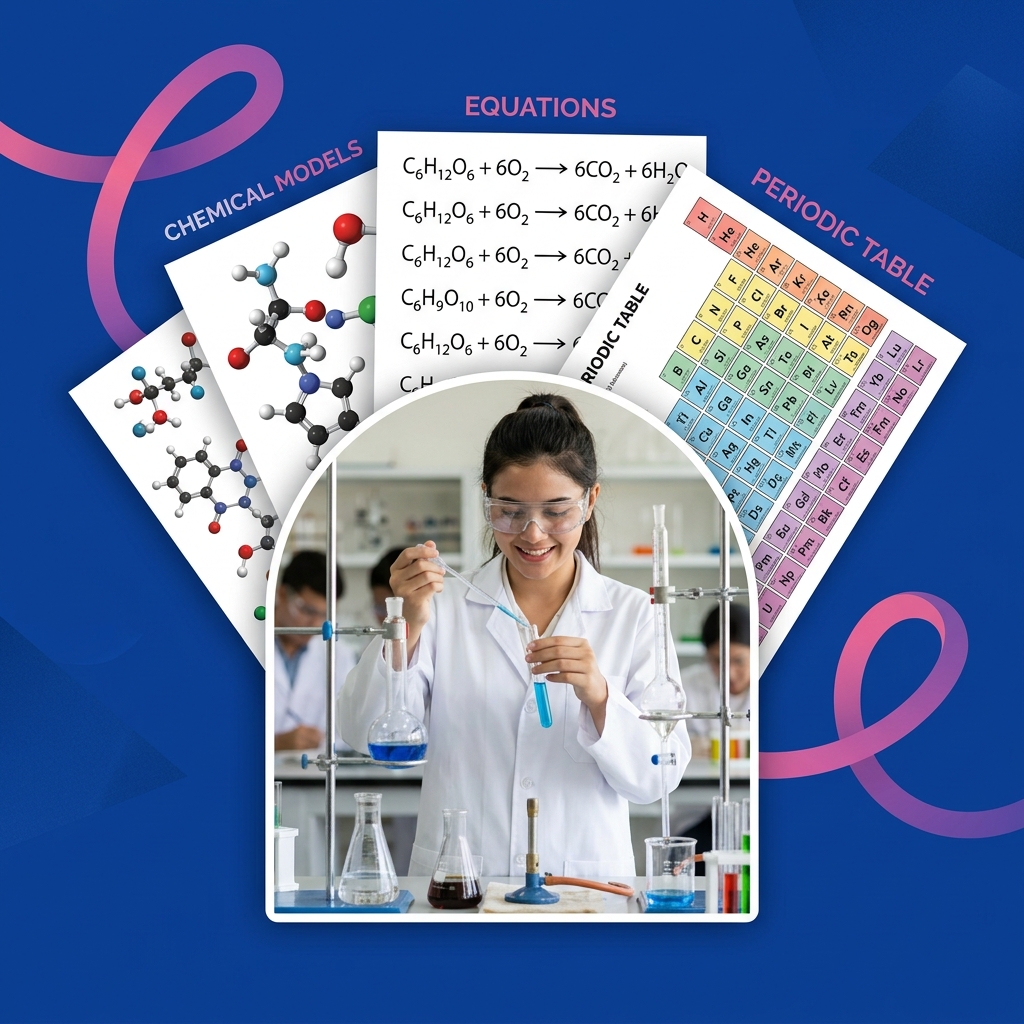
Introductory college chemistry (General Chemistry) is famously a filter course for pre-med, engineering, and science majors. The transition from qualitative high school science to quantitative, equation-driven college chemistry requires a deep understanding of molecular relationships and mathematical conversion factors.
Specifically, stoichiometry—the calculation of relative quantities of reactants and products in chemical reactions—causes significant frustration due to multi-step dimensional analysis.
AI models can act as personal chemistry tutors, helping you visualize molecular ratios, explain naming rules (nomenclature), and check your stoichiometry setups.
However, pasting your chemistry homework directly into an AI and copying the balanced equations or mass yields is a violation of academic integrity. If you bypass the mathematical conversions yourself, you will perform poorly on proctored exams. The key is to use AI to verify your setups and provide Socratic hints.
Chemistry study workflow with AI
- Focus your scientific mindset: Master the core analytical strategies before tackling problem sets.
- Translate naming nomenclature: Ask the AI to explain naming patterns (e.g., covalent vs. ionic naming).
- Practice Socratic balancing: Instruct the AI to check your balanced chemical equations step-by-step.
- Master dimensional analysis: Prompt the AI to identify errors in your mole-to-gram conversion setups.
Building a mathematical mindset for science
Excelling in quantitative sciences like chemistry requires more than memorizing formulas. You must understand the underlying logic of dimensions and units.
In A Mind for Numbers: How to Excel at Math and Science, Dr. Barbara Oakley outlines how shifting between "focused" and "diffuse" thinking modes helps your brain parse complex scientific relationships. Procrastinating on chemistry problem sets leads to cognitive overload. Instead, build your mathematical confidence by breaking down multi-step stoichiometry conversions into visual grids, testing yourself without looking at solutions, and using AI tools strictly as hint-based checkpoints to guide your learning.
The Chemistry Tutor Prompt
To configure your AI assistant as a chemistry tutor that helps you learn without giving away solutions, start your study block with this prompt:
Act as a college chemistry tutor. I am studying [Topic, e.g., balancing chemical equations and stoichiometry].

Your goal is to guide me conceptualizing the calculations. Please follow these rules:
1. When I give you a problem, do not write the final calculation or balanced equation.
2. Instead, outline the conversion pathway (e.g., grams of A -> moles of A -> moles of B -> grams of B) in text.
3. Check my steps. If I make an error in my balancing coefficients or mole ratios, explain the specific step where I went wrong.
4. Give me a Socratic hint if I ask for help.
Step-by-Step Stoichiometry Review
Step 1 — Check your balancing coefficients
Write down your unbalanced equation and balance it on paper. Use the AI to verify your ratios:
I am balancing this equation: H2 + O2 -> H2O. My balanced coefficients are 2, 1, and 2 respectively. Is this ratio correct?Step 2 — Verify your molar masses
Calculating molar mass (grams per mole) from the periodic table is a common area for simple arithmetic errors. Have the AI check your values:
I calculated the molar mass of [Compound, e.g., CuSO4] as 159.6 grams/mole. Is this correct?Step 3 — Stress-test your unit conversions
Show the AI your dimensional analysis pathway to check if your units cancel out correctly:
I am converting 25 grams of [Compound A] to grams of [Compound B]. Here is my setup: (25 g A) * (1 mol A / molar mass A) * (mole ratio B/A) * (molar mass B / 1 mol B). Please verify if my conversion factors are set up correctly.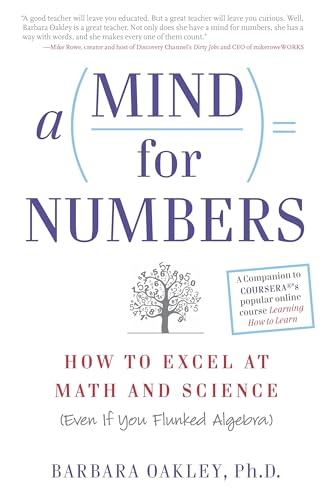
A Mind for Numbers: How to Excel at Math and Science
Dr. Barbara Oakley's actionable guide to unlocking analytical thinking. Perfect for students tackling STEM classes who want to beat procrastination and master complex formulas.
AI Study Pilot receives a small commission from qualifying Amazon purchases at no extra cost to you.Common mistakes
* Copy-pasting complex math directly: AI engines often hallucinate stoichiometry numbers or perform simple division errors when given raw text. Always recalculate the math yourself.
* Confusing coefficients with subscripts: Subscripts (e.g., the 2 in H2O) represent molecular bonds and cannot be changed. Coefficients (e.g., the 2 in 2H2O) represent molar ratios. AI models sometimes confuse these when explaining balancing.
* Neglecting limiting reactant checks: When given masses for two reactants, always run a limiting reactant check first. AI models frequently skip this check and compute yields based on the excess reactant unless explicitly prompted.
Disclosure: AI Study Pilot may add affiliate links later. We recommend free-first tools where possible and never promise guaranteed grades or outcomes.