Materials & Mechanics · Updated June 2026
Learn Stress-Strain Curves and Hooke's Law with AI Safely
Master normal stress, strain, Young's Modulus, yield strength, and tensile testing curves using Socratic AI coaching to build engineering mechanics intuition safely.

In civil, mechanical, aerospace, and materials engineering, understanding how materials deform under load is essential to designing safe structures and machine components. When a structural member is subjected to an external force, it experiences internal resistance. To analyze this behavior independently of the component's size, engineers use two fundamental variables:
- Engineering Stress (\(\sigma\)): The force (\(P\)) divided by the original cross-sectional area (\(A_0\)):
\[\sigma = \frac{P}{A_0}\]
- Engineering Strain (\(\epsilon\)): The change in length (\(\Delta L\)) divided by the original length (\(L_0\)):
\[\epsilon = \frac{\Delta L}{L_0}\]
To study these properties, engineers perform a tensile test by pulling a specimen until it fractures, plotting the resulting stress vs. strain. The relationship between stress and strain in the initial linear region is governed by Hooke's Law:
\[\sigma = E \epsilon\]
where \(E\) is Young's Modulus (Modulus of Elasticity), a measure of a material's stiffness.
Because calculating stress, strain, and Young's modulus involves algebraic manipulations and unit conversions, students frequently ask AI to solve their mechanics of materials homework. However, relying on AI to perform these conversions and calculations bypasses the solid mechanics intuition required for structural design. This guide details a Socratic workflow to utilize AI as a mechanics of materials coach to master the stress-strain curve.
Step 1: Navigating the Regions of the Stress-Strain Curve Socraticly
A typical stress-strain curve for a ductile material (like structural steel) has distinct regions:
- Elastic Region: The initial linear portion where deformation is temporary. If the load is removed, the material returns to its original shape. Hooke's Law applies here.
- Yielding (Yield Strength, \(\sigma_y\)): The point where the material begins to deform permanently (plastic deformation).
- Strain Hardening: The region where the material undergoes plastic deformation and actually becomes stronger due to dislocation movements, reaching its Ultimate Tensile Strength (UTS).
- Necking & Rupture: Beyond UTS, the cross-sectional area decreases rapidly in a localized region ("necking"), and the stress drops until the material fractures at the Rupture Point.
Use this prompt to check your curve comprehension Socraticly:
I am learning to identify regions on a stress-strain curve for a ductile metal. Act as a Socratic engineering mechanics tutor. Do not draw the curve or define the points for me. Ask me to identify the boundaries between elastic and plastic deformation, explain what happens to the material structurally at the yield point, and describe the physical difference between ultimate tensile strength and rupture strength. Guide me.Step 2: Applying Hooke's Law and Calculating Young's Modulus Socraticly
To calculate Young's Modulus (\(E = \sigma / \epsilon\)), you must ensure that your stress and strain values are in consistent units. Stress is commonly measured in Pascals (\(\text{Pa}\), \(\text{MPa}\), or \(\text{GPa}\)) or pounds per square inch (\(\text{psi}\) or \(\text{ksi}\)), while strain is a dimensionless ratio.
Using AI to run these unit conversions and division steps prevents you from building the estimation skills needed to check if your answers make physical sense.
Use this prompt to master Hooke's Law Socraticly:
I am analyzing a tensile test specimen with a diameter of 12.8 mm and a gauge length of 50 mm. Under a load of 30 kN, the gauge length elongates by 0.08 mm. Act as a Socratic solid mechanics coach. Do not calculate the stress, strain, or Young's modulus for me. Walk me through calculating the cross-sectional area, converting units to standard SI (meters and Newtons), and solving for stress and strain step-by-step. Guide me.Step 3: Differentiating Ductile vs. Brittle Materials Socraticly
Materials behave differently under tension:
- Ductile Materials (e.g., steel, aluminum, copper) exhibit large plastic deformations before fracture, showing significant necking.
- Brittle Materials (e.g., concrete, glass, cast iron) exhibit little to no plastic deformation, fracturing suddenly once they reach their elastic limit.
Use this Socratic prompt to check your materials comparison:
I am comparing the tensile behavior of structural steel (ductile) and concrete (brittle). Act as a Socratic materials engineering tutor. Do not compare the curves for me. Ask me to describe how their stress-strain plots differ in terms of plastic region length, yield point definition (including the 0.2% offset method), and fracture mechanism. Guide me.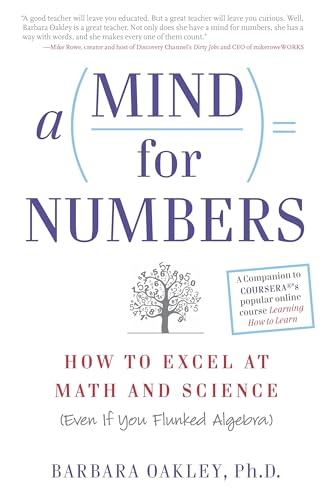
A Mind for Numbers: How to Excel at Math and Science
Dr. Barbara Oakley's actionable guide to unlocking analytical thinking. Perfect for students tackling STEM classes who want to beat procrastination and master complex formulas.
AI Study Pilot receives a small commission from qualifying Amazon purchases at no extra cost to you.Common mistakes
Keep an eye out for these classic pitfalls when studying mechanics of materials:
- Mixing up Engineering vs. True Stress/Strain: Engineering stress/strain divides by the original area and length, while True stress/strain divides by the instantaneous area and length. During necking, engineering stress decreases, but true stress increases continuously up to fracture. AI tools regularly mix up these two models.
- Unit conversion errors: Converting millimeters to meters, or Megapascals (\(\text{MPa} = 10^6 \text{ Pa}\)) to Gigapascals (\(\text{GPa} = 10^9 \text{ Pa}\)), is a primary source of math errors. Remember that \(1\text{ MPa} = 1\text{ N/mm}^2\).
- Applying Hooke's Law in the plastic region: Hooke's Law (\(\sigma = E\epsilon\)) is only valid in the linear elastic region. Once the stress exceeds the yield strength, the relationship is non-linear, and Hooke's Law is completely invalid. Ask AI: "Quiz me Socraticly on when Hooke's Law is applicable and why applying it beyond the yield point is a safety hazard in design. Guide me."
FAQ
- What is the 0.2% offset method? For materials without a well-defined yield point (like aluminum), the yield strength is determined by drawing a line parallel to the elastic region starting at a strain of 0.002 (0.2%) and finding where it intersects the stress-strain curve. Prompt: "Socraticly quiz me on how to apply the 0.2% offset method on a stress-strain graph step-by-step. Guide me."
- What is the difference between stiffness, strength, and toughness? Stiffness is resistance to elastic deformation (Young's modulus), strength is resistance to plastic deformation (yield/tensile strength), and toughness is the total energy absorbed before fracture (area under the entire curve). Prompt: "Act as a Socratic tutor. Quiz me on how stiffness, strength, and toughness are represented mathematically on a stress-strain curve. Guide me."
- What is Poisson's Ratio? Poisson's ratio (\(\nu\)) is the ratio of lateral strain to longitudinal strain under axial tension: \(\nu = -\epsilon_{\text{lateral}} / \epsilon_{\text{longitudinal}}\). It represents how a material thins as it is stretched. Prompt: "Socraticly quiz me on Poisson's ratio, its typical ranges for metals, and how it relates to volume change under tension. Guide me."
Final recommendation
Stress-strain relations are the foundation of structural safety and mechanical design. Do not let AI calculate your cross-sectional areas or solve your linear equations. Instead, draw your specimen free-body diagrams, identify your elastic and plastic boundaries on paper, manage your prefixes and units carefully, and leverage Socratic AI sessions to audit your stiffness calculations and material classifications.
Disclosure: AI Study Pilot may add affiliate links later. We recommend free-first tools where possible and never promise guaranteed grades or outcomes.