STEM study · Updated June 2026
How to Learn Mechanical Engineering and Master Statics and Dynamics With AI Safely
Master vector force systems, structural equilibrium equations, and free-body diagram mapping with Socratic AI feedback and hints.
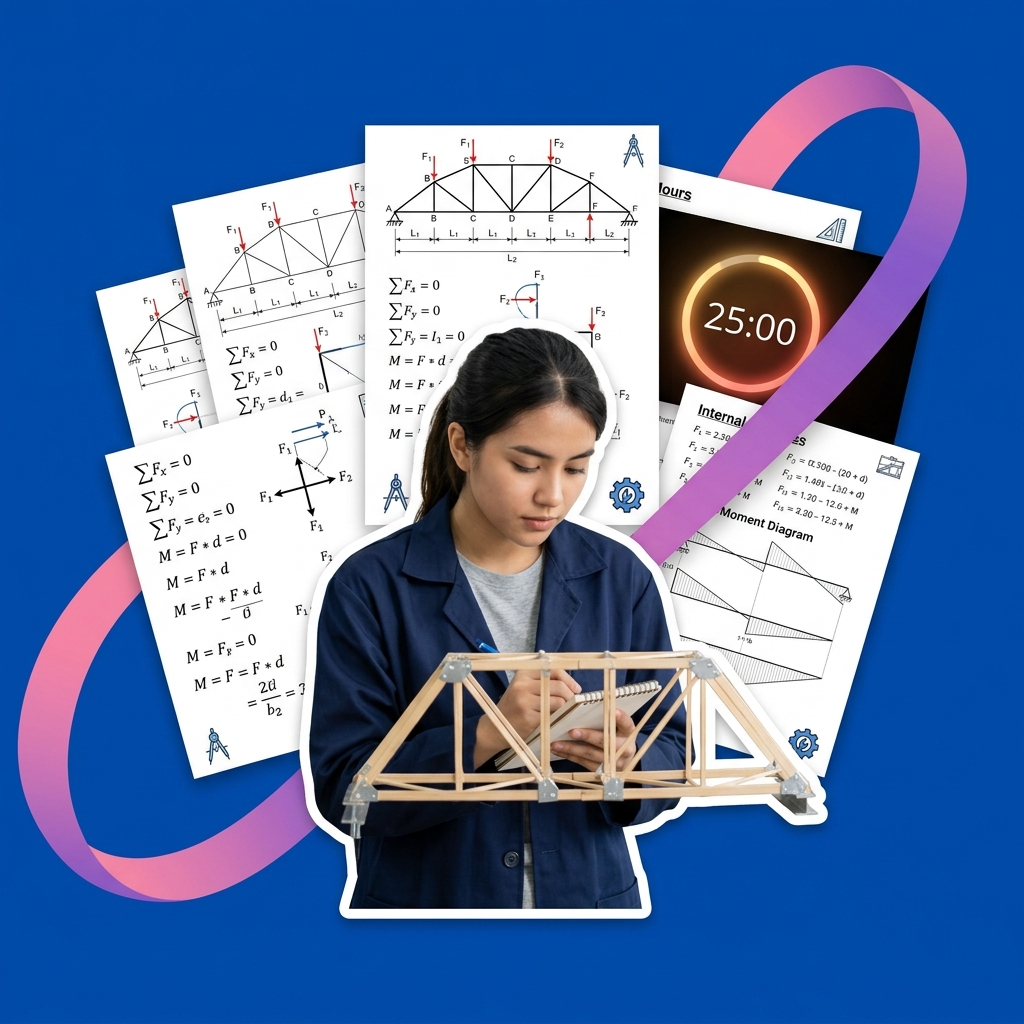
Statics and Dynamics are the gateway courses for mechanical, aerospace, civil, and structural engineering majors. They bridge the gap between basic physics and advanced machine design or structural analysis. Because these courses require solving complex, multi-step vector equations, students often default to using AI to compute final numbers or solve practice problems for them.
However, copying solutions bypasses the critical process of building spatial reasoning and mechanical intuition. This guide outlines a safe, conceptual study workflow to use AI as a Socratic engineering coach to master truss analysis, force systems, and particle dynamics.
Step 1: Mapping Free-Body Diagrams (FBDs) Socraticly
A free-body diagram is the single most important tool in statics and dynamics. If your FBD is incorrect, your equations of equilibrium will be incorrect. Instead of asking AI to draw or solve the FBD, use it to audit your force identification.
Set up an FBD conceptual check using this prompt:
I am solving a statics problem involving a rigid body on a frictionless incline with a pin support and a cable tension force. Act as a Socratic engineering professor. Do not solve the problem or draw the diagram. Ask me one question at a time to help me identify all the active forces, support reactions, and their coordinate components. Evaluate my answers and guide me with hints.Step 2: Deriving Equations of Equilibrium Step-by-Step
Truss analysis (using the Method of Joints or Method of Sections) requires setting up equilibrium equations where the sum of forces and sum of moments equal zero ($\Sigma F = 0$, $\Sigma M = 0$).
Use AI to check your algebraic setups and verify your moment calculations about a specific point without giving away the final answers.
Practice truss analysis with this prompt:
I am analyzing a 2D truss using the Method of Joints. I have set up my equations for joint A. Act as a Socratic engineering coach. I will paste my force equilibrium equation setup. Check if my force directions, trigonometry components, and sign conventions are correct. Do not solve it; ask questions to guide me if I made an error.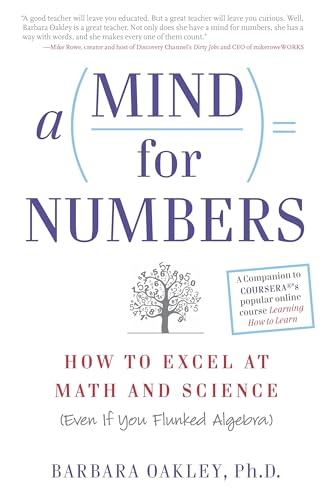
A Mind for Numbers: How to Excel at Math and Science
Dr. Barbara Oakley's actionable guide to unlocking analytical thinking. Perfect for students tackling STEM classes who want to beat procrastination and master complex formulas.
AI Study Pilot receives a small commission from qualifying Amazon purchases at no extra cost to you.Common mistakes
When studying engineering mechanics with AI, avoid these common traps:
- Forgetting coordinate conventions: Signs ($+$ or $-$) depend entirely on your coordinate system. Asking AI to solve equations without establishing a coordinate system leads to confusing sign discrepancies.
- Letting AI do the vector math: Finding cross products ($\vec{r} \times \vec{F}$) for 3D moments is a major exam topic. Solve the determinants by hand, and ask AI only to verify your intermediate matrix setups.
- Neglecting dynamic friction parameters: In dynamics, ensure you are using the coefficient of kinetic friction ($\muk$) rather than static friction ($\mus$) once motion is established.
FAQ
- How can I use AI to study particle kinematics? Paste a dynamic scenario (e.g., projectile motion under wind resistance) and ask AI: "What are the governing differential equations for this motion? Guide me through setting up the integrals to find velocity as a function of time."
- Can AI check my torque and moment calculations? Yes! Paste your moment equation about a specific pivot point, detailing your lever arm lengths and angle components, and ask: "Is my moment summation about point B set up correctly?"
Final recommendation
Mechanical intuition is built through hands-on calculation and spatial visualization. Use physical textbooks to study structural diagrams, write out vector components on paper or a smart notepad to avoid copying errors, and leverage Socratic AI feedback to master the math.
Disclosure: AI Study Pilot may add affiliate links later. We recommend free-first tools where possible and never promise guaranteed grades or outcomes.