Engineering & electronics · Updated June 2026
Learn Operational Amplifiers with AI Safely
Master ideal op-amp rules, closed-loop gain derivations, and active filters using Socratic AI coaching to build analog circuit design intuition safely.
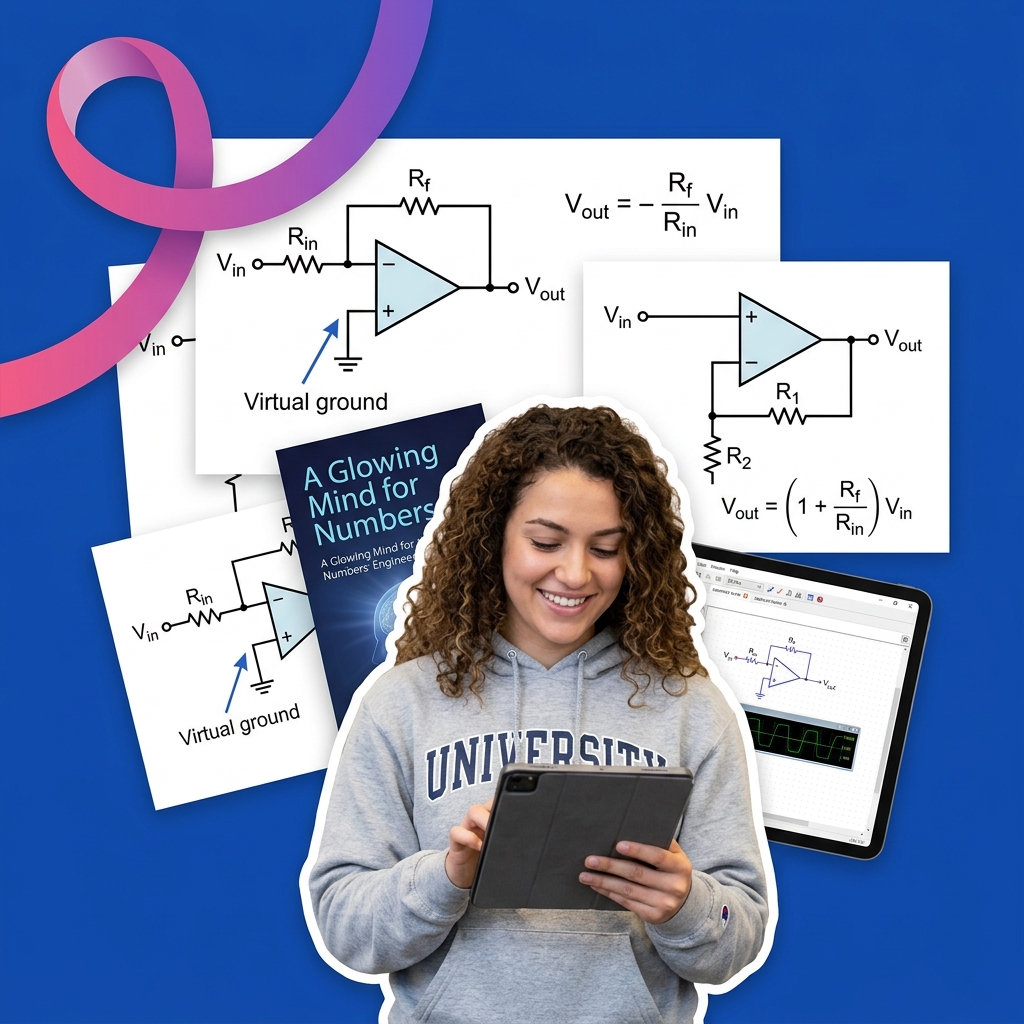
In electrical and computer engineering, the operational amplifier (op-amp) is one of the most versatile and widely used building blocks of analog circuit design. An op-amp is a high-gain, direct-coupled, active electronic device with differential inputs (inverting, \(v_-\), and non-inverting, \(v_+\)) and a single-ended output (\(v_{out}\)). By applying external components in a feedback loop (typically negative feedback), engineers can configure op-amps to perform a wide variety of operations: signal amplification, filtering, addition, integration, differentiation, and impedance matching.
Because solving op-amp circuits involves algebraic equations and nodal analysis (Kirchhoff's Current Law), students frequently ask AI to solve their circuits, draw their schematics, or write out their nodal equations. However, relying on AI to solve these equations or label your nodes bypasses the fundamental circuit-analysis intuition needed to design instrumentation amplifiers, audio mixers, or sensor interfaces. This guide outlines a Socratic workflow to utilize AI as an analog circuits tutor to master operational amplifier analysis safely.
Step 1: Mastering Ideal Op-Amp Assumptions Socraticly
To simplify circuit analysis, engineers use the "ideal op-amp" model. This model assumes three core characteristics:
- Infinite Open-Loop Gain (\(A_{OL} \approx \infty\)): Any small difference between the input terminals is magnified infinitely at the output.
- Infinite Input Impedance (\(R_{in} \approx \infty\)): No current flows into either the inverting (\(i_- = 0\)) or non-inverting (\(i_+ = 0\)) input terminals.
- Zero Output Impedance (\(R_{out} \approx 0\)): The output can supply any amount of current to the load without dropping voltage.
Under negative feedback, these assumptions lead to the crucial virtual short concept: \(v_+ = v_-\). Instead of asking AI to solve the circuit for you, use it to prompt your terminal voltage assessments.
Use this prompt to check your ideal op-amp understanding Socraticly:
I am learning to analyze an op-amp circuit under negative feedback. Act as a Socratic analog circuits tutor. Do not solve the circuit. Ask me to state the two ideal op-amp golden rules regarding input current and terminal voltages under negative feedback, and have me explain what 'virtual ground' means physically in an inverting configuration. Guide me.Step 2: Deriving Inverting & Non-Inverting Gain Configurations Socraticly
The two fundamental closed-loop configurations are the inverting amplifier (input connected via a resistor to \(v_-\)) and the non-inverting amplifier (input connected directly to \(v_+\)). To find the gain \(A_v = \frac{v_{out}}{v_{in}}\), you apply Kirchhoff's Current Law (KCL) at the inverting node. For an inverting amplifier, this yields \(A_v = -\frac{R_f}{R_{in}}\), and for a non-inverting amplifier, it yields \(A_v = 1 + \frac{R_f}{R_1}\). Using AI to run these algebraic reductions prevents you from learning how to apply nodal analysis to custom circuits.
Use this prompt to check your gain derivations Socraticly:
I am deriving the closed-loop voltage gain of a non-inverting op-amp circuit with input voltage Vin at the non-inverting terminal, a feedback resistor Rf, and a resistor R1 connected from the inverting terminal to ground. Act as a Socratic circuit analysis coach. Do not write down the derivation or the final gain formula. Ask me to write the KCL equation at the inverting node step-by-step and prompt me to apply the virtual short condition to substitute voltages. Guide me.Step 3: Modeling Integrator and Differentiator Circuits Socraticly
By replacing the feedback or input resistor with a capacitor, you can configure an op-amp to perform calculus on the input signal. In an integrator circuit, the capacitor is in the feedback path, yielding an output proportional to the integral of the input: \(v_{out}(t) = -\frac{1}{RC}\int v_{in}(t)dt\). In a differentiator circuit, the capacitor is in the input path, yielding an output proportional to the derivative of the input: \(v_{out}(t) = -RC\frac{dv_{in}(t)}{dt}\). Using AI to solve these time-domain equations prevents you from understanding phase shifts and frequency response.
Use this prompt to study op-amp calculus circuits Socraticly:
I am analyzing an op-amp integrator circuit with a resistor R at the input and a capacitor C in the feedback loop. Act as a Socratic electronics coach. Do not solve the differential equation or write the time-domain voltage formula. Ask me to express the current through the input resistor and the current through the feedback capacitor in terms of node voltages, and prompt me to apply KCL to find the relationship between Vin(t) and Vout(t). Guide me.
A Mind for Numbers: How to Excel at Math and Science
Dr. Barbara Oakley's actionable guide to unlocking analytical thinking. Perfect for students tackling STEM classes who want to beat procrastination and master complex formulas.
AI Study Pilot receives a small commission from qualifying Amazon purchases at no extra cost to you.Common mistakes
Keep an eye out for these classic pitfalls when studying op-amps:
- Violating negative feedback assumptions: The virtual short condition (\(v_+ = v_-\)) is only valid if there is negative feedback (a path from the output back to the inverting input \(v_-\)). If the feedback is positive, or if there is no feedback (open loop/comparator configuration), then \(v_+ \neq v_-\). AI tools regularly apply \(v_+ = v_-\) incorrectly to comparators. Ask AI: "Quiz me Socraticly on the difference in terminal relationships between an op-amp with negative feedback and one acting as an open-loop comparator. Guide me."
- Neglecting saturation limits: A physical op-amp cannot output a voltage larger than its supply voltages (\(V_{CC}\) and \(V_{EE}\), usually \(\pm 15\text{ V}\)). If your gain calculation predicts \(v_{out} = 20\text{ V}\), but the supply is \(+15\text{ V}\), the output will saturate at \(+15\text{ V}\).
- Confusing current paths: Remember that although no current enters the input terminals (\(i_+ = i_- = 0\)), current does flow out of the output terminal. Assuming KCL applies to the output terminal as if it were a high-impedance node is a highly common mistake.
FAQ
- What is the difference between open-loop gain and closed-loop gain? Open-loop gain (\(A_{OL}\)) is the gain of the op-amp itself without external feedback, typically very high (\(\approx 10^5\) to \(10^6\)). Closed-loop gain (\(A_v\)) is the gain of the circuit with feedback, which is determined entirely by external resistors and is highly stable. Prompt: "Socraticly quiz me on how negative feedback trades high gain for bandwidth and stability in op-amp circuits. Guide me."
- What is the Common-Mode Rejection Ratio (CMRR)? CMRR is a measure of the op-amp's ability to reject signals common to both input terminals while amplifying the differential signal: \(\text{CMRR} = 20\log_{10}|\frac{A_d}{A_c}|\). A high CMRR is critical for rejecting noise. Prompt: "Act as a Socratic tutor. Quiz me on how a differential amplifier suppresses noise on both input lines and how to calculate output voltage given CMRR. Guide me."
- What is slew rate? Slew rate is the maximum rate of change of the op-amp's output voltage, typically measured in \(\text{V}/\mu\text{s}\). If the input signal changes too rapidly, the output will lag behind, causing distortion. Prompt: "Socraticly quiz me on how slew rate limits the amplitude and frequency of a sinusoidal output signal. Guide me."
Final recommendation
Operational amplifiers are the bridge between physical sensors and digital processing. Do not let AI simplify your circuit schematics or solve your KCL equations. Instead, draw your current loops, write out KCL at your inverting nodes on paper, check your feedback polarity, and leverage Socratic AI sessions to audit your nodal analysis and check your gain limits.
Disclosure: AI Study Pilot may add affiliate links later. We recommend free-first tools where possible and never promise guaranteed grades or outcomes.