Chemistry · Updated June 2026
How to Learn Carbonyl Chemistry and Master Nucleophilic Addition with AI Safely
Master nucleophilic addition to aldehydes and ketones, acetal/hemiacetal formation, imine/enamine reactions, and Grignard mechanisms using Socratic AI coaching safely.
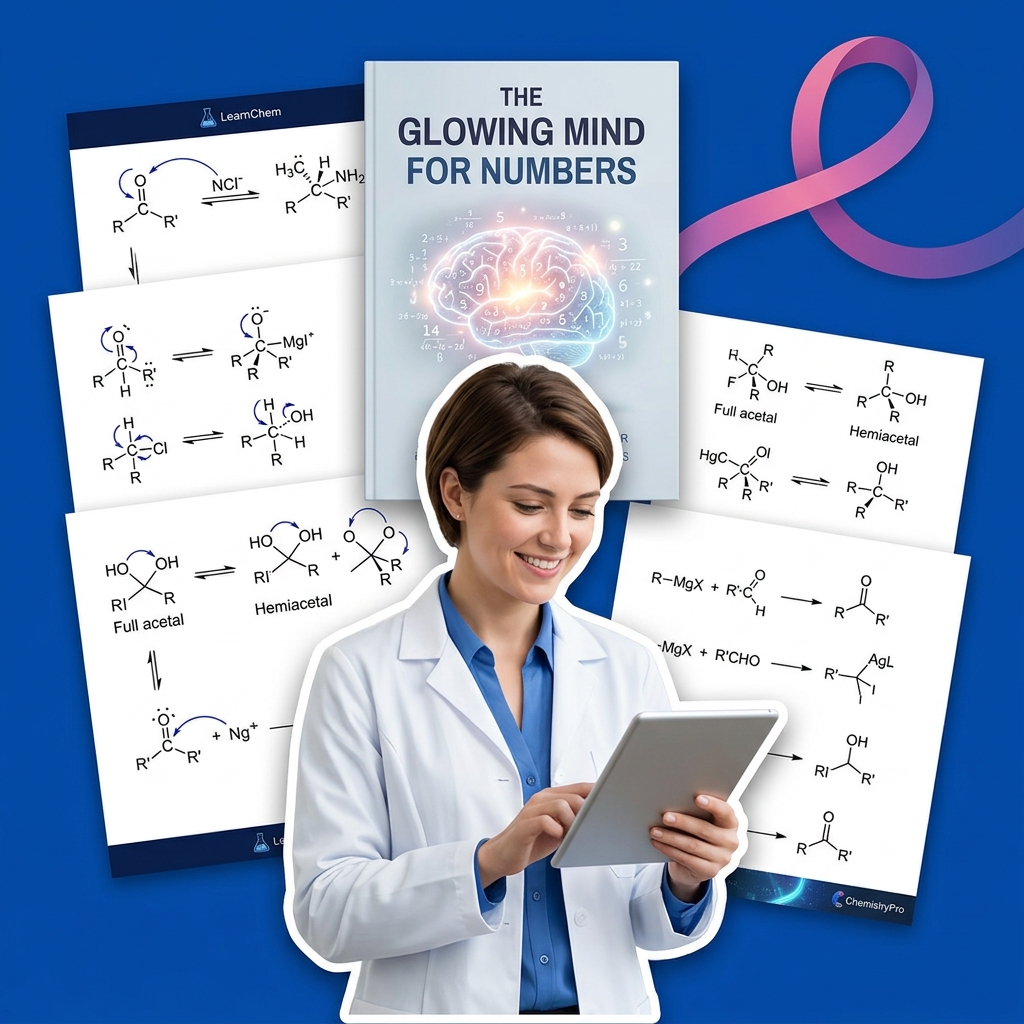
In organic chemistry, Carbonyl Chemistry is the study of reactions involving the carbonyl group ($C=O$), which is found in aldehydes, ketones, carboxylic acids, and their derivatives. Because oxygen is highly electronegative, the carbonyl carbon is strongly electrophilic (electron-deficient), making it highly susceptible to attack by nucleophiles. The fundamental reaction of aldehydes and ketones is nucleophilic addition.
A nucleophilic addition reaction typically follows these key steps:
- Nucleophilic Attack: A nucleophile attacks the electrophilic carbonyl carbon, pushing the $\pi$ electrons of the double bond onto the carbonyl oxygen, forming a tetrahedral intermediate.
- Protonation: The negatively charged oxygen (alkoxide) is protonated by an acid source, yielding an alcohol or a derivative.
Depending on the strength of the nucleophile, carbonyl additions can yield diverse products:
- Hydrates & Hemiacetals/Acetals: Formed by addition of water or alcohols under acid or base catalysis.
- Imines & Enamines: Formed by addition of primary or secondary amines, followed by dehydration.
- Alcohols (via Grignard or Hydrides): Formed by addition of powerful carbon nucleophiles (Grignard reagents, $RMgX$) or hydride reducing agents ($NaBH4$ or $LiAlH4$).
Because drawing curved arrow mechanisms and predicting stereochemical outcomes (addition to the re or si face) is intellectually rigorous, students frequently ask AI models to draw mechanisms, write synthesis steps, or solve homework problems directly. However, letting AI draw the intermediates for you prevents you from understanding electron flow and steric hindrance, which are vital for designing retrosynthetic pathways. This guide outlines a Socratic workflow to utilize AI as an organic chemistry coach.
Step 1: Mapping Carbonyl Reactivity Socraticly
Aldehydes are generally more reactive toward nucleophilic addition than ketones due to both electronic and steric reasons:
- Steric: Aldehydes have only one alkyl group blocking the incoming nucleophile, whereas ketones have two.
- Electronic: Alkyl groups are electron-donating (via induction), which stabilizes the partial positive charge on the carbonyl carbon of a ketone, making it less electrophilic.
Using AI to rank reactivity directly deprives you of learning how to analyze inductive effects and steric interactions.
Use this Socratic prompt to check your reactivity logic:
I am comparing the reactivity of formaldehyde, acetaldehyde, and acetone toward nucleophilic addition. Act as a Socratic organic chemistry tutor. Do not rank the compounds or write the explanation for me. Ask me to compare the size of the groups attached to the carbonyl carbon. Prompt me to explain how alkyl groups donation stabilizes the carbocation-like character of the carbonyl carbon. Guide me.Step 2: Formulating Acetal Formation Mechanisms Socraticly
Acetal formation is an acid-catalyzed process where an aldehyde or ketone reacts with two equivalents of alcohol. The reaction passes through a hemiacetal intermediate (which has one ether group and one alcohol group on the same carbon) before converting to a full acetal (two ether groups).
Allowing AI to draw the step-by-step mechanism directly prevents you from visualizing proton transfers and the departure of water as a leaving group.
Use this prompt to master acetal mechanisms Socraticly:
I am drawing the mechanism for the acid-catalyzed conversion of cyclohexanone to its diethyl acetal. Act as a Socratic organic chemistry coach. Do not write out the steps or draw the curved arrows. Ask me to identify the first step in any acid-catalyzed carbonyl reaction. Prompt me to trace the formation of the hemiacetal and explain why water is a better leaving group than hydroxide. Guide me.Step 3: Auditing Grignard Reactions and Protecting Groups Socraticly
Grignard reagents ($RMgX$) are exceptionally strong nucleophiles and bases. Because they are highly basic, they cannot be used on carbonyl compounds that contain acidic protons (like alcohols, carboxylic acids, or amines), as the Grignard will immediately deprotonate them instead of attacking the carbonyl. To prevent this, you must use a protecting group (like a silyl ether or an acetal) to mask the reactive acidic group.
Use this Socratic prompt to analyze Grignard compatibility and protecting group strategies:
I want to synthesize a compound by reacting a Grignard reagent (methylmagnesium bromide) with a ketone that also contains a carboxylic acid group on the other end of the molecule. Act as a Socratic organic chemistry tutor. Do not solve the synthesis. Ask me to explain what happens when a Grignard reagent encounters a carboxylic acid. Prompt me to design a protecting group strategy to mask the acid before the addition. Guide me.
A Mind for Numbers: How to Excel at Math and Science
Dr. Barbara Oakley's actionable guide to unlocking analytical thinking. Perfect for students tackling STEM classes who want to beat procrastination and master complex formulas.
AI Study Pilot receives a small commission from qualifying Amazon purchases at no extra cost to you.Common mistakes
Be on the lookout for these classic pitfalls when studying carbonyl reactions:
- Ignoring Catalysis Conditions: Attempting to draw acetal formation mechanisms under basic conditions is a common student error. Acetals require acid catalysis because hydroxide is a poor leaving group and cannot be displaced without protonation. Base-catalyzed reactions stop at the hemiacetal stage.
- Drawing Pentavalent Carbons: A classic "organic chemistry sin" is drawing a carbon with 5 bonds. When a nucleophile attacks the carbonyl carbon, you must show the $C=O$ double bond breaking and the electrons moving to the oxygen simultaneously.
- Overlooking Stereochemistry: The carbonyl carbon is $sp^2$-hybridized and planar. The nucleophile has an equal probability of attacking from either the top (re face) or bottom (si face), yielding a racemic mixture of enantiomers if a new chiral center is created. Ask AI: "Quiz me Socraticly on the stereochemical outcome of nucleophilic addition to prochiral ketones. Guide me."
FAQ
- Why do primary amines yield imines, while secondary amines yield enamines? A primary amine ($RNH2$) has two protons, allowing it to lose both and form a $C=N$ double bond (imine). A secondary amine ($R2NH$) has only one proton, so it cannot form a stable double bond with carbon without a positive charge; instead, it loses a proton from an adjacent ($\alpha$) carbon to form a $C=C$ double bond (enamine). Prompt: "Act as a Socratic amine chemistry expert. Quiz me on the mechanism differences that lead to imines versus enamines. Guide me."
- How does the Wittig reaction differ from standard nucleophilic addition? The Wittig reaction uses a phosphorus ylide ($Ph3P=CR2$) to convert aldehydes and ketones directly into alkenes ($C=C$). The reaction proceeds through a 4-membered cyclic intermediate (oxaphosphetane). Prompt: "Socraticly guide me to trace the formation of the oxaphosphetane ring in the Wittig reaction. Guide me."
- Why can't NaBH4 reduce carboxylic acids, but LiAlH4 can? $NaBH4$ is a mild reducing agent that only reduces highly electrophilic carbonyls (aldehydes and ketones). $LiAlH4$ is a much stronger reducing agent that can reduce less electrophilic carbonyls (carboxylic acids, esters, amides) because the aluminum-hydrogen bond is more polar and reactive. Prompt: "Quiz me Socraticly on the reduction mechanism differences between NaBH4 and LiAlH4. Guide me."
Final recommendation
Carbonyl chemistry is the gateway to synthetic design and pharmaceutical synthesis. Do not delegate your curved-arrow mechanism traces, reactivity rankings, or protecting group sequences to AI. Instead, sketch your tetrahedral intermediates, trace your proton transfers manually, audit your stereochemical outcomes, and leverage Socratic AI sessions to check your catalysis limits, Grignard incompatibilities, and reduction boundaries.
Disclosure: AI Study Pilot may add affiliate links later. We recommend free-first tools where possible and never promise guaranteed grades or outcomes.