Chemistry & pre-med · Updated June 2026
How to Learn Organic Chemistry Functional Groups and Master IUPAC Nomenclature with AI Safely
Master functional group identification and chemical IUPAC naming using Socratic AI coaching to map carbon backbones, substituents, and numbering priorities safely.
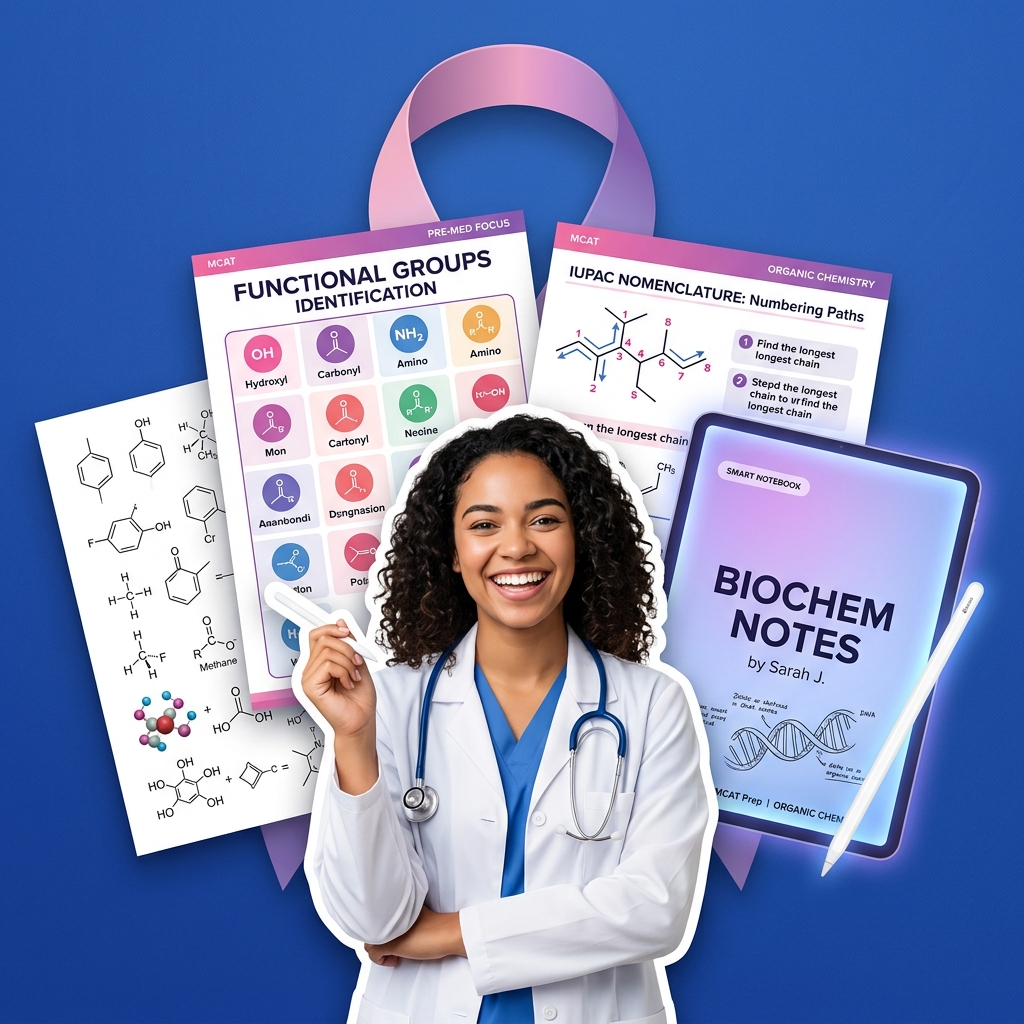
In organic chemistry, functional groups are specific groupings of atoms within molecules that have their own characteristic properties, regardless of the other atoms present in the molecule. Common functional groups include alkanes, alkenes, alkynes, alcohols, ethers, aldehydes, ketones, carboxylic acids, esters, amines, and amides. IUPAC (International Union of Pure and Applied Chemistry) nomenclature is the standardized systematic method used to name organic chemical compounds. Because naming long, branched molecules requires applying a strict sequence of priority and numbering rules, many students copy molecular formulas or structures directly into AI tools, asking them to generate the name.
However, copying IUPAC names from AI tools bypasses the logical and rules-based processes required to parse molecular structures. To succeed in advanced coursework (like biochemistry, pharmacology, or advanced synthesis) and on exams like the MCAT, you must master the structural classification and naming rules. This guide outlines a safe, active-learning study workflow to use AI as a Socratic chemistry coach to master functional groups and IUPAC nomenclature.
Step 1: Identifying the Longest Carbon Chain and Principal Functional Group Socraticly
The first step in IUPAC naming is identifying the longest continuous carbon chain containing the highest-priority functional group. This group determines the suffix of the parent name (e.g., an alcohol gets "-ol", a ketone gets "-one"). Students often select the wrong parent chain when branches are complex. Instead of asking AI to identify the parent chain, use Socratic checkpoints.
Prompt the AI to check your parent chain setup using this template:
I am naming an organic compound that has a 7-carbon chain with a double bond between C2-C3, a hydroxyl (-OH) group on C4, and a methyl group on C5. Act as a Socratic organic chemistry tutor. Do not name the compound or list the parent name. Ask me to identify which functional group has the highest nomenclature priority, state what parent suffix it gets, and determine the length of the parent carbon chain containing this group. Evaluate my answers and guide me with hints.Step 2: Numbering the Parent Chain Socraticly
Once the parent chain is identified, you must number the carbon atoms starting from the end that gives the highest-priority functional group the lowest possible number. If there is a tie, you apply rules for double/triple bonds, and then substituents.
Practice checking numbering priority with this prompt:
In my 7-carbon compound with a double bond between C2-C3, a hydroxyl (-OH) group on C4, and a methyl group on C5, I am deciding whether to number from left to right or right to left. Act as a Socratic chemistry coach. Do not state the correct numbering path. Ask me to compare the functional group priority of the alkene vs the alcohol, and ask how this priority determines which end of the chain is carbon-1. Evaluate my answers.Step 3: Naming Substituents and Assembling the Compound Name
Substituents (like methyl, ethyl, bromo, or nitro groups) are named as prefixes and listed in alphabetical order (ignoring prefixes like di-, tri-, or sec-). Finally, the locant numbers, substituent names, and parent suffix are assembled into a single IUPAC name.
Check your name assembly Socraticly with this prompt:
I want to assemble the full IUPAC name for my 7-carbon compound, which has the parent chain numbered to give the -OH group the lowest number. The substituents are a methyl group on C5 and the double bond. Act as Socratic chemistry coach. Do not state the final IUPAC name. Ask me to list the substituents in alphabetical order, identify their locants, and explain how to combine these prefixes with the parent chain name. Evaluate my steps and guide me.
Rocketbook Smart Reusable Notebook
Eco-friendly, reusable physical notebook that digitizes and syncs your hand-written diagrams and notes directly to your favorite cloud storage for AI-assisted study.
AI Study Pilot receives a small commission from qualifying Amazon purchases at no extra cost to you.Common mistakes
When studying chemical nomenclature with AI, watch out for these pitfalls:
- Misapplying group priorities: Carboxylic acids have higher priority than esters, which are higher than aldehydes, ketones, alcohols, amines, alkenes, and alkynes. AI models frequently mix up priorities, resulting in names like "hydroxy-hexanone" instead of "oxo-hexanol". Always refer to a standard IUPAC priority table. Check this boundary Socraticly by prompting: "Quiz me Socraticly on the relative priority of an amide vs a ketone. Ask me which one determines the parent suffix."
- Alphabetizing prefixes incorrectly: When sorting prefixes alphabetically, ignore multipliers like "di-" or "tri-" (e.g., "ethyl" comes before "dimethyl" because "e" precedes "m"). AI models often sort "dimethyl" under "d". Make sure your Socratic prompts check alphabetization rules.
- Relying on AI for complex cyclic or bicyclic compounds: AI tools frequently generate incorrect names for complex bridged ring systems or stereocenter indicators (R/S or E/Z). Draw these out in a smart notebook, determine the stereochemistry, and use AI Socraticly to check your step-by-step logic.
FAQ
- How can I use AI to study stereochemistry in nomenclature? Stereocenters are indicated at the beginning of the IUPAC name in parentheses (e.g., (2R, 3S)-). Ask the AI: "Walk me Socraticly through assigning R or S configuration to a chiral center. Ask me to assign priority numbers to the four substituents around the carbon. Do not solve it for me."
- Can AI help me understand common names vs. IUPAC names? Yes. Many molecules are known by common names (like isopropyl alcohol or acetone) rather than their IUPAC names (2-propanol or 2-propanone). Prompt: "Socraticly quiz me on the difference between the common name and systematic IUPAC name for acetic acid and toluene. Guide me."
- How do I verify ester and ether naming with AI? Esters are named as alkyl alkanoates (e.g., ethyl acetate), and ethers as alkoxyalkanes. Ask AI: "Quiz me Socraticly on how to identify the alcohol-derived part vs the acid-derived part of an ester to determine its name. Guide my reasoning."
Final recommendation
Organic nomenclature is a logical system of priority rules. Draw carbon backbones clearly on paper or in a smart notebook, circle your functional groups, number your parent chains methodically, and use Socratic AI checkpoints to audit your priority mappings and prefixes without relying on automated solvers.
Disclosure: AI Study Pilot may add affiliate links later. We recommend free-first tools where possible and never promise guaranteed grades or outcomes.