STEM study · Updated June 2026
How to Learn Organic Chemistry and Master Reaction Mechanisms With AI Safely
Learn how to use AI safely to master organic chemistry reaction mechanisms, understand electron movements, and practice synthesis step-by-step.
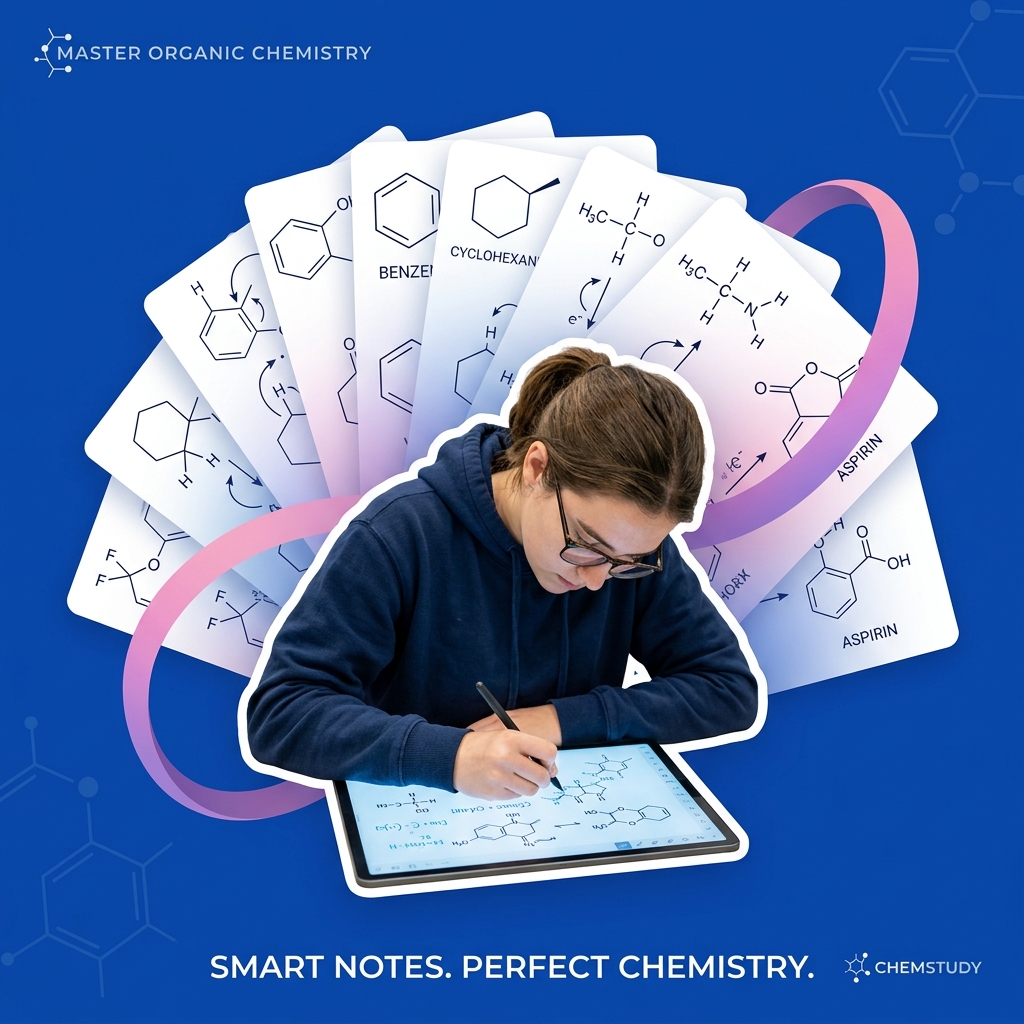
Organic Chemistry (commonly known as "Orgo") is one of the most notoriously difficult pre-med and chemistry requirements in college. Unlike general chemistry classes that involve significant mathematical calculation, Organic Chemistry is heavily visual and procedural. It requires you to understand the 3D shapes of molecules, spatial arrangements, and the movement of electrons.
The most common trap students fall into is attempting to memorize hundreds of individual reactions and reagents. Because the sheer volume of material is so high, pure memorization inevitably fails during exams where you must predict products or propose synthesis pathways for molecules you've never seen before.
AI assistants can act as interactive visual chemistry tutors. You can use an AI to break down complex mechanisms step-by-step, explain why a nucleophile attacks a specific carbon, and generate progressive practice synthesis challenges.
However, using AI to solve your homework assignments or write your laboratory pre-lab reports is a violation of academic integrity. The key is to use the AI to verify your understanding of reaction mechanisms and explain concepts, rather than using it to complete your assignments.
Visual chemistry workflow with AI
- Identify the nucleophile and electrophile: Use AI to learn the basic reactive sites on common functional groups.
- Understand electron arrow-pushing: Request step-by-step descriptions of electron movements.
- Practice hand-drawn active recall: Draw reaction mechanisms by hand first, then digitize them to compare against verified mechanisms.
- Solve backward synthesis problems: Challenge yourself with retro-synthesis prompts generated by the AI.
The Cognitive Value of Hand-Drawing Molecules
Organic Chemistry cannot be studied effectively on a keyboard. Typing out chemical formulas (like CH3CH2OH) obscures the critical 3D geometry of the molecule. To understand stereochemistry, stereocenters, and chair conformations, you must draw them by hand.
In Make It Stick: The Science of Successful Learning, cognitive scientists emphasize that the physical act of drawing and writing out structures helps encode concepts into long-term memory.
Using a smart reusable notebook (like a Rocketbook) is a highly efficient way to study. You can hand-draw dozens of skeletal structures, reaction intermediates, and mechanism arrows, scan them instantly to digitize and save them, and then erase the page to start over. This lets you practice active recall over and over without wasting paper, while building a clean digital library of study guides that you can query with AI.
The Reaction Mechanism Prompt
To understand the exact step-by-step electron movement in a reaction, upload the names of your starting materials and reagents, and ask this prompt:
Act as a college organic chemistry professor. Explain the mechanism of [e.g., the SN2 substitution reaction between bromoethane and sodium hydroxide] conceptually.

Please generate a structured review:
1. Identify the nucleophile and the electrophile, explaining why they act as such.
2. Describe the step-by-step movement of electrons (using standard arrow-pushing terminology).
3. Describe the structure of the transition state and any stereochemical consequences (e.g., inversion of configuration).
4. Provide 3 conceptual check-for-understanding questions about how solvent choice or substrate substitution would affect the reaction rate.
Step-by-Step O-Chem Review
Step 1 — Map the reactants
Before drawing any arrows, you must locate the active centers. Ask the AI:
Explain the relative nucleophilicity and electrophilicity of the reactants in: [insert reaction reactants, e.g., acetone and sodium borohydride]. Which bond is broken first?Step 2 — Draw the mechanism by hand
Draw out your proposed reaction steps, intermediate carbocations, and final products on your smart notebook. Take a scan to save it. Then, ask the AI to describe the standard textbook mechanism for that reaction to verify if your drawn intermediates match.
Step 3 — Run a retrosynthesis quiz
Retrosynthesis (working backward from a target molecule to starting materials) is the most challenging part of organic chemistry exams. Prompt the AI:
Provide a 3-step retrosynthesis practice challenge for a college organic chemistry student. Do not give the answer immediately. Give me the target molecule, and let me propose the steps. I will reply, and you will evaluate my synthesis pathway.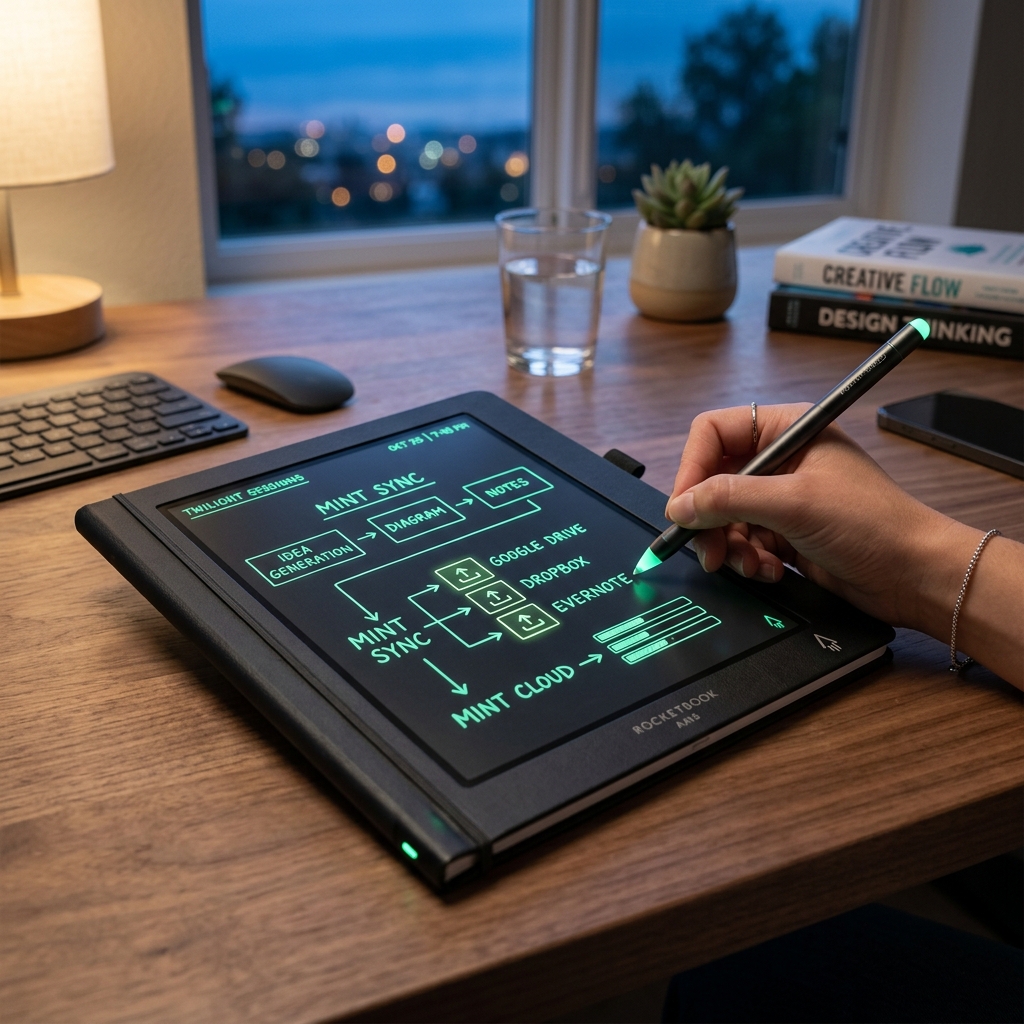
Rocketbook Smart Reusable Notebook
Eco-friendly, reusable physical notebook that digitizes and syncs your hand-written diagrams and notes directly to your favorite cloud storage for AI-assisted study.
AI Study Pilot receives a small commission from qualifying Amazon purchases at no extra cost to you.Common mistakes
Memorizing reactions without understanding mechanisms: Reagents can change, but the rules of nucleophile-electrophile attraction remain the same. Focus on why the electrons move, not just what* the final product is.
* Ignoring stereochemistry: Failing to show wedge-and-dash bonds or indicating the wrong stereocenters (R vs S) is a quick way to lose points on exams. Always indicate 3D geometry in your hand-drawn practice.
* Letting AI do the synthesis code: Don't use chemical prediction tools or AIs to do your synthesis homework. Treat the AI as an office-hours tutor to ask conceptual questions when you get stuck on a step.
Disclosure: AI Study Pilot may add affiliate links later. We recommend free-first tools where possible and never promise guaranteed grades or outcomes.