Chemistry & physics · Updated June 2026
Learn Quantum Chemistry & Schrödinger Equation with AI Safely
Master wave-particle duality, the Schrödinger wave equation, and atomic orbital quantum numbers using Socratic AI coaching to build physical chemistry intuition safely.
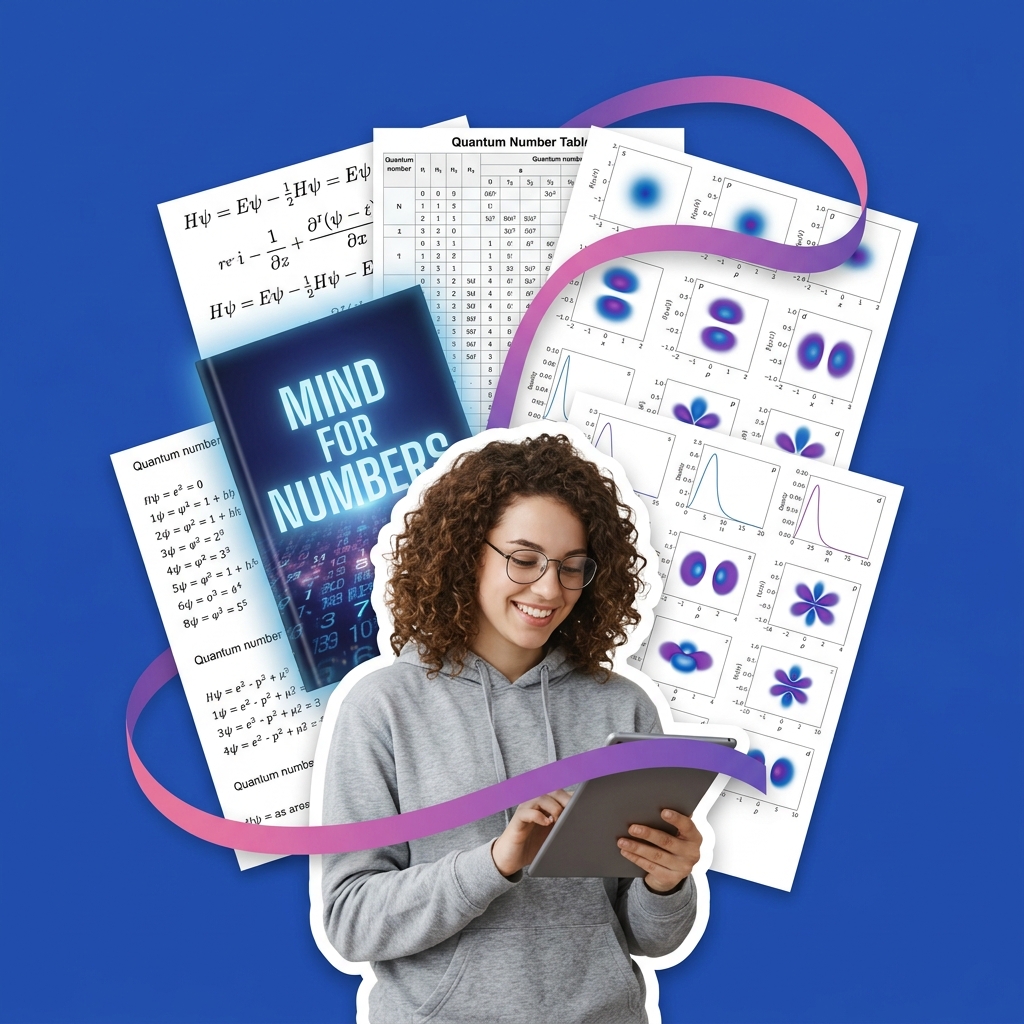
In chemistry and physics, quantum chemistry applies quantum mechanics to address chemical systems at the molecular level. It explains why atoms form bonds, how molecules interact with light, and why electrons occupy specific regions around a nucleus (atomic orbitals) rather than orbiting like planets. At the heart of quantum chemistry lies the Schrödinger equation, a partial differential equation that describes how the quantum state of a physical system changes over time. For stationary states, the time-independent Schrödinger equation is written as:
\[\hat{H}\psi = E\psi\]
where \(\hat{H}\) is the Hamiltonian operator representing the total energy, \(\psi\) is the wave function of the system, and \(E\) is the system's energy level.
Because solving the Schrödinger equation for systems (like a particle in a box or a hydrogen atom) involves advanced calculus, linear algebra, and complex numbers, students frequently ask AI to solve their entire problem sets or run Python solvers. However, letting AI calculate energy levels or sketch wave functions bypasses the physical and mathematical intuition necessary to understand chemical bonding, spectroscopic transitions, or materials science. This guide outlines a Socratic workflow to utilize AI as a physical chemistry tutor to build quantum mastery safely.
Step 1: Understanding Wave-Particle Duality & Planck's Equation Socraticly
Quantum mechanics begins with the realization that light and matter display both wave-like and particle-like properties. Light behaves like particles (photons) with energy \(E = h\nu\), while moving matter (like electrons) behaves like waves with a de Broglie wavelength:
\[\lambda = \frac{h}{p} = \frac{h}{mv}\]
Rather than asking AI to compute the wavelength of a moving electron for you, use it to check your units, algebraic conversions, and conceptual understanding of wave behavior at the atomic scale.
Use this prompt to check your wave-particle calculations Socraticly:
I am calculating the de Broglie wavelength of an electron traveling at 1.5 * 10^6 m/s. Act as a Socratic physical chemistry tutor. Do not solve the calculation or give me the final wavelength. Ask me to identify the values and units of Planck's constant (h) and the mass of an electron (m), explain how to set up the equation, and evaluate my conversion steps. Guide me.Step 2: Setting Up the Schrödinger Equation Socraticly
The wave function \(\psi\) contains all the observable information about a quantum system. The Hamiltonian operator \(\hat{H}\) consists of kinetic energy and potential energy operators: \(\hat{H} = -\frac{\hbar^2}{2m}\nabla^2 + V(r)\). For a simple one-dimensional model like the "particle in a box" (where $V(x) = 0$ inside the box and \(V(x) = \infty\) outside), the Schrödinger equation simplifies to:
\[-\frac{\hbar^2}{2m}\frac{d^2\psi(x)}{dx^2} = E\psi(x)\]
Instead of asking AI to solve this differential equation, use it to guide you through applying boundary conditions to solve for the wave function and quantized energy levels.
Use this prompt to check your Schrödinger setup Socraticly:
I am solving the Schrödinger equation for a particle in a 1D box of length L. Act as a Socratic quantum mechanics tutor. Do not solve the differential equation or write the energy formula. Ask me what the boundary conditions are for the wave function at x = 0 and x = L, prompt me to explain why the wave function must be zero outside the box, and guide me through the normalization process of the wave function step-by-step. Guide me.Step 3: Interpreting Wave Functions & Quantum Numbers Socraticly
While the wave function \(\psi\) itself is a mathematical construct that can have complex values, its absolute square \(|\psi|^2\) represents the probability density of finding a particle (like an electron) at a given point in space. For a hydrogen atom, solving the Schrödinger equation yields a set of wave functions called orbitals, which are defined by three spatial quantum numbers: the principal (\(n\)), angular momentum (\(l\)), and magnetic (\(m_l\)) quantum numbers, along with the spin (\(m_s\)) quantum number. Using AI to list allowed quantum states prevents you from understanding the rules of quantum numbers.
Use this prompt to master quantum states Socraticly:
I am learning the rules for quantum numbers in a hydrogenic atom. I want to check if a state with n = 3, l = 3, and ml = -1 is allowed. Act as a Socratic quantum chemistry coach. Do not tell me if the state is allowed or list the valid ranges. Ask me to state the rule that defines the allowed values of the angular momentum quantum number l based on n, and guide me to evaluate if my proposed values conform to those rules. Guide me.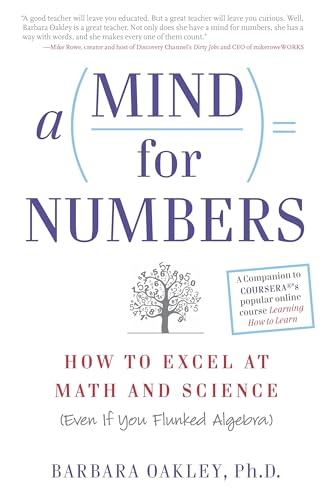
A Mind for Numbers: How to Excel at Math and Science
Dr. Barbara Oakley's actionable guide to unlocking analytical thinking. Perfect for students tackling STEM classes who want to beat procrastination and master complex formulas.
AI Study Pilot receives a small commission from qualifying Amazon purchases at no extra cost to you.Common mistakes
Keep an eye out for these classic traps when studying quantum chemistry:
- Confusing the wave function with probability density: The wave function \(\psi(x)\) can be positive, negative, or complex, and has no direct physical representation. The probability density \(|\psi(x)|^2\) is strictly positive and real. Confusing these leads to major conceptual errors in bonding and nodal behavior.
- Forgetting units and constants: Quantum math uses extremely small numbers (like Planck's constant \(h \approx 6.626 \times 10^{-34}\text{ J}\cdot\text{s}\) and electron mass \(m_e \approx 9.109 \times 10^{-31}\text{ kg}\)). Arithmetic errors and unit mismatches (like confusing Joules and electron-Volts) are highly common. Ask AI: "Quiz me Socraticly on unit consistency in quantum calculations and how to convert energy values between Joules, eV, and wavenumbers. Guide me."
- Violating boundary conditions: Quantum wave functions must be continuous, single-valued, and normalizable (the integral of \(|\psi|^2\) over all space must equal 1). If a proposed wave function doesn't meet these requirements, it is physically impossible. Use AI to study this: "Prompt me Socraticly to explain the mathematical criteria a function must meet to be a physically acceptable quantum wave function. Guide me."
FAQ
- What is a node in a wave function? A node is a point or plane where the wave function \(\psi\) passes through zero, meaning the probability density \(|\psi|^2\) at that node is exactly zero. Radial nodes are spherical shells, while angular nodes are planes or cones. Prompt: "Socraticly quiz me on how to calculate the total number of radial and angular nodes in a hydrogen atom orbital given its quantum numbers n and l. Guide me."
- Why are energy levels quantized? Energy levels are quantized because the boundary conditions of physical systems (like an electron bound in an atom or a particle in a box) restrict the wave function to specific, stable standing wave patterns. Unquantized waves would interfere destructively and vanish. Prompt: "Act as a Socratic tutor. Explain why boundary conditions lead to quantization and quiz me on the physical analogy of a vibrating guitar string. Guide me."
- How does the Heisenberg Uncertainty Principle? It is a fundamental limit of quantum mechanics stating that the position (\(x\)) and momentum (\(p\)) of a particle cannot be measured simultaneously with arbitrary precision: \(\Delta x \Delta p \ge \frac{\hbar}{2}\). Prompt: "Socraticly quiz me on how the Heisenberg Uncertainty Principle prevents an electron from collapsing into the atomic nucleus. Guide me."
Final recommendation
Quantum chemistry is the gateway to understanding chemical properties at their fundamental level. Avoid relying on AI solvers or graphing tools to map orbitals or compute energy eigenvalues. Instead, write out your operator expressions, apply boundary conditions step-by-step on paper, and leverage Socratic AI sessions to audit your quantum number rules, normalize wave functions, and solidify your physical intuition.
Disclosure: AI Study Pilot may add affiliate links later. We recommend free-first tools where possible and never promise guaranteed grades or outcomes.