Engineering & math · Updated June 2026
How to Learn Signal Processing and Master Fourier Transforms With AI Safely
Master Fourier transforms and signal frequency mapping using Socratic AI coaching to understand time-to-frequency conversions and spectral diagrams safely.
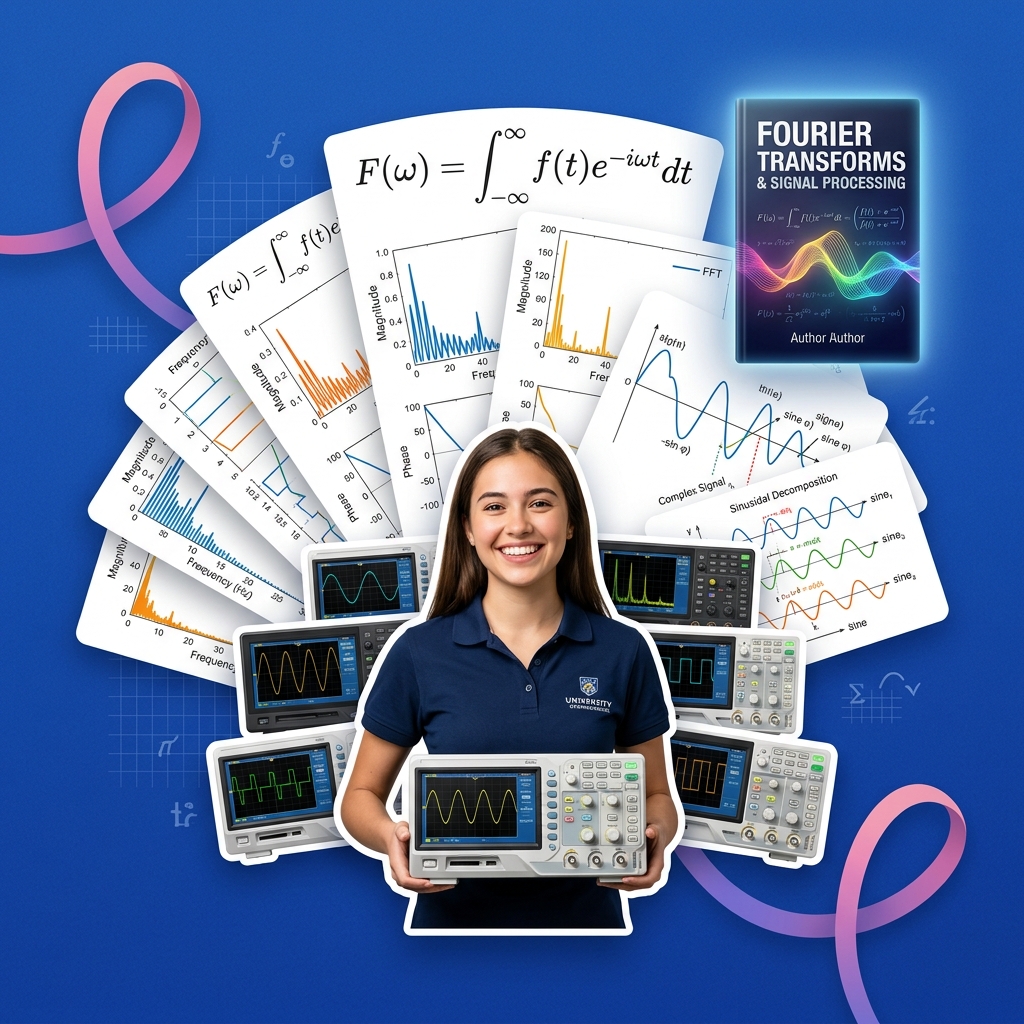
In electrical engineering and applied physics, signal processing is a fundamental discipline that bridges math and real-world systems. At the heart of this field lies the Fourier Transform—a mathematical operation that decomposes a time-domain signal into its constituent frequencies. Whether you are analyzing continuous waves using integration or computing the Discrete Fourier Transform (DFT) for digital signal analysis, mastering these transforms requires solid calculus skills and a deep conceptual understanding of the frequency domain. Because the math involves complex numbers, infinite limits, and matrix transformations, students frequently copy homework equations directly into AI models to obtain quick solutions.
However, relying on AI to solve integrals and plot frequency spectra for you bypasses the critical conceptual leaps required to interpret physical signals. To succeed in advanced coursework (like communications systems, digital signal processing, or control systems), you must develop the intuition to translate math into physical insights. This guide outlines a safe, active-learning study workflow to use AI as a Socratic signal processing coach.
Step 1: Setting Up the Continuous Fourier Transform Integral Socraticly
To convert a continuous time-domain signal x(t) into its frequency-domain representation X(f), you must set up the Fourier Transform integral. A common stumbling block is handling complex exponentials, Euler's formula, and integration-by-parts for piecewise functions. Instead of asking the AI to compute the integral, use it to check your limits and coordinate setup.
Prompt the AI to check your setup using this template:
I am practicing setting up the continuous Fourier Transform integral for a single rectangular pulse x(t) of width T, centered at the origin. Act as a Socratic engineering tutor. Do not solve the integration or write out the final formula. Ask me to state the standard definition of the continuous Fourier Transform, define the limits of integration for this specific pulse, and explain how to apply Euler's formula to simplify the complex exponential. Evaluate my answers and guide me with hints.Step 2: Transitioning to the Discrete Fourier Transform (DFT)
In practical applications, signals are sampled digitally, requiring the Discrete Fourier Transform (DFT). The mathematical shift from integration to summation introduces new concepts like sampling rate, Nyquist frequency, and spectral leakage. AI tools can easily write code to run a Fast Fourier Transform (FFT), but understanding the relationship between indices and physical frequencies is up to you.
Practice translating the indices and checking your understanding with this prompt:
I have a discrete signal with N = 8 samples, and I want to compute the DFT manually to find the frequency bin representation. Act as a Socratic signal processing coach. Do not write out the DFT formula or perform the matrix multiplications. Ask me to state the DFT summation formula, explain what frequency corresponds to the index k = N/2, and describe how sampling frequency determines the frequency spacing between bins. Guide me Socraticly.Step 3: Designing Filters and Analyzing Frequency Responses
Once a signal is in the frequency domain, you can design filters (low-pass, high-pass, or band-pass) to remove noise. The transfer function H(f) determines how the amplitude and phase of each frequency component are modified. Understanding how poles and zeros on the s-plane or z-plane affect the filter's frequency response is key.
Check your filter design concepts with this prompt:
I am designing a simple first-order RC low-pass filter and want to determine its frequency response. The cutoff frequency is given by fc = 1 / (2 * pi * R * C). Act as a Socratic filter design tutor. Do not derive the transfer function or plot the response. Ask me to explain how the ratio of output voltage to input voltage changes as frequency approaches zero and infinity, and prompt me to explain what the phase shift is at the cutoff frequency. Guide me with hints.
A Mind for Numbers: How to Excel at Math and Science
Dr. Barbara Oakley's actionable guide to unlocking analytical thinking. Perfect for students tackling STEM classes who want to beat procrastination and master complex formulas.
AI Study Pilot receives a small commission from qualifying Amazon purchases at no extra cost to you.Common mistakes
Be sure to watch out for these pitfalls when studying signal processing:
- Misinterpreting frequency spacing: When running an FFT in Python or MATLAB, the output array indices do not directly map to Hertz. AI models often generate plotting code that aligns labels incorrectly. Always double-check your frequency vector calculation: f = index * (fs / N). Verify this setup Socraticly by prompting: "Explain how to map the output array of a 1024-point FFT sampled at 10 kHz to actual frequencies. Ask me questions to check my understanding."
- Assuming AI arithmetic is correct for complex calculations: AI models frequently struggle with Euler's conversions (cos(theta) + j*sin(theta)) and complex division. Always carry out algebraic simplifications and numerical computations on paper or using a verified math kernel.
- Ignoring aliasing and Nyquist limits: If a signal is sampled below twice its maximum frequency, high-frequency components wrap around into lower frequencies, causing distortion (aliasing). Socraticly test your understanding of sampling criteria by asking AI: "Quiz me on how aliasing manifests mathematically when x(t) = cos(2pif*t) is under-sampled. Ask me about folding frequencies without telling me the answer."
FAQ
- How can I use AI to understand the convolution theorem? The convolution theorem states that convolution in the time domain is equivalent to multiplication in the frequency domain. Ask the AI: "Walk me Socraticly through proving why multiplying two frequency spectra is computationally faster than performing time-domain convolution for large datasets. Ask me to compare operation counts."
- Can AI help me understand FFT butterfly diagrams? Yes. Butterfly diagrams visualize the divide-and-conquer strategy of the Radix-2 FFT. Prompt: "Socraticly quiz me on how a Radix-2 decimation-in-time FFT splits an N-point DFT into even and odd samples. Ask me about the role of twiddle factors."
- How do I verify windowing concepts? Windowing (using Hamming or Hann windows) reduces spectral leakage caused by analyzing finite-length signal segments. Ask the AI: "Quiz me on the trade-offs between main lobe width and sidelobe levels when choosing a rectangular window vs a Hamming window. Socraticly guide my reasoning."
Final recommendation
Signal processing is best understood visually and mathematically. Write out your integrals and summations clearly, map time-domain waveforms to frequency spectrum grids on paper, and use Socratic AI checkpoints to audit your Euler conversions, Nyquist limits, and filtering logic without relying on automated solvers.
Disclosure: AI Study Pilot may add affiliate links later. We recommend free-first tools where possible and never promise guaranteed grades or outcomes.