Signal Processing · Updated June 2026
How to Learn the Sampling Theorem and Master Nyquist Rate Calculations with AI Safely
Master sampling frequency calculations, Nyquist rate limits, frequency folding, anti-aliasing filters, and signal reconstruction using Socratic AI coaching safely.
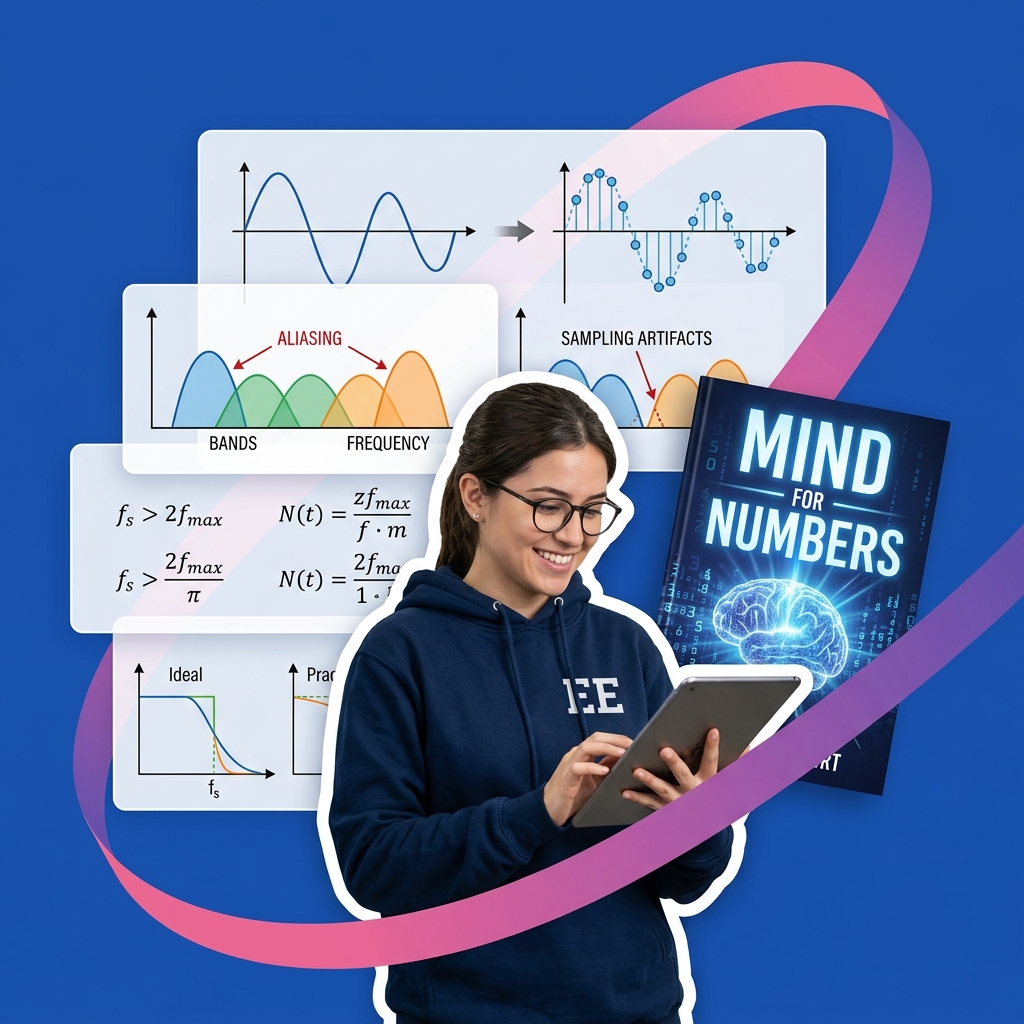
In signal processing, telecommunications, and digital audio, the Nyquist-Shannon Sampling Theorem is the bridge between continuous-time analog signals and discrete-time digital signals. The theorem establishes a fundamental condition: a continuous-time signal can be completely represented by its samples and perfectly reconstructed without loss of information if it is sampled at a rate greater than twice its highest frequency component.
The core concepts of sampling theory include:
- Nyquist Rate (\(f_N\)): The minimum sampling rate required to avoid losing information, defined as:
\[f_N = 2 f_{\max}\]
where \(f_{\max}\) is the maximum frequency present in the analog signal.
- Aliasing: The distortion that occurs when a signal is sampled at a rate below the Nyquist rate (\(f_s \le 2 f_{\max}\)). High-frequency components "fold back" into the lower frequency spectrum, appearing as completely different, lower-frequency signals that cannot be distinguished from the original low-frequency components.
- Low-pass Filtering: To prevent aliasing, an analog anti-aliasing filter (a low-pass filter) is applied before sampling to remove all frequency components above the Nyquist limit (\(f_s / 2\)). During reconstruction, a reconstruction filter (another low-pass filter) is used to smooth the sampled impulses back into a continuous wave.
Because visualizing frequency folding and calculating sampling intervals can be conceptually difficult, students often ask AI models to compute Nyquist rates, determine foldback frequencies, or solve Fourier integrals directly. However, letting AI solve these equations for you prevents you from developing the mathematical intuition needed to design analog-to-digital converters (ADCs), process digital audio, or analyze telemetry data. This guide outlines a Socratic workflow to utilize AI as a signal processing and DSP coach.
Step 1: Mapping Sampling Rates and Nyquist Limits Socraticly
Calculating the Nyquist rate is straightforward when a signal is defined by a single sine wave, but real-world signals are combinations of multiple frequencies. To find the Nyquist rate, you must identify the highest frequency component (\(f_{\max}\)) present in the signal's spectrum, regardless of the amplitudes of the other components.
Use this Socratic prompt to check your sampling rate calculations:
I am calculating the Nyquist rate for a signal defined by the equation x(t) = 3 cos(200 pi t) + 5 sin(600 pi t) cos(100 pi t). Act as a Socratic signal processing tutor. Do not solve the equation or give me the Nyquist rate. Ask me to expand the trigonometric product term using product-to-sum identities. Prompt me to identify the individual frequencies present in the signal and guide me to find the maximum frequency.Step 2: Visualizing Aliasing and Frequency Folding Socraticly
When sampling violates the Nyquist criterion, high frequencies fold back into the digital spectrum. The apparent frequency (\(f_{\text{apparent}}\)) of an aliased signal can be calculated by finding the distance to the nearest integer multiple of the sampling frequency:
\[f_{\text{apparent}} = |f_{\text{analog}} - k f_s|\]
where \(k\) is the integer that minimizes the absolute difference.
Allowing AI to compute the aliased frequency directly removes the opportunity to draw the spectrum and visualize how frequencies wrap around the Nyquist boundary.
Use this prompt to master aliasing concepts Socraticly:
I am sampling a 12 kHz analog sine wave at a sampling frequency of 10 kHz. Act as a Socratic DSP coach. Do not calculate the aliased frequency for me. Ask me to state the Nyquist limit for this sampling frequency. Prompt me to explain where the 12 kHz component lies relative to this limit and guide me to calculate where it folds back in the spectrum.Step 3: Designing Anti-Aliasing and Reconstruction Filters Socraticly
In practical systems, perfect brick-wall filters (which cut off frequencies instantly) do not exist. Engineers must design transition bands and select filter orders to minimize aliasing while avoiding signal distortion. Understanding how filter cutoffs interact with sampling rates is critical for hardware and software design.
Use this Socratic prompt to check your filter designs:
I am designing an audio recording system with a sampling rate of 44.1 kHz. I need to design a low-pass anti-aliasing filter to ensure that any signal component above 22.05 kHz is attenuated by at least 80 dB. Act as a Socratic electrical engineering professor. Do not tell me what cutoff frequency or filter type to use. Ask me to explain how a transition band affects my filter choice and guide me to evaluate the trade-offs between a higher sampling rate and filter complexity.
A Mind for Numbers: How to Excel at Math and Science
Dr. Barbara Oakley's actionable guide to unlocking analytical thinking. Perfect for students tackling STEM classes who want to beat procrastination and master complex formulas.
AI Study Pilot receives a small commission from qualifying Amazon purchases at no extra cost to you.Common mistakes
Be on the lookout for these classic pitfalls when studying sampling theory:
- Confusing Angular Frequency with Hertz: Signal equations are often given in terms of angular frequency (\(\omega = 2 \pi f\)). A common mistake is using the value of \(\omega\) directly as the frequency in Hz. Always convert \(\omega\) to \(f\) by dividing by \(2\pi\) before calculating the Nyquist rate. Ask AI: "Quiz me Socraticly on angular vs cyclical frequencies and how to avoid scaling errors in DSP equations. Guide me."
- Forgetting the Anti-Aliasing Filter: Students sometimes assume that digital filtering can remove aliasing after the signal has been sampled. Once aliasing occurs during the sampling process, the high-frequency and low-frequency components are permanently blended and cannot be separated. The anti-aliasing filter must be analog and applied before the ADC. Ask AI: "Socraticly quiz me on why digital filters cannot fix aliased signals post-ADC. Guide me."
- Misinterpreting the Nyquist Limit vs Nyquist Rate: The Nyquist rate is the minimum sampling frequency required for a given signal (\(2 f_{\max}\)). The Nyquist limit (or Nyquist frequency) is the maximum frequency that a given sampling rate can resolve (\(f_s / 2\)). Confusing these terms leads to incorrect system specifications. Ask AI: "Quiz me Socraticly on the differences between Nyquist rate and Nyquist frequency. Guide me."
FAQ
- Why is the standard CD audio sampling rate 44.1 kHz? The human ear can hear frequencies up to approximately 20 kHz. According to the sampling theorem, the sampling rate must be at least 40 kHz to prevent aliasing. The extra 4.1 kHz provides a practical transition band for the analog anti-aliasing filters used in early digital audio equipment. Prompt: "Act as a Socratic audio engineer. Quiz me on the historical and technical reasons behind the 44.1 kHz audio standard. Guide me."
- What is the Whittaker-Shannon interpolation formula? This is the mathematical formula used to reconstruct the continuous signal from its discrete samples:
\[x(t) = \sum_{n=-\infty}^{\infty} x(n T_s) \operatorname{sinc}\left(\frac{t - n T_s}{T_s}\right)\]
It uses the sinc function (which represents an ideal low-pass filter in the frequency domain) to interpolate between the sampled points. Prompt: "Socraticly guide me to understand how the sinc interpolation formula smooths discrete sample points into a continuous wave. Guide me."
- What is oversampling and why is it used? Oversampling is sampling a signal at a rate significantly higher than the Nyquist rate. It spreads the quantization noise over a wider frequency band and allows the use of much simpler, cheaper analog anti-aliasing filters with wider transition bands. Prompt: "Quiz me Socraticly on how oversampling simplifies analog filter design and improves dynamic range in ADCs. Guide me."
Final recommendation
The Sampling Theorem is the foundation of our digital world. Do not delegate your frequency calculations, trigonometric expansions, or filter specifications to AI. Instead, sketch your spectrum diagrams, convert your frequencies to Hertz, calculate your Nyquist boundaries manually, and leverage Socratic AI sessions to audit your aliasing foldbacks, transition bands, and ADC resolutions.
Disclosure: AI Study Pilot may add affiliate links later. We recommend free-first tools where possible and never promise guaranteed grades or outcomes.