Engineering & geology · Updated June 2026
Learn Soil Mechanics & Phase Relationships with AI Safely
Master void ratio, porosity, water content, and unit weight calculations in soil mechanics using Socratic AI coaching to build geotechnical intuition safely.

In civil engineering and engineering geology, soil mechanics is the branch of science that addresses the physical properties and behavior of soil deposits under load. In their natural state, soils are not solid blocks; they are particulate systems consisting of solid mineral grains and empty spaces called voids. These voids are filled with water, air, or both. Geotechnical engineers use a three-phase diagram to represent this system, splitting the soil into its solid, liquid (water), and gaseous (air) phases to analyze its composition, compaction density, and shear strength.
Because deriving phase equations and calculating weight-volume parameters (like void ratio, porosity, saturation, and unit weights) involves a web of algebraic formulas, students frequently ask AI to solve their homework sets or run automated spreadsheets. While code can speed up calculations on actual projects, letting AI solve your initial homework exercises bypasses the fundamental phase diagram logic needed to assess building foundations, retain walls, or evaluate landslide risks. This guide outlines a Socratic workflow to utilize AI as a geotechnical engineering tutor to master soil phase relationships safely.
Step 1: Understanding the Three-Phase Soil System Socraticly
A soil element is visually modeled as a block divided into three distinct sections: solids at the bottom, water in the middle, and air at the top. The volume side of the diagram lists the volume of air (\(V_a\)), volume of water (\(V_w\)), and volume of solids (\(V_s\)), where the volume of voids is \(V_v = V_a + V_w\) and the total volume is \(V = V_v + V_s\). The weight side lists the weight of air (\(W_a \approx 0\)), weight of water (\(W_w\)), and weight of solids (\(W_s\)), with total weight \(W = W_w + W_s\). Instead of asking AI to draw or fill the diagram, use it to check your phase allocation logic based on given laboratory measurements.
Use this prompt to master the three-phase diagram Socraticly:
I am setting up a soil phase diagram for a sample with a total volume of 0.01 m^3, total weight of 180 N, water content of 15%, and specific gravity of solids (Gs) of 2.7. Act as a Socratic geotechnical engineering tutor. Do not solve for the volumes or weights or draw the diagram. Ask me how to calculate the weight of solids (Ws) and weight of water (Ww) using the water content relationship first, and guide me step-by-step.Step 2: Defining Weight-Volume Relationships Socraticly
Once the weights and volumes of the phases are determined, you can compute various volumetric and gravimetric ratios:
- Void Ratio (\(e\)): Ratio of void volume to solid volume (\(e = \frac{V_v}{V_s}\)).
- Porosity (\(n\)): Ratio of void volume to total volume (\(n = \frac{V_v}{V}\)).
- Degree of Saturation (\(S_r\)): Ratio of water volume to void volume (\(S_r = \frac{V_w}{V_v}\)), expressed as a percentage.
- Water Content (\(w\)): Ratio of water weight to solid weight (\(w = \frac{W_w}{W_s}\)).
- Dry Unit Weight (\(\gamma_d\)): Ratio of solid weight to total volume (\(\gamma_d = \frac{W_s}{V}\)).
Using AI to calculate these values for you prevents you from understanding how these ratios scale with moisture and compaction.
Use this prompt to check your parameter definitions Socraticly:
I have calculated the volumes for a soil sample: Vs = 0.006 m^3 and Vv = 0.004 m^3. Act as a Socratic civil engineering coach. Do not calculate the void ratio or porosity. Ask me to state the definitions of void ratio (e) and porosity (n) using my volume variables, and prompt me to explain how they mathematically relate to one another (expressing n in terms of e). Guide me.Step 3: Deriving Interrelationships and Unit Weights Socraticly
In geotechnical exams, you are rarely given all weights and volumes directly. Instead, you must use algebraic interrelationships to find missing values. A highly useful derivation technique is to assume a unit volume of solids (\(V_s = 1\)) or total volume ($V = 1$) to solve the entire phase diagram algebraically. For example, using the relationship \(S_r e = w G_s\) allows you to verify saturation, void ratio, and water content consistency. Using AI to run these derivations prevents you from developing the algebraic agility needed for complex geotechnical problems.
Use this prompt to study derivations Socraticly:
I need to derive the formula for dry unit weight \gamma_d in terms of bulk unit weight \gamma and water content w: \gamma_d = \gamma / (1 + w). Act as a Socratic soil mechanics tutor. Do not write the derivation for me. Ask me to express bulk unit weight and dry unit weight in terms of total weight W, solid weight Ws, and total volume V, and prompt me to use the water content definition to connect them. Guide me.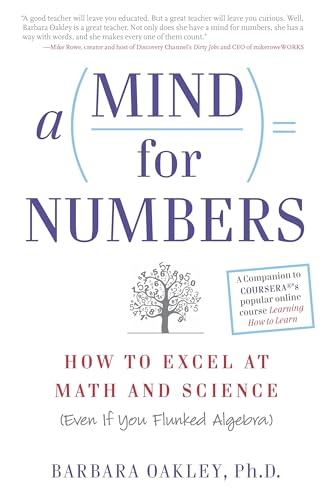
A Mind for Numbers: How to Excel at Math and Science
Dr. Barbara Oakley's actionable guide to unlocking analytical thinking. Perfect for students tackling STEM classes who want to beat procrastination and master complex formulas.
AI Study Pilot receives a small commission from qualifying Amazon purchases at no extra cost to you.Common mistakes
Keep an eye out for these classic pitfalls when studying soil phase relationships:
- Confusing void ratio (e) and porosity (n): Void ratio is divided by solid volume \(V_s\), meaning \(e\) can be greater than \(1.0\) (especially in organic clays). Porosity is divided by total volume \(V\), meaning \(n\) must always be strictly less than \(1.0\) (or \(100\%\)). Confusing these in equations like \(\gamma_d = \frac{G_s \gamma_w}{1+e}\) is extremely common.
- Neglecting the weight of air: Always remember that while air occupies volume (\(V_a\)), its weight is negligible (\(W_a = 0\)). Mixing up total weight \(W\) with solid weight \(Ws\) in dry conditions will lead to errors.
- Using incorrect density units: Geotechnical engineering uses both density (\(\rho\), in \(\text{g/cm}^3\) or \(\text{kg/m}^3\)) and unit weight (\(\gamma\), in \(\text{kN/m}^3\)). Remember that \(\gamma = \rho \cdot g\). Confusing these lead to incorrect constants (e.g., using \(\rho_w = 1000\text{ kg/m}^3\) when you need \(\gamma_w \approx 9.81\text{ kN/m}^3\)). Ask AI: "Quiz me Socraticly on the differences in equations when using mass density versus unit weights in soil mechanics. Guide me."
FAQ
- What is specific gravity of solids (Gs)? Specific gravity is the ratio of the unit weight of soil solids to the unit weight of water: \(G_s = \frac{\gamma_s}{\gamma_w} = \frac{W_s}{V_s \gamma_w}\). Typical values range between \(2.65\) and \(2.80\). Prompt: "Socraticly quiz me on how to calculate the volume of solids Vs given solid weight Ws, Gs, and the unit weight of water. Guide me."
- What does 100% saturation mean physically? A degree of saturation of \(100\%\) (\(S_r = 1.0\)) means that all void spaces are completely filled with water (\(V_w = V_v\), and \(V_a = 0\)). This is a two-phase soil system (solid and liquid), common below the water table. Prompt: "Act as a Socratic tutor. Quiz me on how a soil phase diagram simplifies when the soil is completely dry versus completely saturated. Guide me."
- Why is dry unit weight used to measure compaction? Dry unit weight measures the weight of soil solids packed into a unit volume. A higher dry unit weight indicates that the soil particles are more densely packed with fewer voids, which increases its load-bearing capacity and reduces permeability. Prompt: "Socraticly quiz me on how the moisture-density curve (Proctor test) determines the optimum moisture content for compaction. Guide me."
Final recommendation
Soil phase relationships form the foundation of geotechnical engineering. Avoid letting AI calculate parameters or fill out phase diagrams for you. Instead, sketch your three-phase blocks, write down your volume and weight boundaries, solve iterations step-by-step, and leverage Socratic AI sessions to audit your unit weights, specific gravity math, and unit conversions.
Disclosure: AI Study Pilot may add affiliate links later. We recommend free-first tools where possible and never promise guaranteed grades or outcomes.