Computer science · Updated June 2026
Learn Theory of Computation & Automata Theory with AI Safely
Master deterministic finite automata, context-free grammars, Turing machines, and pumping lemma proofs using Socratic AI prompting to learn theoretical computer science safely.
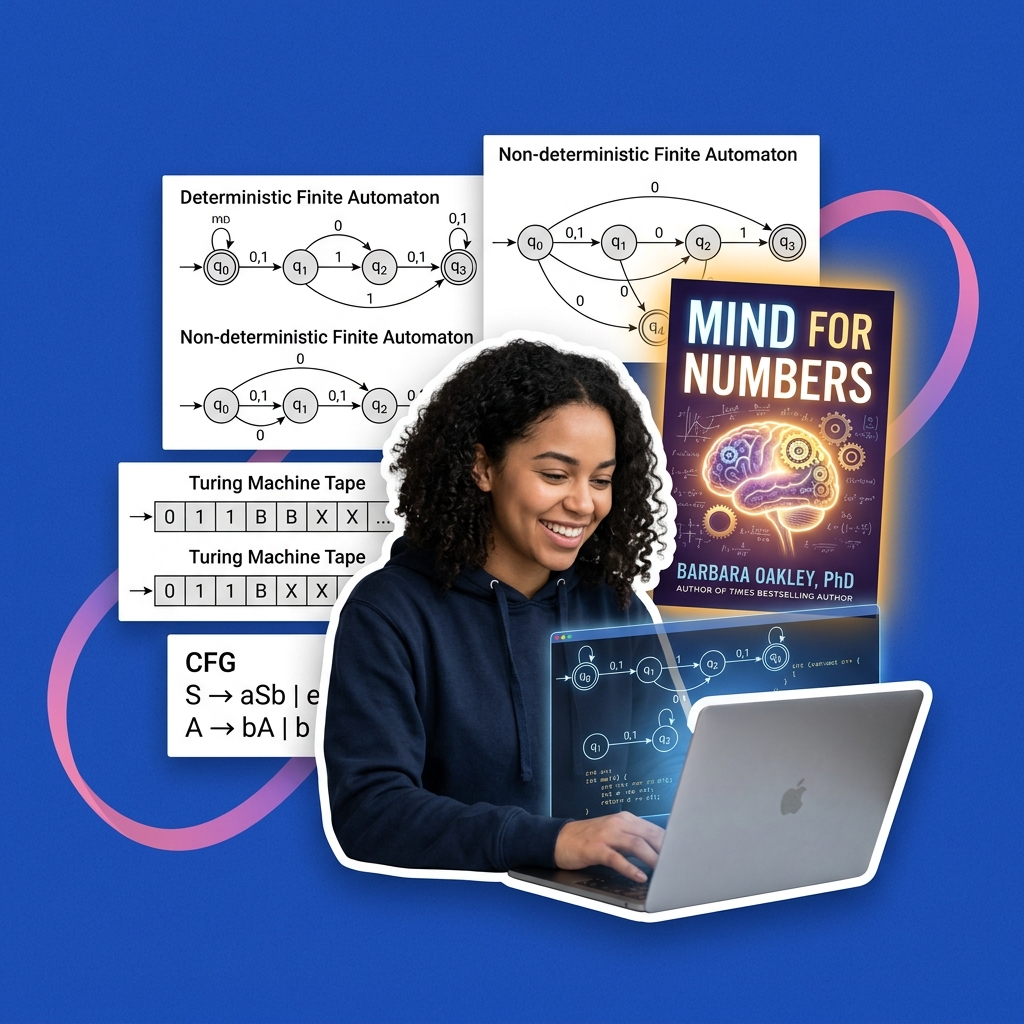
In theoretical computer science, the Theory of Computation explores the fundamental capabilities and limitations of computers. It is divided into three major branches: automata theory (the study of abstract machines and formal languages), computability theory (what can and cannot be solved by a computer), and complexity theory (how efficiently problems can be solved). The foundation of this field relies on formal languages and the mathematical machines that recognize them, progressing from Finite Automata (for regular languages) to Pushdown Automata (for context-free languages) and finally Turing Machines (for recursively enumerable languages).
Because theory of computation involves highly abstract mathematics, state transition diagrams, and formal mathematical proofs, students frequently copy complex languages (such as proving that $L = \{0^n 1^n \mid n \ge 0\}$ is not regular) into AI tools and ask them to write the proofs or draw the transition tables. However, letting AI write these formal proofs or design automata for you removes the rigorous logical reasoning needed to understand computational limits, compile code, or pass computer science theory exams. This guide outlines a safe, Socratic study workflow to use AI as an automata theory and computation coach.
Step 1: Designing Finite Automata (DFA and NFA) Socraticly
A Deterministic Finite Automaton (DFA) is formally defined as a 5-tuple $(Q, \Sigma, \delta, q0, F)$ where $Q$ is the set of states, $\Sigma$ is the alphabet, $\delta: Q \times \Sigma \to Q$ is the transition function, $q0 \in Q$ is the start state, and $F \subseteq Q$ is the set of accept states. A Non-deterministic Finite Automaton (NFA) allows transitions to multiple states or on empty string ($\epsilon$) inputs.
To design automata correctly, you must trace inputs step-by-step. Use this prompt to practice designing finite automata Socraticly:
I am designing a DFA over the alphabet {0, 1} that accepts only the strings that contain the substring '010'. Act as a Socratic automata tutor. Do not write the transitions or draw the state diagram. Ask me to identify the minimum number of states needed to track this substring, ask how to handle transitions that break the pattern, and guide me state-by-state to construct the transition table.Step 2: Proving Irregularity Using the Pumping Lemma
To prove that a language is not regular, computer scientists use the Pumping Lemma. It states that if a language $L$ is regular, there is a pumping length $p$ such that any string $w \in L$ with length $|w| \ge p$ can be split into three parts, $w = xyz$, satisfying:
- $y \ne \epsilon$ (the string to be pumped is non-empty)
- $|xy| \le p$ (pumping occurs within the first $p$ characters)
- For all $i \ge 0$, $xy^iz \in L$ (pumping $y$ any number of times stays in the language)
Students often get stuck choosing the string $w$ or proving the contradiction for all possible splits of $xyz$. Use this prompt to walk through a Pumping Lemma proof Socraticly:
I want to prove that the language L = {a^n b^n | n >= 0} is not regular using the Pumping Lemma. Act as a Socratic computer science professor. Do not write the proof or choose the string for me. Ask me to propose a string w of length >= p that is in L, ask me how the constraint |xy| <= p restricts where the y substring can lie, and guide me to show that pumping y down (i = 0) or up (i = 2) results in a string outside L.Step 3: Structuring Context-Free Grammars (CFGs) Socraticly
Context-Free Grammars (CFGs) define context-free languages and are used heavily in compiler design to specify the syntax of programming languages. A CFG is defined as $(V, \Sigma, R, S)$ where $V$ is a set of variables, $\Sigma$ is terminal symbols, $R$ is production rules, and $S$ is the start variable. Grammars require recursive definitions to handle matched structures (like nested parentheses or HTML tags).
Use this prompt to build your context-free grammar logic Socraticly:
I am trying to write a Context-Free Grammar for the language L = {0^n 1^(2n) | n >= 0}. Act as a Socratic compiler theory coach. Do not write the production rules or the grammar. Ask me how to define the base case string, ask how to design a recursive rule that adds one '0' on the left and two '1's on the right simultaneously, and guide me through verifying my grammar on sample strings.
A Mind for Numbers: How to Excel at Math and Science
Dr. Barbara Oakley's actionable guide to unlocking analytical thinking. Perfect for students tackling STEM classes who want to beat procrastination and master complex formulas.
AI Study Pilot receives a small commission from qualifying Amazon purchases at no extra cost to you.Common mistakes
Keep these typical theory of computation pitfalls in mind:
- Violating the DFA transition rule: Every state in a DFA must have exactly one outgoing transition for every symbol in the alphabet. If your alphabet is $\{0, 1\}$, a state cannot have two transitions on
0, nor can it have zero transitions on1. NFAs allow this, but DFAs do not. - Incorrectly assuming the partition in Pumping Lemma: When proving a language is non-regular, you cannot choose a specific split of $w = xyz$ (e.g., assuming $y = a^2$). You must show that a contradiction occurs for any partition of $w$ that satisfies the constraints $|xy| \le p$ and $y \ne \epsilon$.
- Confusing Decidability and Recognizability: A language is Turing-decidable (recursive) if some Turing Machine halts and accepts all strings in the language and halts and rejects all strings not in the language. A language is Turing-recognizable (recursively enumerable) if some Turing Machine halts and accepts strings in the language, but may loop infinitely on strings not in the language. AI tools frequently conflate these definitions.
FAQ
- What is the difference between DFA and NFA? A DFA has exactly one deterministic transition for each symbol from each state. An NFA can have zero, one, or multiple transitions, and can also make transitions without reading any input symbol ($\epsilon$-transitions). NFA and DFA are equivalent in power; any NFA can be converted to an equivalent DFA using the subset construction algorithm.
Prompt: "Socraticly quiz me on how the subset construction algorithm works to convert an NFA to a DFA and guide me through a small 3-state NFA example."
- What is the Pumping Lemma for Context-Free Languages? Similar to the regular pumping lemma, it states that any context-free language has a pumping length $p$ such that any string $w \in L$ with $|w| \ge p$ can be split into $w = u v x y z$ where $|vwy| \le p$, $vy \ne \epsilon$, and for all $i \ge 0$, $u v^i x y^i z \in L$.
Prompt: "Socraticly quiz me on the differences between the regular pumping lemma and the context-free pumping lemma. Guide me."
- What is the Halting Problem? The Halting Problem is a famous decision problem that asks whether a given computer program (Turing Machine) will finish running or run forever on a given input. Alan Turing proved that a general algorithm to solve the Halting Problem for all possible program-input pairs is mathematically impossible (undecidable).
Prompt: "Socraticly explain Alan Turing's diagonal proof of the undecidability of the Halting Problem. Ask me questions along the way to test my understanding of proof by contradiction."
Final recommendation
Theoretical computer science is built on absolute mathematical precision. Do not copy transition tables or pumping proofs from AI models. Instead, sketch your state transition paths manually, trace edge cases on paper, and leverage Socratic AI sessions to audit your DFA constraints, pumping lemma splits, and grammar structures.
Disclosure: AI Study Pilot may add affiliate links later. We recommend free-first tools where possible and never promise guaranteed grades or outcomes.