Engineering & mechanics · Updated June 2026
How to Learn Structural Analysis and Map Shear and Bending Diagrams With AI Safely
Master structural analysis and shear/bending diagram logic using Socratic AI coaching to map beam loadings, reactions, and internal forces safely.

In civil and mechanical engineering, mastering structural analysis is fundamental. Learning to draw Shear Force Diagrams (SFD) and Bending Moment Diagrams (BMD) is a core requirement in mechanics of materials and structural engineering classes. Because translating beam loads, point forces, and distributed pressures into shear and bending moment equations involves tedious calculus and algebra, many students copy load problems into AI tools to get instant diagrams.
However, letting AI draw the diagrams and write out the reactions prevents you from developing the spatial and mathematical intuition needed to solve complex loading scenarios during closed-book exams and in structural design work. This guide outlines a safe, active-learning study workflow to use AI as a Socratic engineering coach to master structural analysis and internal forces diagramming.
Step 1: Solving Support Reactions Socraticly
Before you can draw shear and bending diagrams, you must calculate the support reactions of the beam (e.g., hinge and roller forces for a simply supported beam). Instead of asking AI to calculate the reactions for you, use it to guide your setup and check your static equilibrium equations.
Set up a support reaction check using this prompt:
I am practicing calculating support reactions for a simply supported beam. The beam is 8 meters long. It has a pin support at the left end (Point A) and a roller support at the right end (Point B). There is a concentrated downward load of 12 kN at 3 meters from Point A, and a uniformly distributed load (UDL) of 4 kN/m acting on the rightmost 3 meters of the beam. Act as a Socratic structural analysis tutor. Do not solve for the reactions. Ask me to list the static equilibrium equations I need to use, and prompt me to write my sum of moments about Point A. Evaluate my work and guide me with hints.Step 2: Deriving Shear Force and Bending Moment Equations
After calculating the support reactions, you must section the beam to write equations for shear force (V) and bending moment (M) as functions of position (x) along the beam. This is where many algebraic errors happen.
Practice writing section equations with this prompt:
I have solved the support reactions for the 8m beam: Reaction A is 10.25 kN and Reaction B is 13.75 kN. I am sectioning the beam in the first interval (x from 0 to 3m) to find the equations for V(x) and M(x). Act as a Socratic engineering coach. Do not write the equations for me. Ask me to draw the imaginary cut, label the internal forces, and write the equilibrium equations for this section. Guide me with hints to make sure I use the correct sign convention.Step 3: Verifying the Diagrams and Key Points
Shear and bending moment diagrams are graphical representations of your V(x) and M(x) equations. Key points include where shear force passes through zero (which corresponds to local maximum or minimum bending moments) and points of inflection.
Audit your diagram drawings using this prompt:
I have drawn my shear force and bending moment diagrams. I found that the shear force drops to zero at x = 3m, and my maximum bending moment occurs at x = 3m with a value of 30.75 kNm. I want to verify if my diagram curves are qualitatively correct. Act as a Socratic structural analysis tutor. Do not write down the correct values or draw the curves. Ask me to describe the shapes of the curves (e.g., linear, parabolic, cubic) in each interval of the beam, and explain the physical reason why the curve shapes change. Guide me with hints.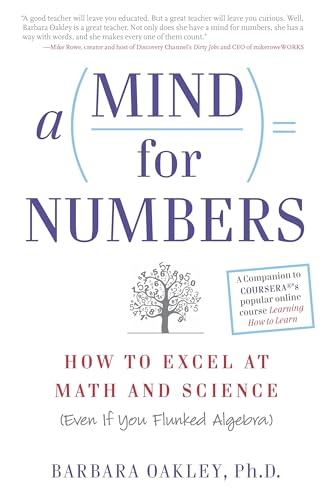
A Mind for Numbers: How to Excel at Math and Science
Dr. Barbara Oakley's actionable guide to unlocking analytical thinking. Perfect for students tackling STEM classes who want to beat procrastination and master complex formulas.
AI Study Pilot receives a small commission from qualifying Amazon purchases at no extra cost to you.Common mistakes
Keep these pitfalls in mind when using AI for structural engineering:
- Defaulting to incorrect sign conventions: Standard structural textbooks (e.g., Hibbeler vs. Beer & Johnston) sometimes use slightly different positive sign conventions for shear and bending moments. AI tools can mix these up. Always clarify your specific convention in your prompts.
- Copying visual diagrams directly: Image-to-text AI models can misinterpret force vectors or line coordinates. Always confirm loading values and support types in plain text to ensure the Socratic coach has accurate inputs.
- Skipping shear-bending calculus verification: Bending moment is the integral of the shear force. AI tools can sometimes provide numbers that violate this calculus relation. Always ask the AI to check your math against basic integration rules: "Verify if the area under my shear curve between x = 0 and x = 3 matches my change in bending moment. Ask me to calculate it and guide me with hints."
FAQ
- How can I use AI to study shear and moment diagrams for cantilever beams? Cantilever beams have a fixed support at one end, which introduces a vertical reaction force and a reaction moment. Ask the AI: "Guide me through setting up the boundary conditions and drawing the shear and moment diagrams for a cantilever beam. Do not give the answers; ask me about the internal shear and moment at the free end first."
- Can AI help me learn truss analysis methods (joints vs. sections)? Yes. Use AI to check your truss zero-force member identification by prompting: "Quiz me on zero-force members for a Warren truss layout. Ask me to explain the rule I am using to find them, and evaluate my reasoning with hints."
- How do I verify structural deflection formulas with AI? Beam deflection involves double integration of the bending moment equation. Ask AI to check your boundary condition setups (e.g., deflection is zero at supports) rather than solving the final integration equation for you.
Final recommendation
Mastering shear and bending diagrams is the foundation for analyzing structural safety and material stresses. Draw your diagrams carefully on paper to build your geometric intuition, write your static equilibrium steps in a structured engineering notebook, and use Socratic AI checks to audit your analytical equations and boundary conditions.
Disclosure: AI Study Pilot may add affiliate links later. We recommend free-first tools where possible and never promise guaranteed grades or outcomes.