Career preparation · Updated June 2026
How to Use AI to Tailor Your Resume and Cover Letter Safely
Learn how to use AI safely to edit resume bullet points, align your experience with job descriptions, and write cover letters in your own voice.
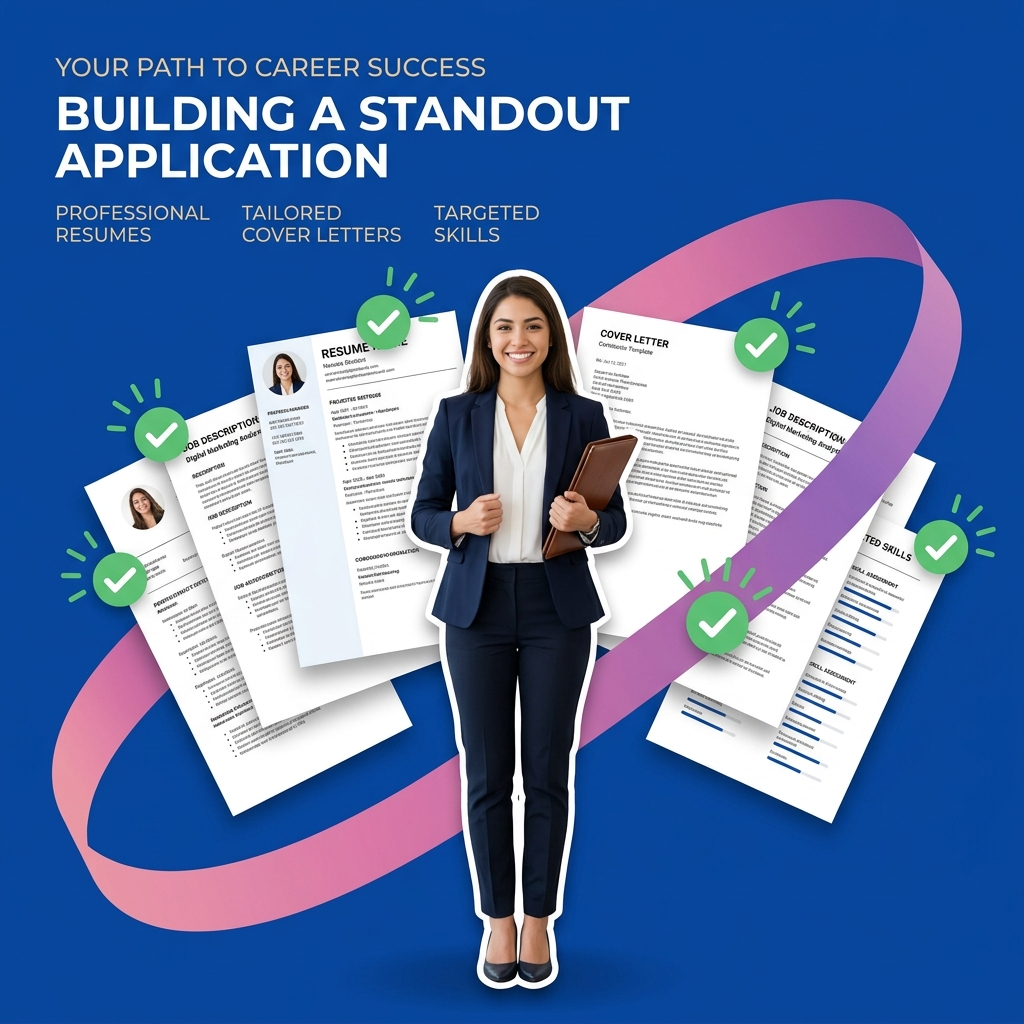
As a college student or recent graduate applying for internships and entry-level jobs, the application process can feel like a numbers game. To stand out, you are told to tailor your resume and cover letter for every single job description to pass Applicant Tracking Systems (ATS) and catch a recruiter's eye.
Tailoring multiple applications manually takes hours. Rushing to use AI to generate entire resumes or write generic cover letters, however, is a major career risk.
AI-generated resumes are easy to spot—they are often packed with buzzwords, boilerplate phrases, and, worse, fabricated projects or skills that you cannot explain during a live interview. Recruiters value authenticity and concrete achievements above all else.
Instead of letting AI write your applications, use it as a strategic editor to help you align your real experiences with job requirements, polish your bullet points, and structure your cover letters in your own voice.
A Safe, Authentic Career Workflow
To use AI safely and ethically during your job hunt, follow this three-step editing workflow:
1. The Bullet Point Action-Verb Polish
Your resume bullet points should show your impact using the Action-Verb + Task + Result framework (often called the STAR method). If your bullets feel passive (e.g., "Responsible for answering customer emails"), paste them into the AI and ask it to suggest three active, impact-focused variations using your actual outcomes.
2. Job Description Keyword Alignment
Paste the target job description and your current resume section into the AI. Ask the AI to identify the top three technical skills or responsibilities in the job description that are missing or underrepresented in your resume. Use this feedback to rewrite your bullet points yourself, ensuring you only include skills you actually possess.
3. Authentic Cover Letter Structuring
A great cover letter explains why you want to work at a specific company and how your background fits the role. Do not ask AI to "write a cover letter for me." Instead, share your background and the job description, and ask the AI to suggest a structured outline for your letter, highlighting which of your experiences to pair with specific company initiatives.
---
Job Application Prompts You Can Copy
Use these optimized prompt templates to speed up your application tailoring:
For Editing Resume Bullet Points
I am tailoring my resume. Here is a bullet point from my previous internship: [Insert Bullet, e.g., "I helped manage the social media accounts and posted updates"]. I want to make this bullet point more impactful using action verbs. Can you suggest three stronger variations? Do not exaggerate my duties; just improve the phrasing.For Keyword Gap Analysis
Here is a job description for an entry-level software engineering internship: [Paste Job Description]. Here is my current list of skills and projects: [Paste Projects/Skills]. Act as a career coach. What are the top three technical keywords or concepts in the job description that I should make sure to highlight in my project descriptions? Only suggest skills that align with my background.For Structuring a Cover Letter
I am writing a cover letter for a data analyst position at [Company Name]. Here is the job description: [Paste Job Description] and here is my background: [Insert your major, key projects, or work history]. Please suggest a 4-paragraph outline for my cover letter, telling me exactly what experience to focus on in each paragraph to align with the company's requirements. Do not write the letter itself.---
Common Career Study Mistakes to Avoid
* Allowing AI to Lie or Hallucinate: If you ask an AI to write a bullet point for a project, it might add technologies or outcomes you never worked with. You must defend your resume in interviews; if you can't explain how a database was configured, you will fail the technical screening.
* Using Boilerplate AI Openings: Avoid cover letters that begin with "I am writing to express my enthusiastic interest in the..." or use terms like "synergy," "tapestry," or "delve." Write in a clean, professional, conversational human tone.
* Failing to Fact-Check the Company: If you use AI to research a company for your cover letter, always verify the facts on the company's official website. AI tools can easily hallucinate company values, past acquisitions, or product names.
---
How to Become a Straight-A Student
A strategic study blueprint designed specifically for college students. Demystifies top performance and shows how to prepare for exams efficiently without cramming.
AI Study Pilot receives a small commission from qualifying Amazon purchases at no extra cost to you.FAQ
Will using AI to write my resume get me filtered out by ATS?
Most ATS systems do not filter out resumes simply because they contain AI-assisted phrasing. However, they do scan for relevance. If your resume is filled with generic AI-generated keyword stuffing that doesn't match your actual experience, human recruiters will quickly filter you out during the manual review.
How do I describe my projects on a resume?
Use the STAR method: Situation, Task, Action, Result. For example: "Designed a database schema (Situation/Task) using PostgreSQL, reducing query latency by 15% (Action/Result)." Ask the AI to help you format your raw project details into this structure.
Should I disclose to recruiters that I used AI for my application?
You do not need to formally disclose that you used AI as a grammar editor or outline planner. However, you must be the sole author of the content. If you cannot speak deeply and authentically about every word on your application, it means you relied too heavily on automation.
Disclosure: AI Study Pilot may add affiliate links later. We recommend free-first tools where possible and never promise guaranteed grades or outcomes.