Interview prep · Updated May 2026
How to Use AI to Prep for Technical Coding Interviews Safely
Learn how to use AI coding models to understand algorithms, practice mock interviews, and build problem-solving frameworks safely.
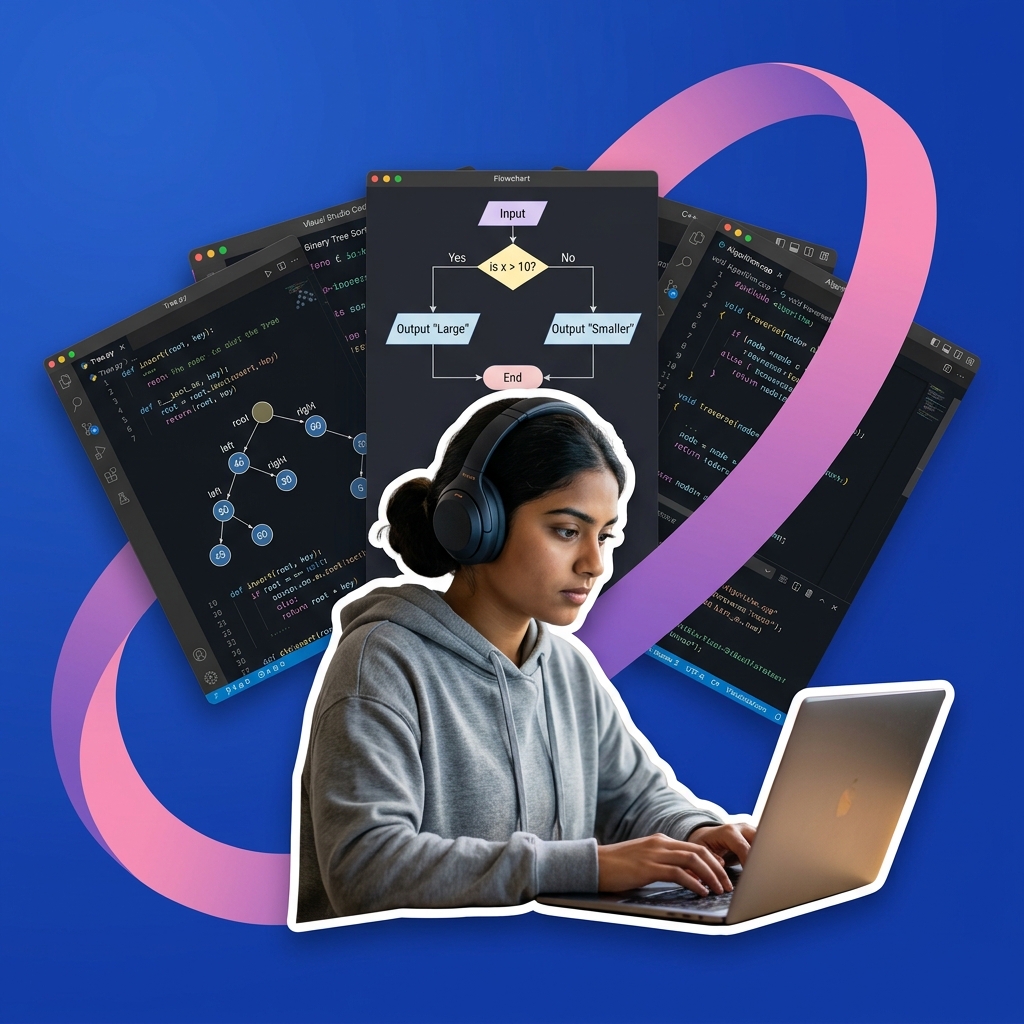
Securing a software engineering internship or entry-level role requires passing technical coding interviews. These interviews evaluate your understanding of data structures, algorithm design, and how you articulate your problem-solving process under pressure.
Many computer science students turn to AI models to help them solve LeetCode problems.
However, copy-pasting solutions from AI directly into your code editor does not prepare you for live interviews. If you cannot explain the time complexity (Big O notation) or describe how you would optimize your solution to a real interviewer, you will fail the assessment. The key to using AI for interview prep is treating it as a conversational mock interviewer and hint coach.
Technical coding interview prep workflow with AI
- Choose a target algorithm: Focus on a specific category (e.g., dynamic programming, sliding window, graph traversals).
- Engage the AI as a hint-based mentor: Instruct the AI to act like a tech interviewer, providing clues and edge cases rather than code.
- Practice explaining code aloud: Speak your reasoning process aloud as you draft your solution.
- Isolate your workspace for deep practice: Use active noise-cancelling headphones to keep your mind locked in on the problem, blocking out ambient noise.
- Request time complexity analysis: Once you solve the problem, ask the AI to verify your time and space complexity models.
Deep focus blocks and quiet workspaces
Solving algorithmic puzzles requires massive working memory. A single distraction can break your train of thought, forcing you to restart your analysis from scratch.
To maximize the output of your practice blocks, isolate your study space. Putting on active noise-cancelling headphones (such as the Soundcore Space Q45 headphones) isolates you from dorm or library distractions, signal-focusing your brain on coding. Alternating 50-minute intense coding sprints with visual timer breaks builds the mental endurance needed for 45-minute live technical interviews.
Step 1 — Setup the "Hint-Only Interviewer" prompt
To prevent the AI from immediately showing you the solution, use this prompt to enforce a structured interview setting:
Act as a senior software engineer conducting a technical mock interview. I want to practice solving a [Algorithm Category, e.g., Linked List cycle detection] problem.

Please follow these rules:
1. Provide the problem description and one example input/output.
2. Do not write any code solutions or suggest specific libraries.
3. If I ask for help, do not give me the code. Instead, give me a single conceptual hint or suggest an edge case to think about (e.g., empty inputs, single element lists).
4. Ask me to explain my approach first before I type any code.

Let's begin! Present the problem.
This simulates the real interview environment, where communication and logic are evaluated alongside syntax.
Step 2 — Talk through your approach
Before writing any code, type out your proposed strategy in bullet points and ask the AI to review your logic:
Here is my proposed approach: I will use a two-pointer method (slow and fast pointers) to traverse the list. If there is a cycle, the fast pointer will eventually catch up to the slow pointer. Does this approach have any major logical flaws?Step 3 — Dry-run code on paper or IDE
Write out your code solution. If you run into syntax errors or logic bugs, do not paste the code to have AI rewrite it. Instead, paste the bug and ask for the why:
My code is returning an AttributeError: 'NoneType' object has no attribute 'next'. Without showing the corrected code, explain why this error occurs in a two-pointer linked list traversal and what null checks I might have missed.This guides you to fix the bug yourself, building critical debugging skills.
Common interview prep mistakes to avoid
* Memorizing solutions: Interviewers frequently tweak standard LeetCode problems. If you memorize the exact solution instead of learning the underlying data structure pattern, you will struggle with minor variations.
* Failing to speak aloud: Tech interviewers evaluate your thought process. Practice explaining your logic aloud while solving problems on your own.
* Ignoring space complexity: Many students optimize only for speed (time complexity) and forget that memory utilization (space complexity) is equally critical in production environments. Always analyze both.

Soundcore Space Q45 Noise-Cancelling Headphones
Premium hybrid active noise-cancelling headphones. Ideal for study sessions in noisy dorms, libraries, or cafes, keeping your focus isolated on your learning.
AI Study Pilot receives a small commission from qualifying Amazon purchases at no extra cost to you.Disclosure: AI Study Pilot may add affiliate links later. We recommend free-first tools where possible and never promise guaranteed grades or outcomes.