Productivity · Updated June 2026
AI Weekly Review Routine for Students: Fix Weak Spots Before Exams
A 30-minute weekly AI review routine that helps students find weak spots, plan study blocks, and prevent small confusions from becoming exam-week panic.
Introduction
Most exam panic is not caused by one bad night. It builds quietly when small confusions pile up for weeks. You miss one lecture point, skim one hard reading, get one quiz question wrong, and move on. By the time the test appears, the weak spots feel huge.
A weekly review routine fixes that. With AI, you can turn scattered notes, quiz mistakes, deadlines, and confusing topics into a short action plan. The point is not to let AI run your semester. The point is to spend 30 honest minutes asking: what did I learn, what is still unclear, and what should I study next?
Quick answer
Once a week, paste a brief summary of your classes, assignments, missed questions, and confusing topics into AI. Ask it to sort your week into wins, weak spots, urgent deadlines, and a realistic study plan. Verify the plan against your syllabus, then schedule only the next 3-5 actions. Keep it private, never upload sensitive classmate information, and use it to guide your own studying — not to excuse skipping the work.
The 30-minute weekly review
Use this on Friday afternoon, Sunday evening, or any repeatable time. The routine works best when it is short enough to actually repeat.
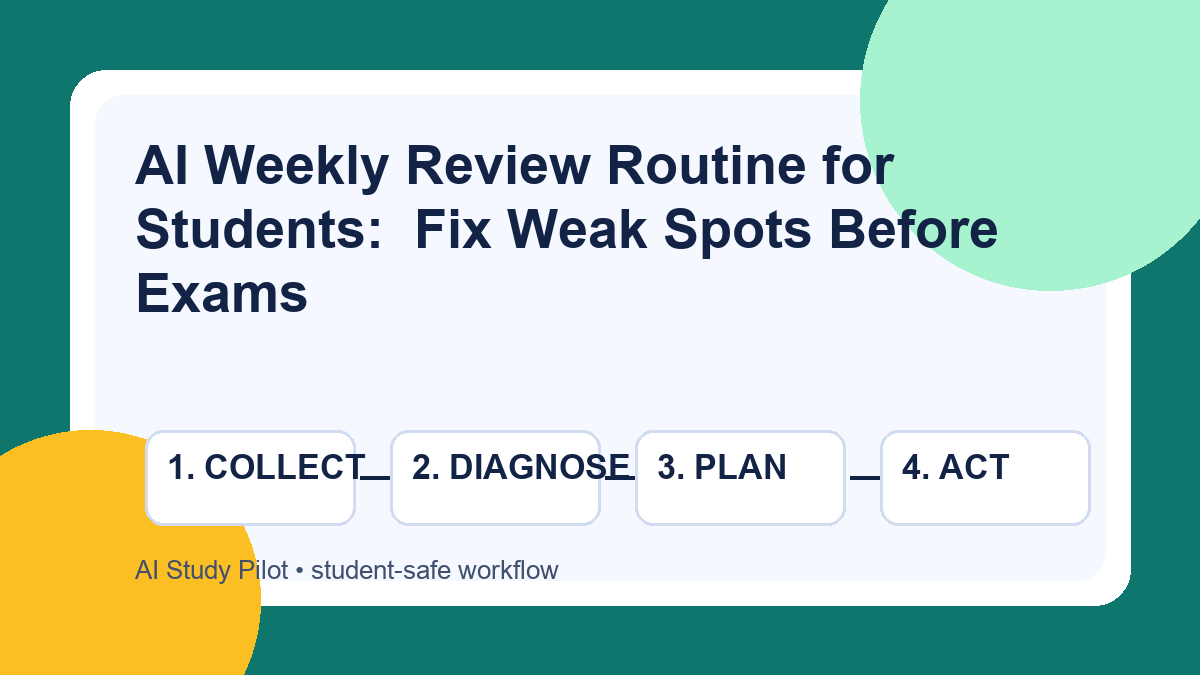
- Collect for 10 minutes: notes, deadlines, quiz mistakes, readings, lab tasks, confusing topics.
- Diagnose for 8 minutes: identify what is weak, late, risky, or still fuzzy.
- Plan for 7 minutes: choose the next few study blocks and practice tasks.
- Reset for 5 minutes: clean your workspace, file notes, and decide the first action.
If you already use our personalized weekly study schedule, this routine is the reflection layer that makes next week's schedule smarter.
What to collect before prompting
Do not paste your entire life into the chatbot. A compact weekly snapshot is enough:
- upcoming deadlines from your syllabus or LMS;
- quiz questions you missed, rewritten in your own words;
- lecture topics that felt confusing;
- readings you did not finish;
- notes that are messy or incomplete;
- commitments that limit study time next week.
Avoid uploading private classmate messages, graded feedback that your school treats as confidential, or sensitive personal details. When in doubt, use the AI privacy checklist.
Copy-ready weekly review prompt
You are helping me do a weekly student review. Do not do my assignments.
Help me identify weak spots, plan study time, and choose next actions.

MY WEEK:
Courses: [list]
Deadlines next 14 days: [list]
What I understood well: [bullets]
What confused me: [bullets]
Quiz/homework mistakes: [bullets, no private data]
Available study blocks next week: [times]
Constraints: [work, commute, family, etc.]

Create:
1. A short summary of the week.
2. My top 5 weak spots, ranked by exam/assignment risk.
3. The next action for each weak spot.
4. A realistic 7-day study plan using only my available blocks.
5. Two questions I should ask my instructor, tutor, or study group.
6. One thing I should stop doing next week.

Keep the plan realistic. If there is too much to do, tell me what to cut.
How to diagnose weak spots
A good weekly review separates different kinds of problems. "I am bad at chemistry" is not actionable. "I can set up stoichiometry but miss limiting reactants" is actionable. Ask AI to label each weak spot as one of these:
- Memory gap: you forgot a term, formula, date, or definition.
- Concept gap: you cannot explain why something works.
- Process gap: you know the idea but cannot complete the steps.
- Source gap: your notes are missing the key explanation.
- Time gap: you understand the work but did not schedule enough practice.
Then choose the matching response. Memory gaps need recall. Concept gaps need explanation and examples. Process gaps need worked practice. Source gaps need better notes or office hours. Time gaps need a calendar change.
Turn the review into practice
The review is useless unless it changes what you do next. For memory gaps, make flashcards with the AI flashcard workflow. For process gaps, create a small practice exam from class notes. For messy material, turn it into a study guide from your notes.
Based on this weekly review, create a 25-minute practice block for my weakest topic.
Include: 5-minute review, 15-minute active practice, 5-minute error check.
Do not give me final answers first. Ask me to attempt, then show the explanation.
A simple weekly review checklist
- Did I check the syllabus and deadlines myself?
- Did I resolve or schedule every urgent weak spot?
- Did I convert at least one weak topic into active recall?
- Did I identify one question for a human expert?
- Did I avoid adding more tasks than I can actually do?
- Did I choose the first study block for next week?
Academic-integrity boundaries
This routine should not produce graded submissions. It can help you reflect, plan, and practice. It should not write discussion posts for you, solve locked quiz questions, or create excuses for missing work. If a prompt starts moving from planning into submitting, pause and check the rules in our cheating guide.
Common mistakes
- Reviewing only deadlines. Deadlines matter, but weak concepts are what hurt exam scores.
- Letting AI over-plan. A beautiful 14-hour plan fails if you only have six hours.
- Skipping missed questions. Mistakes are the highest-value data you have.
- Never asking humans. AI can help diagnose confusion, but instructors know the course.
- Changing systems weekly. Keep one routine long enough to learn from it.
FAQ
How long should a weekly review take?
Thirty minutes is enough for most students. If it takes longer, you are probably rewriting notes instead of reviewing them.
Should I do this for every class separately?
Start with one combined review, then split out a class only if it has a major exam, lab, or project.
Can AI make my weekly schedule automatically?
It can draft one, but you must check it against real deadlines, energy, commute time, and course priorities. See the weekly study schedule guide for the planning layer.
Final recommendation
Set a recurring 30-minute review. Bring your weak spots, missed questions, and deadlines. Ask AI to organize them, then choose a few realistic actions. Small weekly course corrections beat heroic exam-week rescue plans.
Disclosure: AI Study Pilot may add affiliate links later. We recommend free-first tools where possible and never promise guaranteed grades or outcomes.