Chemistry & pre-med · Updated June 2026
How to Solve Acid-Base Equilibria and Buffer Calculations With AI Safely
Master chemical equilibria and buffer calculations using Socratic AI coaching to map ICE tables, Henderson-Hasselbalch equations, and acid-base reactions safely.
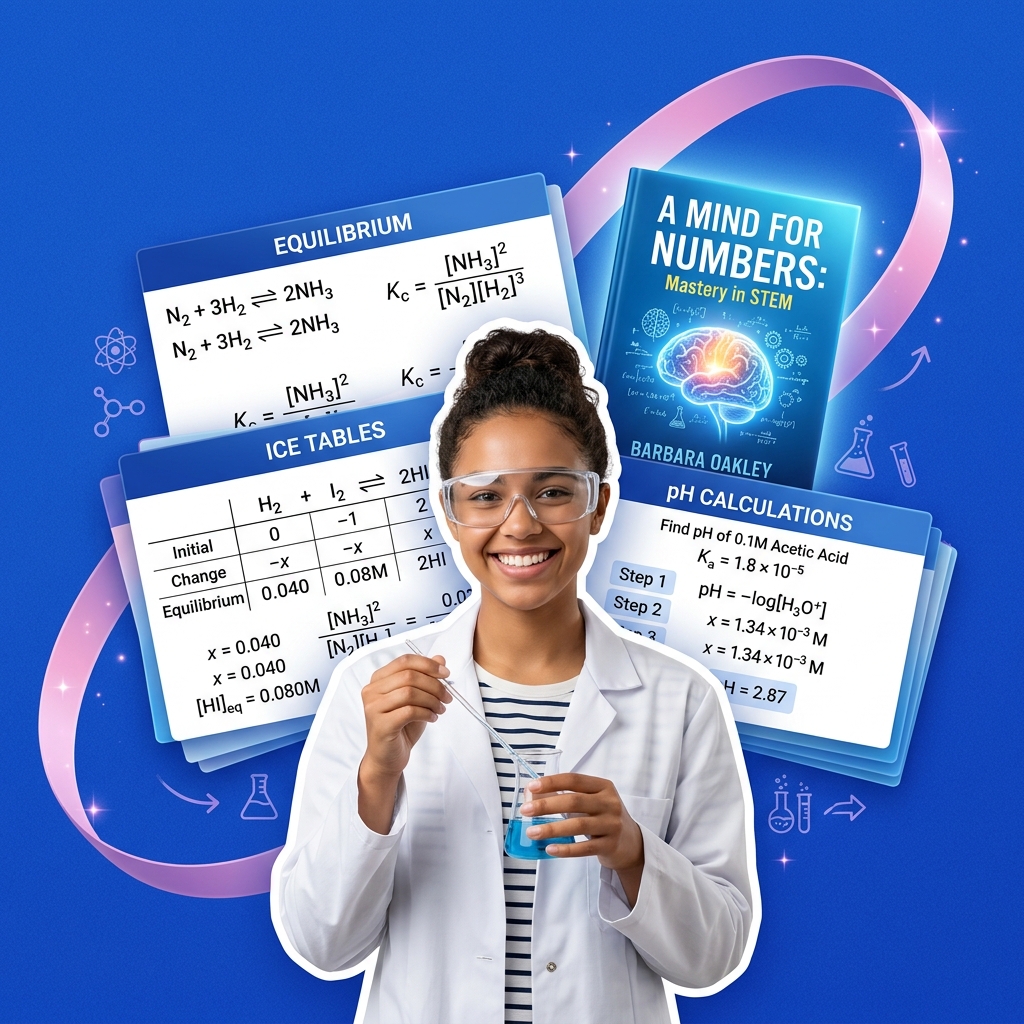
In general chemistry, mastering chemical equilibria is a significant milestone. Solving weak acid or weak base problems requires using ICE (Initial, Change, Equilibrium) tables, translating concentrations into equilibrium constant (Ka or Kb) expressions, and determining the pH. When buffers are introduced—solutions of weak conjugate acid-base pairs that resist pH changes—calculations involve the Henderson-Hasselbalch equation and stoichiometry. Because solving equilibrium equations requires multiple mathematical setups and algebraic approximations, many students copy homework problems into AI tools to get quick numerical answers.
However, letting AI fill out ICE tables and calculate pH for you prevents you from building the diagnostic and mathematical skills needed to succeed in advanced chemistry coursework (like analytical chemistry or biochemistry) and on the MCAT or PCAT. This guide outlines a safe, active-learning study workflow to use AI as a Socratic chemistry coach to master acid-base equilibria and buffer calculations.
Step 1: Setting Up the ICE Table Socraticly
For weak acid or base solutions, you must define the dissociation reaction and set up an ICE table to track concentrations. A common mistake is setting up the table with incorrect stoichiometric coefficients or mixing up weak acids with strong acids. Instead of asking AI to solve the ICE table for you, use it to verify your setup.
Set up an ICE table check using this prompt:
I am practicing setting up an ICE table for a weak acid solution. The solution is 0.15 M nitrous acid (HNO2), which has a Ka = 4.0 x 10^-4. Act as a Socratic chemistry tutor. Do not write out the ICE table or calculate the pH. Ask me to write the chemical equation for the dissociation of nitrous acid in water, and prompt me to explain what values go into the Initial row. Evaluate my answer and guide me with hints.Step 2: Evaluating the 5% Approximation Rule
When solving for the change in concentration (x) in the Ka expression, you get a quadratic equation: Ka = (x^2) / (C - x). In many cases, if the initial concentration (C) is much larger than Ka, you can approximate C - x as C to avoid using the quadratic formula. You must verify if this approximation is valid (the 5% rule).
Practice checking the approximation with this prompt:
In my nitrous acid ICE table, my Ka expression is 4.0 x 10^-4 = (x^2) / (0.15 - x). I want to use the approximation that 0.15 - x is approximately 0.15 to solve for x. Act as a Socratic chemistry coach. Do not solve for x or state if the approximation is valid. Ask me how to set up the simplified equation, how to calculate x, and how to verify if the 5% rule is satisfied. Evaluate my answers and guide me with hints.Step 3: Performing Buffer and Henderson-Hasselbalch Calculations
A buffer solution contains a weak acid and its conjugate base. When strong acid or base is added, you first perform stoichiometry to find the new concentrations, then use the Henderson-Hasselbalch equation: pH = pKa + log([conjugate base] / [weak acid]).
Check your buffer calculations using this prompt:
I am calculating the pH of a buffer solution containing 0.20 M acetic acid (CH3COOH) and 0.15 M sodium acetate (CH3COONa). The pKa of acetic acid is 4.76. I want to calculate the pH of the buffer, and then determine the new pH after adding 0.02 M of a strong base (NaOH). Act as Socratic chemistry tutor. Do not calculate the pH or write the equations. Ask me to state the Henderson-Hasselbalch equation and explain how the addition of the strong base affects the concentrations of acetic acid and acetate. Guide me with hints.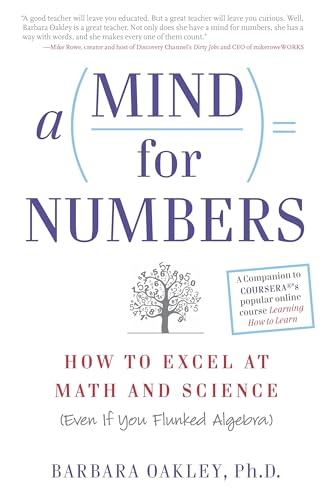
A Mind for Numbers: How to Excel at Math and Science
Dr. Barbara Oakley's actionable guide to unlocking analytical thinking. Perfect for students tackling STEM classes who want to beat procrastination and master complex formulas.
AI Study Pilot receives a small commission from qualifying Amazon purchases at no extra cost to you.Common mistakes
Keep these pitfalls in mind when using AI for general chemistry:
- Forgetting that strong salts fully dissociate: When sodium acetate (CH3COONa) is added to a solution, it dissociates completely into Na+ and CH3COO-. The Na+ is a spectator ion, and the conjugate base is CH3COO-. AI tools sometimes treat salts as weak electrolytes; make sure your Socratic prompt specifies that the salt dissociates completely.
- Relying on AI for logarithms and arithmetic: AI language models frequently make arithmetic mistakes when calculating negative logarithms (-log[H+]) or taking powers of ten. Always perform the final arithmetic calculation on your own scientific calculator.
- Confusing Ka and Kb: For weak base calculations, you must use Kb and solve for pOH first, then find pH (pH = 14 - pOH). AI tools often mix up Ka and Kb or directly calculate pH as if it were an acid. Verify your steps by prompting: "I am solving a weak base equilibrium for ammonia. Ask me if I should use Ka or Kb, and how to relate pOH to pH. Guide me with hints."
FAQ
- How can I use AI to study acid-base titrations? Titrations involve calculating pH at different points (initial, before equivalence, equivalence, and after equivalence). Ask the AI: "Guide me through calculating the pH at the equivalence point of a weak acid-strong base titration. Do not give the answer; ask me about the hydrolysis of the conjugate base at this point and guide me Socraticly."
- Can AI help me study polyprotic acids (acids with multiple protons)? Yes. Polyprotic acids (like H2SO3 or H3PO4) dissociate in steps, each with its own Ka. Prompt: "Quiz me on why we can usually ignore the second dissociation step (Ka2) when calculating the pH of a diprotic acid. Guide me Socraticly with hints."
- How do I verify buffer capacity with AI? Buffer capacity is the amount of acid/base a buffer can absorb before pH changes significantly. Ask AI to check your conceptual understanding of how buffer concentration impacts capacity rather than asking it to calculate specific capacities.
Final recommendation
Solving equilibrium and buffer problems requires a methodical, step-by-step approach. Write out your chemical reactions clearly, construct initial-change-equilibrium (ICE) tables on paper to track concentrations, and use Socratic AI checkpoints to audit your algebraic assumptions, Henderson-Hasselbalch setups, and chemical rationales.
Disclosure: AI Study Pilot may add affiliate links later. We recommend free-first tools where possible and never promise guaranteed grades or outcomes.