Subject workflow · Art history
How to Use AI to Study Art History and Visual Analysis
Use AI to practice art-history visual analysis without inventing facts: observation, context, comparison, thesis, and source checks.
Quick answer
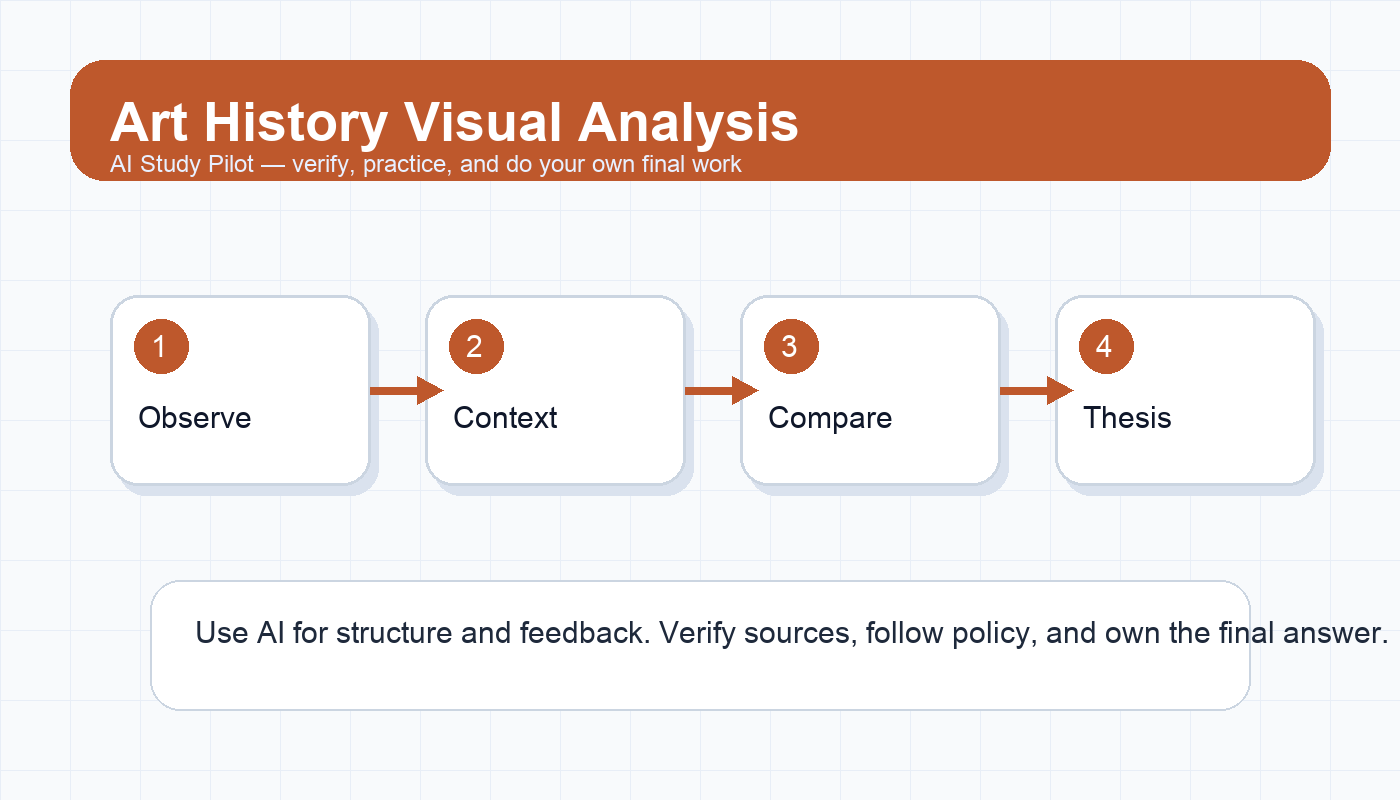
Use AI for art history as a visual-analysis coach: list what you observe, ask for questions that deepen formal analysis, compare your notes with course concepts, and practice explaining how visual evidence supports a thesis. Do not ask AI to identify an artwork from a low-quality image and trust the result, invent museum labels, fabricate historical context, or write the final essay for you. Art history rewards careful looking and source-grounded interpretation.
This workflow pairs well with AI literature analysis and close reading, AI history primary-source analysis, and AI outline help for humanities research papers.
Why art history is a good AI study use case
Art history has a skill gap that AI can support without replacing the student: moving from “I see a painting” to a disciplined description of composition, color, line, scale, material, iconography, patronage, period, and argument. Many students jump too quickly to biography or symbolism. AI can slow the process down by asking better questions.
The danger is that visual AI and chatbots can be confidently wrong. They may misidentify works, confuse artists, invent dates, or apply generic symbolism. That is why this workflow starts with your own observation and course materials. AI is the coach, not the authority.
The four-step workflow
- Step: Observe · Student job: Describe what is visible · AI job: Ask formal-analysis questions
- Step: Context · Student job: Add course facts and readings · AI job: Organize facts without inventing
- Step: Compare · Student job: Notice similarities and differences · AI job: Build a comparison grid
- Step: Thesis · Student job: Make an argument · AI job: Test whether evidence supports it
Copy-ready prompt: visual-analysis coach
You are my art-history study coach. Do not identify the artwork or invent historical facts. Use only the observations and course notes I provide.

Artwork or object:
[paste title/artist/date only if confirmed by class, museum, or textbook]

My visual observations:
[paste what I can see: composition, color, figures, space, material, line, light, scale]

Course concepts or reading notes:
[paste relevant notes]

Help me:
1. Sort my observations into formal-analysis categories.
2. Ask 8 questions that would make my looking more precise.
3. Identify which observations could support an interpretation.
4. Flag any claim that needs a source check.
5. Suggest a thesis pattern I can complete in my own words.

Do not write the essay for me.
Step 1: describe before interpreting
Start with visible facts. What is in the image? Where is your eye pulled first? How are figures arranged? What colors dominate? Is the space shallow or deep? Is the surface smooth, textured, flat, carved, assembled, or photographic? What is large, small, centered, cropped, repeated, hidden, or emphasized?
AI can turn a messy observation list into categories, but it should not replace looking. If you upload or describe an image, do not assume the model sees every detail accurately. Your class image, museum page, or textbook caption is the source for identification.
Step 2: add verified context
Context includes artist, date, place, medium, patron, movement, religious or political setting, and course themes. Only add context from sources you can verify: lecture slides, assigned readings, museum pages, catalog entries, or scholarly sources. Ask AI to organize your notes into “known facts,” “interpretive possibilities,” and “questions to verify.”
This prevents a common problem: writing a confident paragraph about symbolism that was never established. If a claim is not in your notes or a credible source, mark it as a question.
Step 3: build a comparison grid
Art history exams often ask you to compare two works. AI is useful for making a grid from your notes. Use columns like composition, material, patronage, period, viewer experience, subject matter, and argument. Then write one sentence about what the comparison reveals.
For example, a comparison should not stop at “both use light.” It should ask how light functions differently: to create drama, guide devotion, reveal anatomy, flatten space, signal modernity, or shape the viewer’s movement. The grid helps you move from observation to interpretation.
Step 4: practice thesis statements
A strong visual-analysis thesis makes a claim about how visual choices create meaning. It does not simply announce a topic. Ask AI to test your thesis by listing the exact visual evidence required. If the evidence list is thin, revise the thesis.
Safer thesis pattern:
In [work], [artist or culture] uses [visual feature 1], [visual feature 2], and [material/compositional choice] to [interpretive claim], which matters because [course theme or historical context].Fill the pattern yourself. Then check whether every phrase has evidence.
Academic integrity guardrails
Do not submit AI-written visual analysis as your own. Do not use AI to fabricate museum-label information, citations, or historical context. Do not bypass required viewing, readings, or image-identification practice. If your professor asks for unaided slide-identification work, follow that rule.
Use AI for studying: practice questions, outline feedback, comparison grids, vocabulary review, and source-check reminders. Keep final interpretation grounded in what you see and what your course materials support.
Common mistakes
- Starting with symbolism before describing the object.
- Treating AI identification as reliable without checking the museum, textbook, or lecture source.
- Using biography as filler instead of visual evidence.
- Making a thesis that could apply to any artwork.
- Forgetting medium, scale, and viewer experience.
Practice drill for slide exams
For slide exams, build short practice cards that test observation before identification. Put the image or title on one side and answer four prompts on the other: visible evidence, likely period or movement, one comparison work, and one source-backed context point. If your instructor requires memorized identifications, follow that requirement, but do not let AI guess on your behalf. Use AI to generate the practice questions after you provide the confirmed title list from class.
One useful drill is the “two-minute looking” exercise. Set a timer, write ten visible details without interpretation, then ask AI to group those details into composition, material, space, figure, color, and viewer experience. Finally, write one sentence connecting three details to a course theme. This keeps AI in the coaching role while training the visual attention your exam actually measures.
Final recommendation
For art history, the best AI workflow is slow looking plus strict verification. Describe first, add confirmed context, compare carefully, and test the thesis against visual evidence. If AI makes you look longer and verify more, it is helping. If it makes you skip looking, it is hurting the assignment.
Disclosure: AI Study Pilot may add affiliate links later. We recommend free-first tools where possible and never promise guaranteed grades or outcomes.