Subject workflow · Updated June 2026
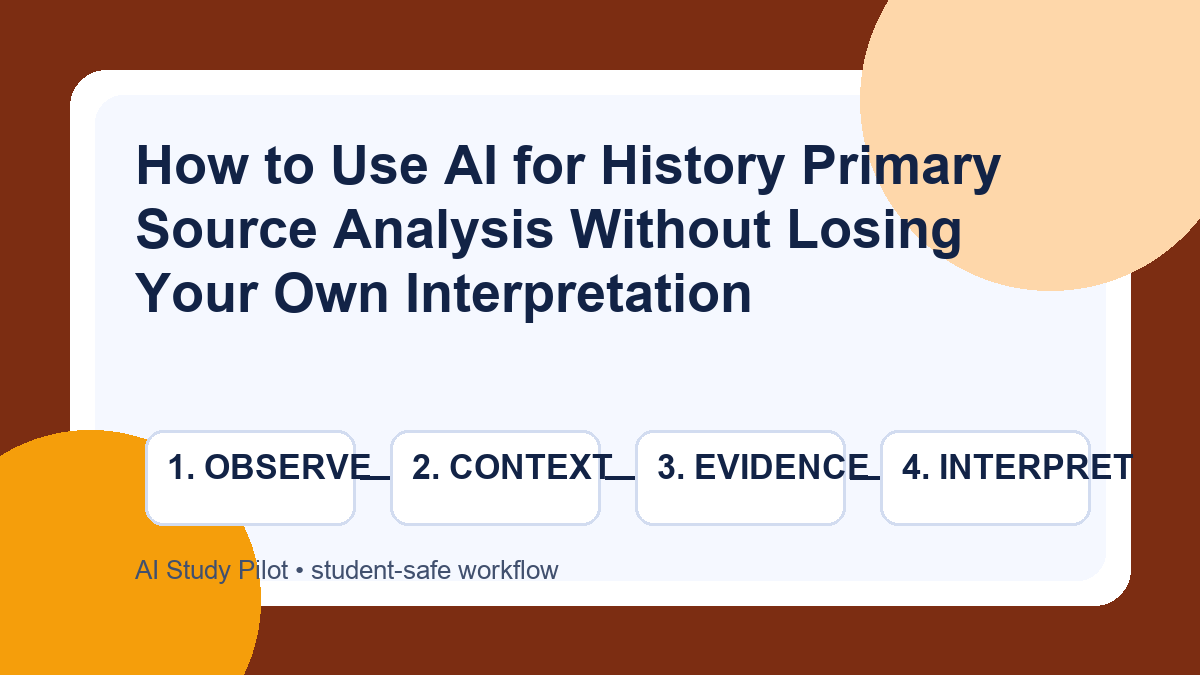
How to Use AI for History Primary Source Analysis Without Losing Your Own Interpretation
A safe AI workflow for history students analyzing primary sources: context questions, close-reading prompts, evidence tables, and interpretation checks without outsourcing your essay.
Introduction
History classes often ask you to do more than remember what happened. You have to analyze primary sources: letters, speeches, laws, photographs, newspaper accounts, diaries, maps, or political cartoons. That is hard because a source can be biased, incomplete, translated, edited, or written for an audience very different from you.
AI can help you ask better questions of a source, build a context checklist, and organize evidence. But it should not replace your interpretation. A history assignment usually grades your argument about evidence, not a chatbot's polished summary. This workflow keeps you in charge.
Quick answer
Use AI to create a source-analysis checklist, define unfamiliar context, and turn your observations into an evidence table. Do your own close reading first, paste only material you are allowed to use, verify historical facts with course sources, and write the final interpretation yourself. Never ask AI to invent citations, claim it has read a source it has not seen, or produce an essay to submit as your own.
Step 1: Read the source before AI
Start with a slow first pass. Mark what you notice before any chatbot frames the source for you. Write down:
- author or creator;
- date and place;
- intended audience;
- genre or format;
- repeated words or images;
- surprising details;
- claims, omissions, or emotional appeals;
- questions you cannot answer yet.
This protects your own interpretation. If you start with an AI summary, you may inherit its priorities and miss what your instructor wanted you to notice.
Step 2: Ask for a context checklist, not a final answer
I am analyzing a primary source for a history class. Help me ask better
context questions, but do not write my interpretation for me.

Source type: [speech, letter, law, image, newspaper article, etc.]
Known details: [author, date, place, course unit]
My first observations: [bullets]
Assignment question: [paste if allowed]

Create:
1. 8 context questions I should answer before interpreting the source.
2. 5 close-reading questions about language, audience, purpose, and bias.
3. A list of historical terms or references I should verify.
4. A warning list of what would be risky to assume.
5. A blank evidence table I can fill in myself.

Do not claim facts unless they are in the information I provided. Mark unknowns.
This prompt gives you a thinking scaffold. It does not hand you a thesis.
Step 3: Build an evidence table
Use a simple table with four columns: observation, quote/detail, possible meaning, and verification needed. You can ask AI to format the table, but you should fill in the evidence. For humanities assignments, this is similar to the safe workflow in outlining history research papers with AI.
- Observation: Repeated phrase · Source detail: Exact quote or visual detail · Possible meaning: What it may suggest · Verify before using: Context, translation, date, audience
- Observation: Missing voice · Source detail: Who is not represented · Possible meaning: Why omission matters · Verify before using: Course reading or lecture notes
- Observation: Emotional appeal · Source detail: Word choice or image · Possible meaning: Intended audience reaction · Verify before using: Historical context
Step 4: Verify context with course materials
AI is especially risky in history when dates, names, translations, and causes are involved. A plausible context sentence can be wrong by a decade or flatten a debate your class has covered carefully. Verify important claims using your textbook, lecture notes, assigned readings, library databases, or instructor-provided context.
If you are working with sources for a research project, use the source evaluation checklist and AI literature review workflow to avoid weak evidence.
Step 5: Draft your own interpretation
After you have observations and context, write a rough answer in your own words. Then AI can be a reviewer:
Here is my draft interpretation of a primary source. Do not rewrite it.
Give feedback on whether my claim is specific, supported by evidence, and
careful about context.

Assignment question: [paste]
My thesis/interpretation: [paste]
Evidence I plan to use: [bullets]
Uncertainties: [bullets]

Respond with:
1. What is strongest in my interpretation.
2. What evidence needs more explanation.
3. Any overclaims or assumptions.
4. Two revision questions for me to answer myself.
That keeps the final reasoning yours. For essay boundaries, see AI essay feedback without cheating.
Special caution for images and political cartoons
For visual sources, AI may describe visible elements but miss historical symbolism or invent meanings. Ask for observation prompts, not a definitive interpretation. You can use this structure:
- What do I literally see?
- What symbols or labels appear?
- Who is represented with power or weakness?
- What audience reaction might the creator want?
- What context from class changes the meaning?
Then verify every symbol against course material.
Academic-integrity boundaries
Acceptable: asking for context questions, definitions, organization, and feedback on your reasoning. Risky or not acceptable: asking AI to write the primary-source analysis, invent citations, produce a thesis you submit, or hide that you used AI where disclosure is required. If unsure, check whether AI use is allowed for schoolwork.
Common mistakes
- Letting AI summarize before you observe. Read first so your interpretation starts with you.
- Treating context as automatically true. Verify dates, people, translations, and causes.
- Using vague evidence. Quote exact words or describe exact visual details.
- Writing a modern judgment only. Historical analysis needs context and audience.
- Submitting AI-made prose. Use feedback, not ghostwriting.
FAQ
Can AI analyze a primary source image?
It can help you notice visible details or generate questions, but it may miss symbols or historical context. Verify with course materials.
Can I paste a primary source into AI?
Only if you are allowed to use and upload that text. Public-domain sources are usually lower risk, but course packets, unpublished scans, or restricted databases may have rules.
Can AI help with citations?
It can remind you of citation elements, but you must verify the final citation. See how to cite ChatGPT and AI when your course requires AI disclosure.
Final recommendation
Use AI as a question generator and evidence organizer. Read first, verify context, and write the interpretation yourself. In history, your argument is the work — protect it.
Disclosure: AI Study Pilot may add affiliate links later. We recommend free-first tools where possible and never promise guaranteed grades or outcomes.