Engineering & thermodynamics · Updated June 2026
Learn Heat Transfer with AI Safely
Master Fourier's law of conduction, Newton's law of cooling for convection, and radiation blackbody equations using Socratic AI coaching to build thermodynamic engineering intuition safely.
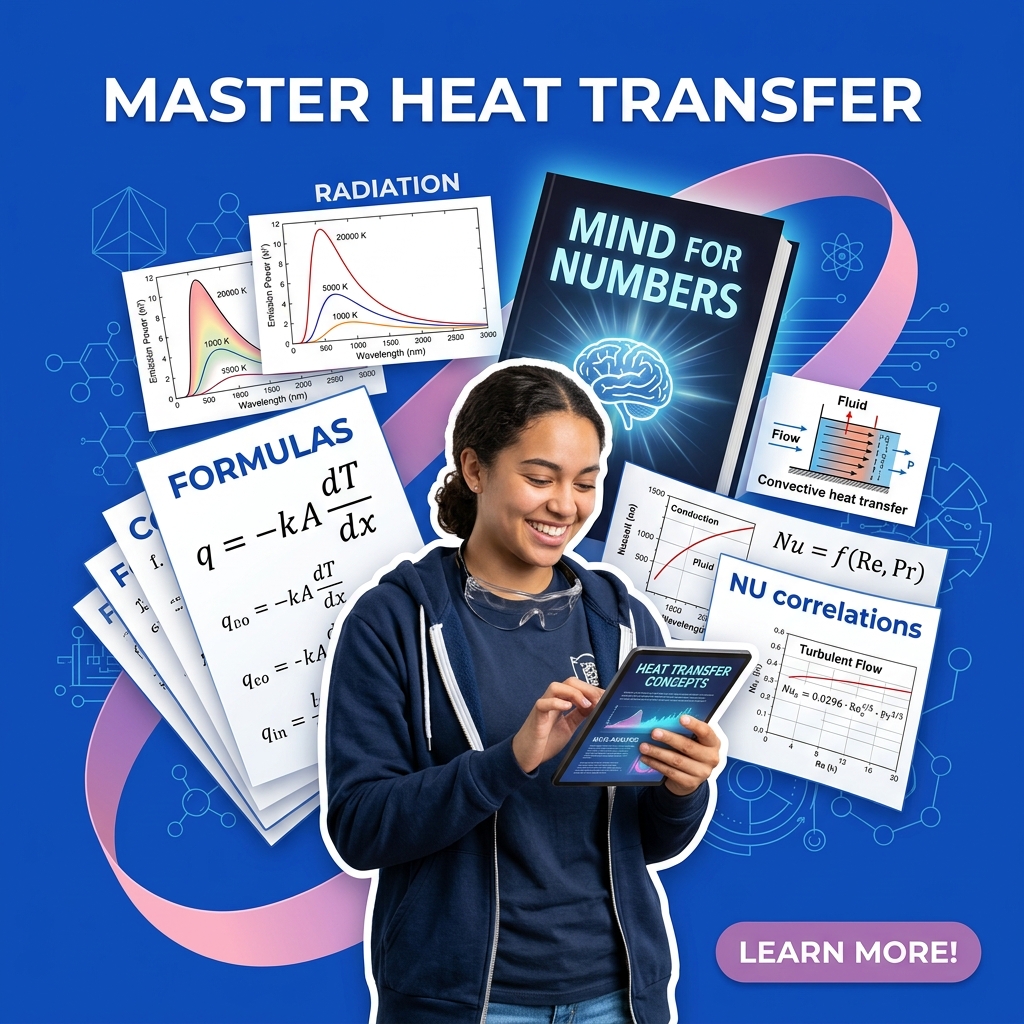
In mechanical, chemical, civil, and aerospace engineering, heat transfer is the study of how thermal energy moves from one physical system to another due to a temperature difference. While classical thermodynamics deals with systems in equilibrium (allowing us to calculate the total energy required for a state change), heat transfer deals with non-equilibrium rates of energy transfer. Thermal energy transfers through three distinct physical modes: conduction (diffusion through stationary matter), convection (energy transfer between a solid surface and a moving fluid), and thermal radiation (energy emission via electromagnetic waves).
Because solving differential heat equations, evaluating fluid boundary layer correlations, and calculating radiation view factors can be mathematically complex, students frequently ask AI to solve their entire homework sets or run numerical solvers. However, relying on AI to simplify your thermal resistance circuits or look up dimensionless Nusselt correlations bypasses the physical intuition needed to design microfluidic heat sinks, engine cooling jackets, or building insulation. This guide outlines a Socratic workflow to utilize AI as a thermodynamics and heat transfer tutor to build engineering mastery safely.
Step 1: Modeling Fourier's Law of Conduction Socraticly
Conduction is the transfer of heat within a solid or a stationary fluid due to molecular vibrations and free electron movements. The rate of heat conduction, \(q_x\), in a given direction \(x\) is proportional to the area \(A\) normal to the flow and the temperature gradient \(\frac{dT}{dx}\), expressed by Fourier's Law:
\[q_x = -k A \frac{dT}{dx}\]
where \(k\) is the material's thermal conductivity. To find temperature profiles, engineers use thermal resistance networks (\(R_t = \frac{L}{kA}\) for a plane wall), analogously to Ohm's Law. Instead of asking AI to calculate heat losses through a composite wall for you, use it to check your thermal resistance setup and boundary conditions.
Use this prompt to check your conduction equations Socraticly:
I am calculating the steady-state heat loss through a composite plane wall consisting of two layers (brick and fiberglass insulation) with a known temperature difference. Act as a Socratic engineering heat transfer tutor. Do not solve the calculation or write down the final thermal resistance equations. Ask me to identify the thermal resistance formulas for conduction, explain how to set up the equivalent thermal circuit for series resistances, and guide me through calculating the total resistance. Guide me.Step 2: Analyzing Convection and Boundary Layers Socraticly
Convection is the transfer of thermal energy between a solid surface and a moving gas or liquid, combining conduction and bulk fluid motion. The heat transfer rate is modeled by Newton's Law of Cooling:
\[q = h A (T_s - T_\infty)\]
where \(h\) is the convection heat transfer coefficient, \(T_s\) is the surface temperature, and \(T_\infty\) is the fluid temperature. Because \(h\) depends on fluid properties, boundary layers, and flow velocity, engineers use dimensionless correlations involving the Nusselt (\(Nu\)), Reynolds (\(Re\)), and Prandtl (\(Pr\)) numbers. Instead of asking AI to select the Nusselt correlation or compute \(h\) for you, use it to prompt your flow regime assessment (laminar vs. turbulent) and fluid property evaluations.
Use this prompt to master convection Socraticly:
I am analyzing forced convection of water flowing over a flat plate. I need to select the correct Nusselt number correlation to find the heat transfer coefficient h. Act as a Socratic thermodynamics tutor. Do not compute the Reynolds number or select the correlation for me. Ask me to state the criteria for determining if a flow over a flat plate is laminar or turbulent, prompt me to define the Reynolds number equation, and have me explain what fluid properties must be evaluated at film temperature. Guide me.Step 3: Analyzing Stefan-Boltzmann Law of Radiation Socraticly
Unlike conduction and convection, thermal radiation does not require a material medium; it transfers thermal energy through electromagnetic waves (photons). All matter at a non-zero temperature emits thermal radiation. The maximum rate of radiation emission from a surface is modeled as a blackbody using the Stefan-Boltzmann Law:
\[E_b = \sigma A T^4\]
where \(\sigma \approx 5.67 \times 10^{-8}\text{ W}/(\text{m}^2\cdot\text{K}^4)\) is the Stefan-Boltzmann constant, and \(T\) is the absolute temperature in Kelvin. Real surfaces emit less than a blackbody, scaled by emissivity (\(\epsilon\)). Instead of asking AI to compute net radiation exchanges between surfaces, use it to guide your view factor definitions and radiation network equations.
Use this prompt to study radiation heat transfer Socraticly:
I am calculating the net radiation heat exchange between two infinitely large parallel black plates at different temperatures T1 and T2. Act as a Socratic heat transfer coach. Do not compute the net heat exchange or write down the final Stefan-Boltzmann radiation equation. Ask me to explain how absolute temperature must be expressed, prompt me to write the formula for net exchange between black surfaces, and ask how emissivity (emissive efficiency) would alter the expression for real surfaces. Guide me.
A Mind for Numbers: How to Excel at Math and Science
Dr. Barbara Oakley's actionable guide to unlocking analytical thinking. Perfect for students tackling STEM classes who want to beat procrastination and master complex formulas.
AI Study Pilot receives a small commission from qualifying Amazon purchases at no extra cost to you.Common mistakes
Keep an eye out for these classic pitfalls when studying heat transfer:
- Mixing Celsius and Kelvin: While temperature differences (\(\Delta T\)) are identical in Celsius and Kelvin, thermal radiation equations use absolute temperature raised to the fourth power (\(T^4\)). Forgetting to convert Celsius to Kelvin (\(T(\text{K}) = T(^\circ\text{C}) + 273.15\)) leads to massive errors. Ask AI: "Quiz me Socraticly on when it is acceptable to use Celsius and when I must convert to Kelvin in heat transfer equations. Guide me."
- Confusing heat transfer rate and heat flux: Heat transfer rate (\(q\) in Watts) is total energy per unit time. Heat flux ($q'' = q/A$ in \(\text{W}/\text{m}^2\)) is rate per unit area. Mixing these up leads to incorrect dimensions.
- Incorrect flow regime classification: Applying laminar correlations to turbulent flows or neglecting buoyancy forces in natural convection leads to completely incorrect convection coefficients. Use AI to study this: "Prompt me Socraticly to distinguish between forced convection and natural convection. Ask me what dimensionless parameters dictate the transition in each regime. Guide me."
FAQ
- What is the physical meaning of thermal conductivity k versus convection coefficient h? Thermal conductivity (\(k\)) is a fundamental physical property of a material measuring its ability to conduct heat. The convection coefficient (\(h\)) is not a material property; it is an experimental parameter that depends on fluid velocity, geometry, surface roughness, and flow regime. Prompt: "Socraticly quiz me on how fluid velocity affects the boundary layer thickness and the resulting convection coefficient h. Guide me."
- What is the Prandtl number? The Prandtl number (\(Pr = \frac{\nu}{\alpha}\)) is a dimensionless number representing the ratio of momentum diffusivity (kinematic viscosity) to thermal diffusivity. It describes the relative thickness of the velocity and thermal boundary layers. Prompt: "Act as a Socratic tutor. Quiz me on what a high Prandtl number vs. a low Prandtl number tells us about thermal boundary layers in oils versus liquid metals. Guide me."
- What is a view factor in radiation? A view factor (\(F_{ij}\)) is a geometric parameter representing the fraction of radiation leaving surface \(i\) that is intercepted by surface \(j\). View factors are crucial for calculating radiation exchanges in enclosures. Prompt: "Socraticly quiz me on the reciprocity relation and summation rules for view factors in a three-surface enclosure. Guide me."
Final recommendation
Heat transfer is a rate-based engineering discipline. Do not let AI construct your composite wall circuits, pick Nusselt correlations, or compute radiation exchanges for you. Instead, draw your thermal circuits, calculate your Reynolds and Prandtl values on paper, and leverage Socratic AI sessions to audit your boundary conditions, fluid properties, and dimension consistency.
Disclosure: AI Study Pilot may add affiliate links later. We recommend free-first tools where possible and never promise guaranteed grades or outcomes.