AI research workflow · Updated May 2026
AI Source Evaluation Checklist for Student Research Papers
AI search tools can surface links quickly, but a research paper still needs credible, relevant, and correctly used sources. This checklist helps students use AI as a research assistant without letting it replace source evaluation.
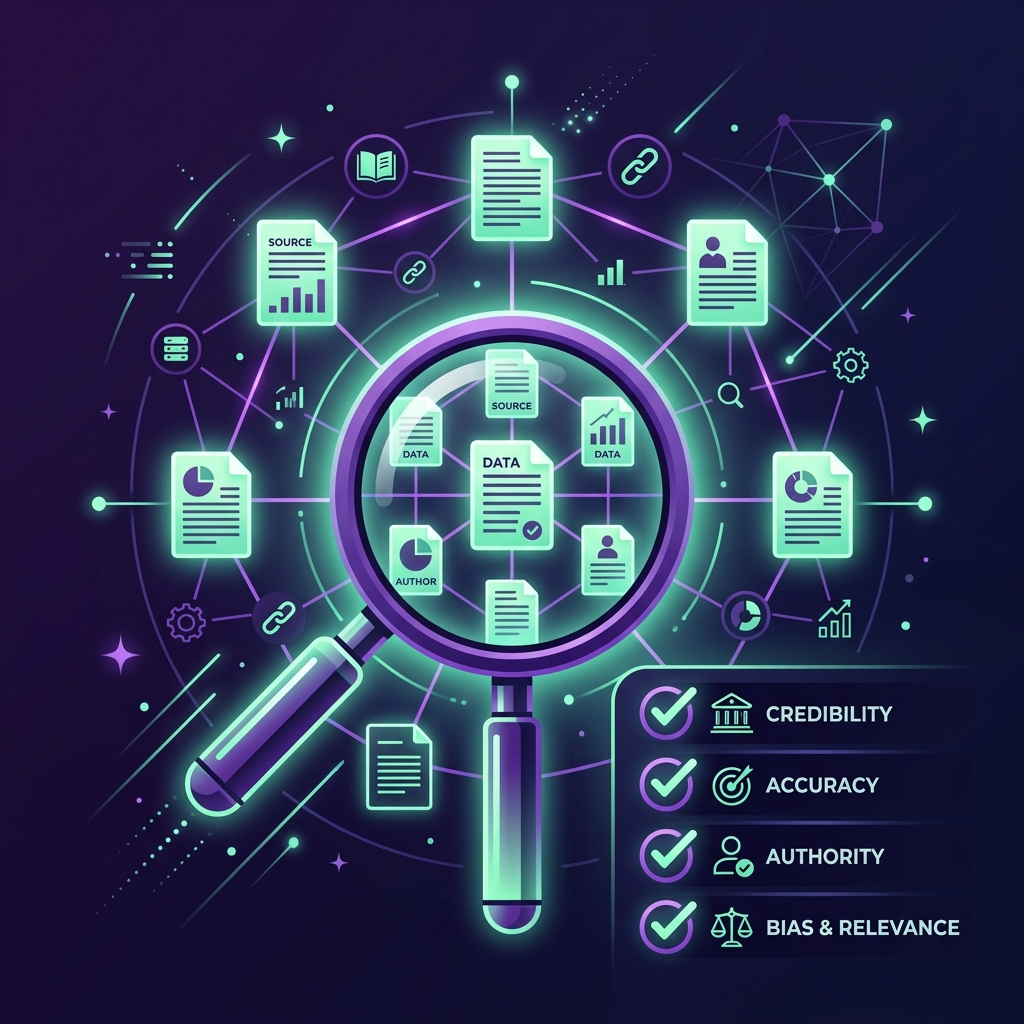
Quick answer
- Use AI to brainstorm search terms and organize a source table.
- Open each source yourself and check author, publisher, date, evidence, and purpose.
- Use lateral reading: leave the page and see what reliable outside sources say about it.
- Write source notes in your own words before drafting.
- Cite only sources you personally inspected and understood.
The goal is not to make AI “find citations” for a finished paragraph. The goal is to build a stronger research trail before you write.
Why this matters now
Students increasingly encounter AI answers with citations, source cards, and summaries. Those features can be useful starting points, but they do not remove your responsibility to evaluate sources. A link can be real and still be irrelevant, outdated, biased, too shallow, or misrepresented by the AI summary.
Research and information-literacy guidance consistently emphasizes evaluating authority, purpose, accuracy, currency, and relevance. Purdue OWL offers criteria for evaluating sources. Mike Caulfield's SIFT approach encourages readers to stop, investigate the source, find better coverage, and trace claims back to original context. Stanford's Civic Online Reasoning materials teach lateral reading as a way to evaluate online information beyond the page itself.
Helpful sources behind this workflow
- Purdue OWL: Evaluating Sources of Information
- Mike Caulfield: SIFT, The Four Moves
- Stanford Civic Online Reasoning: Introduction to Lateral Reading
Step 1 — Start with a research question, not a citation hunt
If your prompt is “give me sources for this essay,” AI may produce a list that looks useful but does not match your assignment. Start by clarifying the research question and the kind of evidence you need.
You are my research planning assistant. Do not write the paper for me. Help me refine this topic into 3 possible research questions, then suggest search terms for each one. For each search term, label whether it is best for background, academic research, statistics, historical context, or opposing viewpoints.

Assignment topic:
[paste topic]

Course level and requirements:
[paste source requirements, if allowed]
Step 2 — Use AI to build a source evaluation table
A table slows you down in a good way. It forces you to ask whether each source actually deserves a place in your paper.
Create a blank source evaluation table for my research project. Columns should include: source title, author/organization, publication date, source type, main claim, evidence used, how it helps my paper, possible limitation, quote/page or section to revisit, and citation status. Leave the table blank for me to fill in.| Checklist item | Question to answer before citing |
|---|---|
| Authority | Who created it, and why should they be trusted on this topic? |
| Evidence | What data, examples, methods, documents, or expert reasoning support the claim? |
| Currency | Is the date appropriate for the topic? Current technology topics may need recent sources. |
| Purpose | Is the source informing, persuading, selling, entertaining, or advocating? |
| Relevance | Does it directly support your research question, or is it only loosely related? |
Step 3 — Practice lateral reading with AI support
Lateral reading means you do not stay trapped inside one polished webpage. You open new tabs, investigate the publisher or author, and compare coverage from reliable outside sources. AI can help generate questions for this process, but you should still inspect the evidence yourself.
I am evaluating this source for a student research paper. Do not decide for me. Give me a lateral-reading checklist: what I should search, what claims I should trace, and what signs would make the source stronger or weaker.

Source title and URL:
[paste source]

My research question:
[paste question]
Step 4 — Ask AI to challenge the source, not praise it
Many students accidentally ask AI to confirm what they already want to argue. Instead, ask for limitations and missing context.
Here are my notes from a source I read. Help me identify possible limitations, missing context, and questions I should answer before using it. Do not add claims from the source unless they appear in my notes. If my notes are too thin, tell me what I need to reread.

My source notes:
[paste your notes]
Step 5 — Keep quotation, paraphrase, and summary separate
AI can blur the difference between the source's words and your interpretation. Keep a simple system: quotes are exact and marked with page, paragraph, or timestamp when available; paraphrases are rewritten in your own sentence structure; summaries explain the larger idea. If you are unsure, return to the original source.
Check my source notes for citation risk. Label each bullet as quote, paraphrase, summary, or my own analysis. If any paraphrase is too close to the original wording I provide, tell me to rewrite it more independently. Do not create citations or page numbers that I did not provide.Step 6 — Use a final source-pass before drafting
Before writing the paper, review the source table and remove weak sources. A smaller set of strong, relevant sources is usually better than a long bibliography you do not understand.
Review my filled source table for a research paper. Flag sources that seem weak, repetitive, too general, outdated for the topic, or not clearly connected to the research question. Suggest what kind of source I should look for next, but do not invent sources.
Make It Stick: The Science of Successful Learning
The gold standard for cognitive science learning. Learn how active recall, spaced repetition, retrieval practice, and varied study schedules dramatically improve retention over passive re-reading.
AI Study Pilot receives a small commission from qualifying Amazon purchases at no extra cost to you.Common mistakes
Mistake 1: Citing sources you never opened
If you did not open and inspect the source, do not cite it. AI summaries can misrepresent what a source says.
Mistake 2: Treating every linked result as academic
Blogs, company pages, news articles, reports, and peer-reviewed studies can all be useful in different contexts. Match the source type to the assignment.
Mistake 3: Ignoring date and context
A historical source may be old on purpose. A source about current AI tools, prices, or policies may become outdated quickly. Decide what currency means for your topic.
Mistake 4: Using sources only to decorate a paragraph
Sources should support, complicate, or provide evidence for your argument. They are not just required objects in a bibliography.
Mistake 5: Letting AI write citations from memory
Use your required style guide and citation tool carefully. Never trust invented publication details, page numbers, DOIs, or URLs.
FAQ
Can AI help me find research sources?
AI can help brainstorm search terms, organize candidate sources, and create evaluation questions. You still need to search databases or the web, open the sources, and verify details yourself.
Is it cheating to use AI for source evaluation?
Usually, using AI to ask evaluation questions or organize notes is learning support. However, your instructor's AI policy comes first, especially if the assignment is designed to assess your independent research process.
What is lateral reading?
Lateral reading means leaving the original page to investigate the source, author, publisher, and claim through other reliable sources before deciding whether to trust it.
Should I cite an AI answer?
Follow your class rules. In most research papers, it is better to cite the original sources you read, not the AI summary that pointed you toward them.
What if AI gives me a source that does not exist?
Do not use it. Search for the title, author, and publication details yourself. If you cannot verify it, remove it from your source list.
Final recommendation
Use AI to make source evaluation more organized, not less responsible. A strong research workflow is simple: clarify the question, inspect the source, read laterally, take honest notes, and cite only what you personally verified.