Research workflow · Source triage
How to Triage a Research Reading List With AI Without Missing Key Sources
A source-triage workflow for students with too many articles: group, prioritize, skim, verify, and build a reading order with AI support.
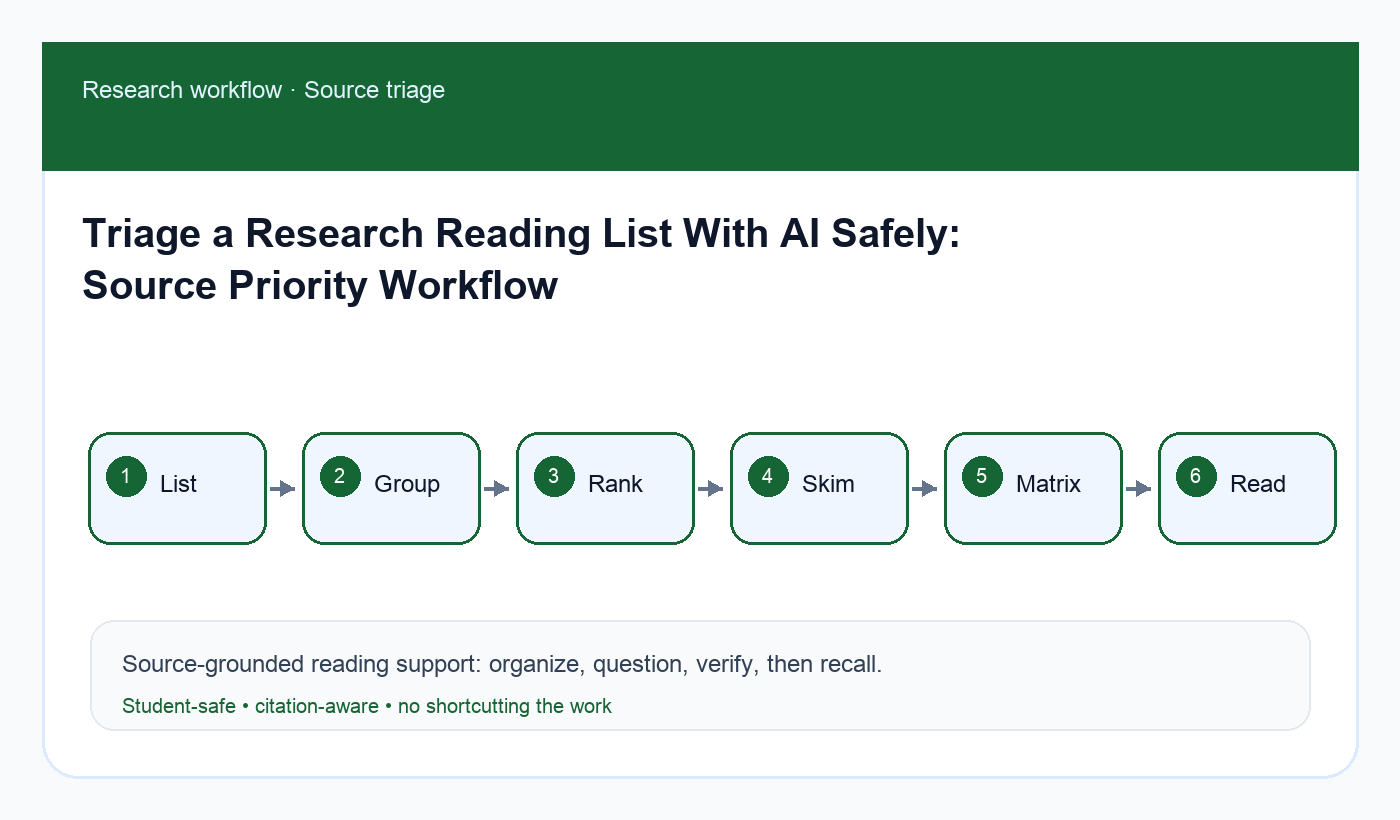
Quick answer
When your research reading list is too long, use AI to triage the list—not to pretend you read everything. Provide titles, abstracts if you have them, assignment goals, and source requirements. Ask AI to group sources by theme, estimate relevance, suggest a reading order, and flag items that need closer evaluation. Then verify credibility and read the high-priority sources yourself.
This workflow works well with AI source evaluation checklist, AI literature synthesis matrix, and AI literature review workflow.
Why triage matters
Students often collect too many sources because searching feels productive. Then the reading pile becomes overwhelming. Triage helps you decide what to read first, what to skim, what to save for background, and what to drop. The point is not to avoid reading. The point is to spend your best attention on the sources that actually support the assignment.
AI is useful because it can sort visible metadata quickly. It is not a credibility detector. It may misread a title, overrate a popular source, or miss a methodological weakness.
The reading-list priority system
- Priority: Core · Use when: Directly answers your research question · Action: Read closely and add to matrix
- Priority: Context · Use when: Explains background or definitions · Action: Skim, cite only if needed
- Priority: Method · Use when: Useful for research design or evidence type · Action: Read methods/results carefully
- Priority: Counterpoint · Use when: Challenges your argument · Action: Read enough to represent fairly
- Priority: Drop · Use when: Off-topic, weak, duplicated, or not allowed · Action: Remove or park
Step 1: define the assignment target
Before ranking sources, write the research question, required source types, course concepts, and deadline. A source can be excellent and still not useful for your assignment. Relevance depends on the target.
If your question is not clear yet, use the assignment prompt to research question workflow before triage.
Step 2: provide metadata, not fake certainty
Give AI the title, author, year, publication venue, abstract, keywords, and your own notes when available. If you only have titles, ask for a rough grouping, not a credibility judgment. Titles can mislead.
Do not ask AI to rank sources it cannot see. Do not ask it to generate article summaries from memory. If you need a summary, provide the abstract or permitted excerpts and verify later.
Copy-ready prompt: reading-list triage
Act as a careful research assistant for source triage. Do not invent article contents, credibility, findings, or citations.

Research question:
[paste question]

Assignment/source requirements:
[paste requirements]

Candidate sources with metadata:
[paste title, author, year, venue, abstract if available]

Create:
1. Theme groups.
2. A suggested reading order.
3. Priority label for each source: core, context, method, counterpoint, or drop.
4. Why each label is tentative.
5. What I must verify before citing.
6. A synthesis-matrix starter with blank claim/evidence cells.

If the abstract or evidence is missing, write INSUFFICIENT INFO.
Step 3: read the top sources actively
Start with the highest-priority sources, but keep your judgment active. For each one, record claim, evidence, method, limitations, and how it relates to your question. If a source seemed promising but does not fit after reading, downgrade it.
Use a synthesis matrix before drafting. It prevents the paper from becoming one paragraph per source and helps you compare evidence across authors.
Step 4: keep a “maybe later” pile
Not every source needs a decision today. Some sources provide background, definitions, or counterarguments. Keep them in a “maybe later” section with one sentence about why they might matter. This reduces anxiety without cluttering your core reading list.
When the paper outline is clearer, return to the maybe pile only if it fills a real gap.
Common mistakes
- Letting AI rank sources without abstracts or metadata.
- Treating triage as a substitute for reading.
- Dropping counterarguments because they are inconvenient.
- Citing sources based only on titles.
- Forgetting assignment source requirements.
Final recommendation
Use AI to sort the reading pile, then use your own reading to make citation decisions. A strong triage system gives you a reading order, evidence gaps, and a synthesis matrix without pretending that unread sources have been mastered.
Disclosure: AI Study Pilot may add affiliate links later. We recommend free-first tools where possible and never promise guaranteed grades or outcomes.