Research tips · Updated June 2026
How to Create a Literature Synthesis Matrix With AI Safely
Learn how to use AI safely to create a literature synthesis matrix, group sources by theme, and transition from summary to synthesis.
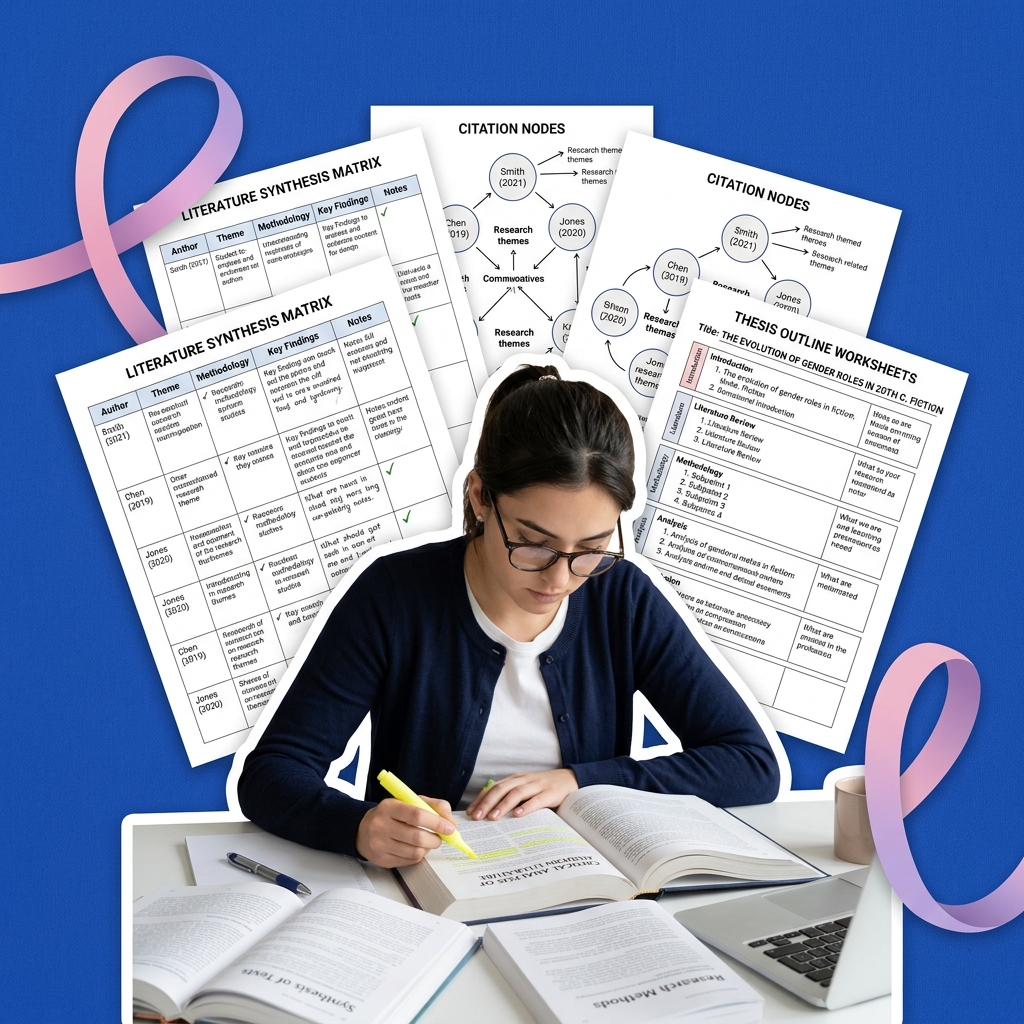
Writing a literature review for a research paper is one of the most common assignments in college, spanning the humanities, social sciences, business, and STEM majors. However, many students fall into the "annotated bibliography trap." They write their literature reviews as a series of separate, consecutive summaries: "Researcher A found X. Researcher B found Y. Researcher C found Z."
This is not a literature review; it is an annotated list. A true literature review requires synthesis—grouping sources by theme, methodology, findings, and conflicts. You must show how different scholars talk to each other, where they agree, where they contradict, and where gaps in the research exist.
To transition from summary to synthesis, academic writing centers at universities like Harvard and UNC recommend using a literature synthesis matrix. This is a grid where rows represent your sources and columns represent key themes or variables in your research.
AI models are exceptionally good at helping you categorize, analyze, and structure these matrices. You can use an AI as a writing center coach to identify thematic categories, compare findings between papers you summarize, and brainstorm how to transition from the grid to the final written paragraph.
However, using an AI to write your literature review or letting it summarize articles you haven't read is a violation of academic integrity. The key is to use the AI to organize and outline your synthesis, while doing the reading and writing yourself.
Conceptual synthesis workflow with AI
- Define thematic categories: Use AI to brainstorm matrix column headings based on your research question.
- Populate the matrix with key claims: Read your sources and place their core findings in the corresponding cells.
- Compare and contrast source connections: Use AI to identify where authors overlap, diverge, or ignore specific variables.
- Outline paragraph transitions: Plan your paragraphs by column (theme) rather than by row (source).
The Paper Process: Planning Over Cramming
Writing a 10-page research paper can feel overwhelming, leading to procrastination and last-minute cramming.
In How to Become a Straight-A Student, Cal Newport details the "Paper Process" — a systematic approach that breaks down writing into discrete, manageable steps: choosing a topic, finding sources, organizing them, outlining, and writing. Newport explains that the key to avoiding writer's block is separating the researching step from the writing step.
A literature synthesis matrix is the ultimate tool for this division. By spending focused deep-work blocks filling out your matrix grid, you do all the hard thinking before you write a single paragraph of your draft. When it comes time to write, you don't have to scramble through a pile of PDFs; you simply write down the connections that are already laid out in your matrix.
The Synthesis Matrix Coach Prompt
To organize your sources and build a structured synthesis matrix with your AI assistant, use this prompt:
Act as a college writing center tutor. I am writing a literature review on [insert research question, e.g., how screen time affects childhood attention spans].

Please help me conceptually:
1. Suggest 4 thematic column headings for my synthesis matrix based on this research question.
2. Explain how I should use these columns to organize my sources.
3. Provide a markdown table template showing how the matrix should look.
4. Ask me 3 questions about my first 2 sources to help me identify where the authors agree or disagree.
Step-by-Step Synthesis Review
Step 1 — Map conflicts and consensus
Once you have entered the data into your matrix, use the AI to analyze connections:
I have 2 sources on [topic]. Source A argues [summarize claim], while Source B argues [summarize claim]. What are the key points of disagreement between these two perspectives? How can I frame this debate in my literature review?Step 2 — Draft thematic transitions
Transitioning from the matrix to the paragraph is where many students get stuck. Ask the AI to help you outline a paragraph based on a column theme:
I have a column in my matrix for [insert theme, e.g., long-term vs short-term effects]. Three sources address this: Source A [findings], Source B [findings], and Source C [findings]. Provide a structural outline for a paragraph that synthesizes these three findings, focusing on thematic transition sentences. Do not write the paragraph.Step 3 — Identify research gaps
Professors look for your ability to identify what is missing in the current literature. Ask the AI:
Based on the current scholarly consensus that [insert consensus, e.g., screen time reduces short-term attention], what are 3 potential research gaps or unexamined variables that a new study could address?
How to Become a Straight-A Student
A strategic study blueprint designed specifically for college students. Demystifies top performance and shows how to prepare for exams efficiently without cramming.
AI Study Pilot receives a small commission from qualifying Amazon purchases at no extra cost to you.Common mistakes
* Summarizing by source, not theme: When writing the review, never organize paragraphs by author. Organize paragraphs by column theme, citing multiple authors within each paragraph to show synthesis.
* Over-relying on AI summaries: Never let AI read the papers for you. AI can help organize, but if you don't read the papers, you won't catch subtle nuances or verify if the AI's claims are accurate.
* Copying thematic writing templates: Use AI to outline the structure of your arguments, but make sure the final voice, vocabulary, and sentence structures are entirely your own.
Disclosure: AI Study Pilot may add affiliate links later. We recommend free-first tools where possible and never promise guaranteed grades or outcomes.