Research planning · Prompt to question
How to Turn an Assignment Prompt Into a Research Question With AI
A safe workflow for turning vague assignment instructions into a focused research question, search plan, and professor-ready clarification list.
Quick answer
AI can help you turn an assignment prompt into a research question by unpacking the task, listing constraints, suggesting possible angles, and testing whether the question is specific enough. It should not choose a thesis for you, invent sources, or write the paper. Your job is to decide what you genuinely want to investigate and verify that the question fits the assignment.
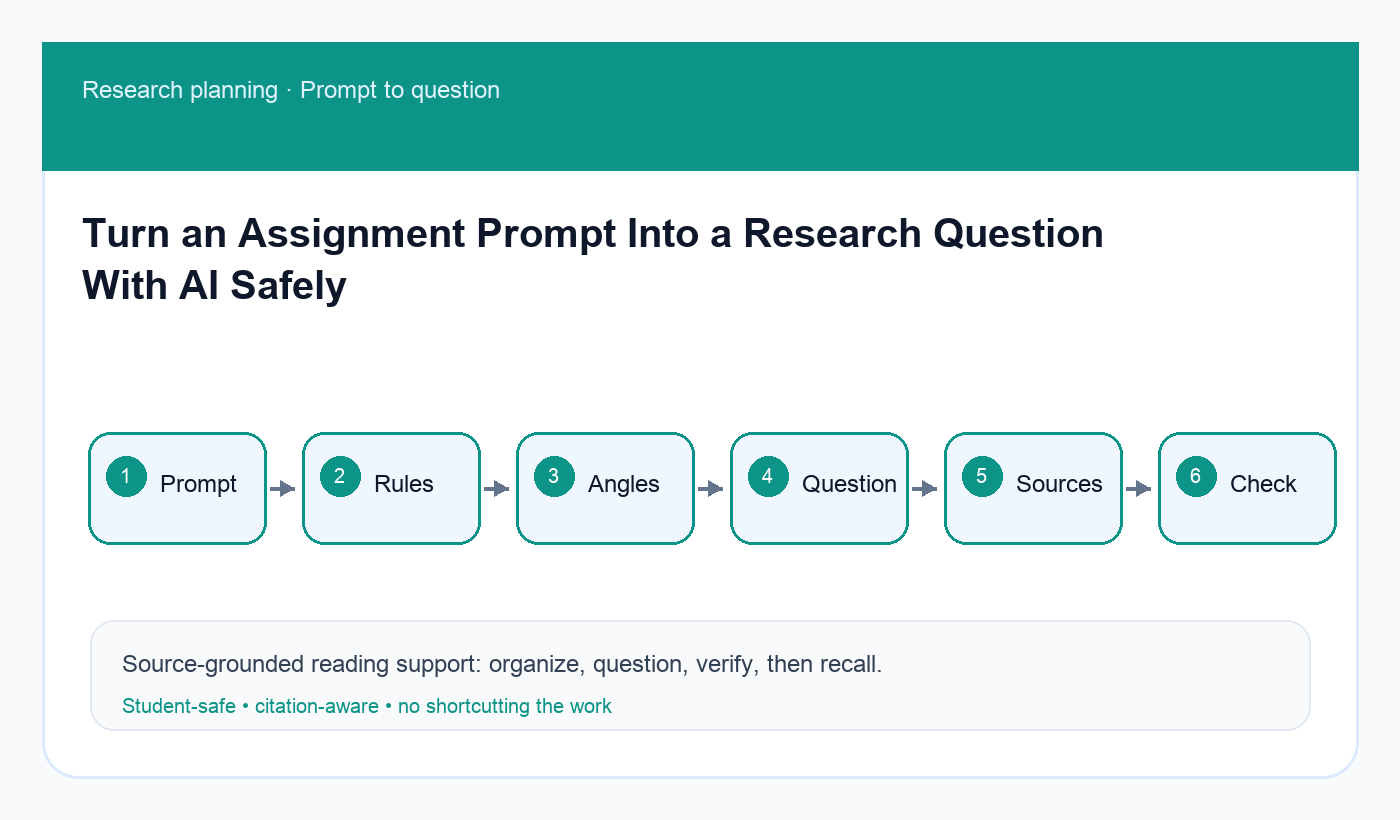
A safe workflow is: paste the prompt, identify required sources and forbidden shortcuts, brainstorm angles, narrow one question, create search terms, and ask your instructor about anything ambiguous. For later stages, use AI literature review workflow, Perplexity research source-check workflow, and AI citation audit checklist.
Why research questions fail
Most weak research projects fail before the first source search. The question is too broad, too factual, too opinion-based, or not connected to the assignment. “Climate change” is a topic, not a research question. “How did local flood policy change after two major storms in one city?” is closer because it has scope, evidence, and an answer that requires analysis.
AI is helpful at showing options quickly. But the final question needs your judgment: what can you research with available sources, within the page limit, and within the course goals?
What to extract from the prompt
- Prompt element: Required source types · Why it matters: Tells you whether scholarly, primary, or course sources are needed
- Prompt element: Course concepts · Why it matters: Keeps the paper tied to class learning
- Prompt element: Page or word limit · Why it matters: Controls question scope
- Prompt element: Due date · Why it matters: Determines research depth
- Prompt element: Rubric language · Why it matters: Reveals how the work will be evaluated
- Prompt element: AI policy · Why it matters: Sets the boundary for help
Step 1: separate requirements from ideas
Copy the assignment prompt into a document and label every requirement. Look for verbs such as analyze, compare, evaluate, interpret, argue, explain, or reflect. Those verbs tell you what kind of question you need. A compare prompt needs at least two cases. An evaluate prompt needs criteria. An interpret prompt needs evidence.
Then list your own interests separately. This prevents the AI tool from blending professor requirements with random topic ideas.
Copy-ready prompt: assignment-to-question planner
Act as a student-safe research planning coach. Do not write my thesis or paper. Help me understand the assignment and create possible research questions I can choose from.

Assignment prompt:
[paste prompt]

Course topic and concepts we have covered:
[paste brief context]

My interests:
[paste 2-5 possible topics]

Create:
1. A requirements checklist.
2. The type of thinking the prompt asks for.
3. Five possible research-question angles.
4. For each angle, explain scope, likely source types, and risks.
5. A short list of clarification questions for my instructor.

Do not invent sources or claim that any source exists.
Step 2: narrow with the “answerable in time” test
A research question should be narrow enough to answer with the time and sources you have. Test it with five checks: who, where, when, what evidence, and what course concept. If you cannot answer those, the question is probably too broad.
For example, “How does social media affect mental health?” is huge. “How do first-year college students describe study stress on campus wellness surveys after midterms?” is narrower, but it requires access to specific surveys. If you cannot get those sources, revise before you commit.
Step 3: create search terms before searching
Ask AI for search terms, not sources. Search terms help you use the library database more effectively while avoiding fake citations. Build a few combinations: main concept, population, place, method, and related terms. Then search in your library, Google Scholar, or approved databases.
When you find sources, evaluate them with the source evaluation checklist. Do not let a model fill your bibliography from memory.
Step 4: make a professor-ready clarification list
If the assignment is unclear, ask concise questions early. AI can help you draft questions such as “Is it acceptable to compare two case studies?” or “Do course readings count toward the required scholarly sources?” This is a legitimate use because it improves communication rather than bypassing the work.
Keep the message short and honest. Mention the question you are considering and the requirement you are trying to satisfy.
Common mistakes
- Asking AI to “give me a thesis” before doing research.
- Choosing a topic that cannot fit the page limit.
- Trusting invented citations.
- Ignoring the rubric verbs.
- Waiting until sources are collected to check whether the question is allowed.
Final recommendation
Use AI at the planning stage to clarify options, not to outsource the intellectual decision. The best research question fits the prompt, uses available evidence, connects to course concepts, and leaves room for your own argument after reading.
Disclosure: AI Study Pilot may add affiliate links later. We recommend free-first tools where possible and never promise guaranteed grades or outcomes.