Safety checklist · Citations and sources
The AI Citation Audit Checklist for Students
A practical pre-submit checklist for verifying AI-assisted citations, quotes, source claims, and bibliography entries.
Quick answer
Before you submit any assignment touched by AI, audit every citation back to the original source. AI can help you organize citations, but it can also invent sources, misquote authors, confuse page numbers, and make unsupported claims sound polished. The safest rule is simple: if you cannot open the source and verify the claim yourself, do not cite it.
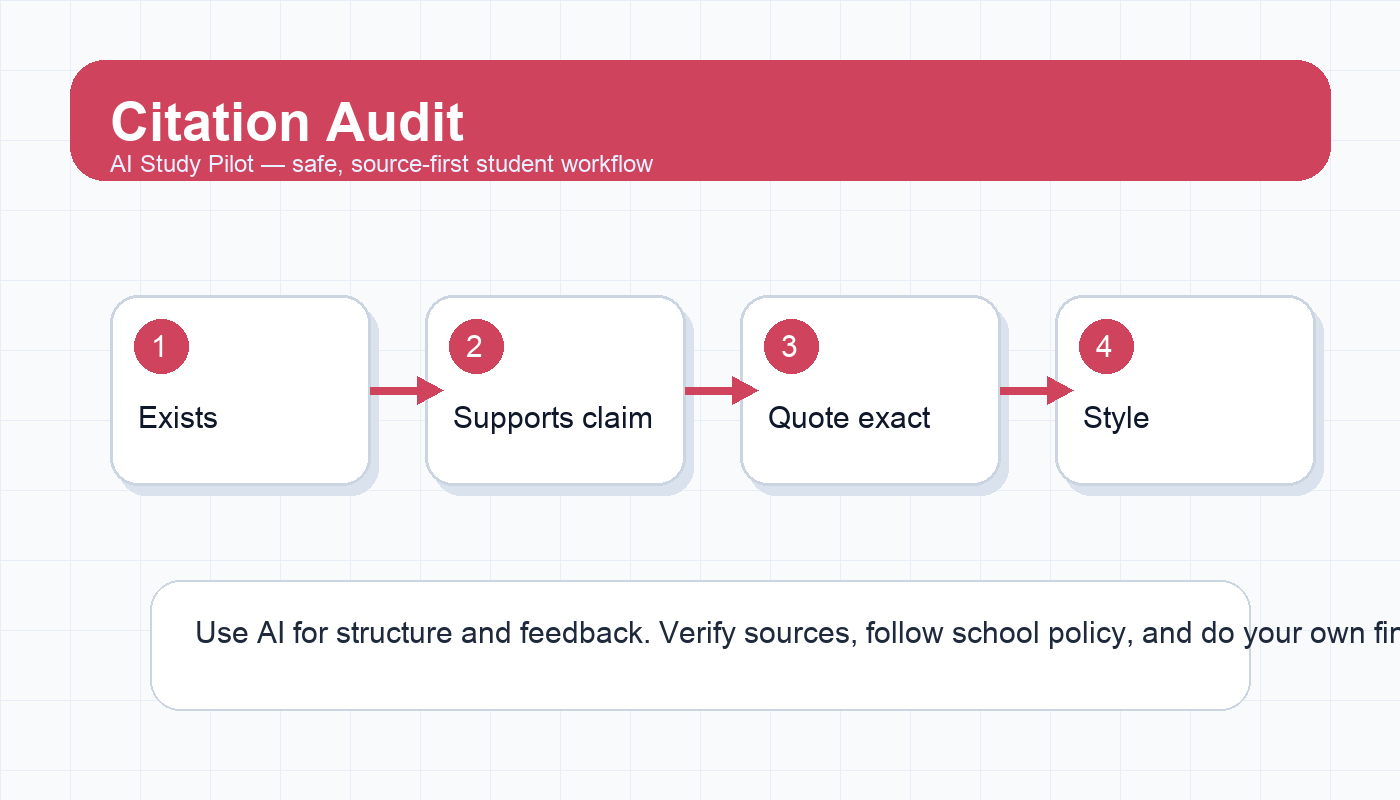
Use this five-pass audit:
- Source existence: does the source actually exist and match the citation?
- Claim support: does the source support the sentence you wrote?
- Quote accuracy: are quoted words exact, with correct page or section details?
- Citation format: does the entry match APA, MLA, Chicago, or your required style?
- AI-use disclosure: does your class require you to disclose AI assistance?
If you need style examples, use the APA/MLA/Chicago AI citation guide. If you are still choosing sources, start with the AI source evaluation checklist.
Why this matters
Citation mistakes are not just formatting problems. A fake citation can damage trust with an instructor. A real source used for a claim it does not support can weaken your argument. A quote with one changed word can become misrepresentation. AI tools make these problems easier to create because they can generate confident academic-looking text even when the underlying source is missing or misunderstood.
The goal of a citation audit is not perfectionism. It is to make sure your paper’s evidence chain is real.
Academic-integrity boundary
Using AI to format, organize, or check citations may be allowed in many classes, but using AI to fabricate evidence is never acceptable. Do not ask a model to create sources for a claim. Do not cite a source you have not checked. Do not hide required AI disclosure. When in doubt, ask your instructor and keep notes showing your process.
For broader boundaries, read Is it cheating to use AI for schoolwork? and the AI privacy checklist.
Copy-ready prompt: citation audit assistant
You are my citation audit assistant. I am not asking you to invent sources or write my paper. Help me check my evidence chain.

Rules:
- Do not create new citations.
- Do not claim a source supports something unless I provide the source text or my verified notes.
- If information is missing, write CHECK ORIGINAL.
- Separate formatting issues from evidence issues.
- Keep my final wording in my own voice.

For each citation below, create an audit table with:
1. Source name.
2. Claim in my paper.
3. What I must verify in the original.
4. Quote/page/section check.
5. Citation-style issue to fix.
6. Risk level: low, medium, high.

My citations and claims:
[paste citation list plus the sentence each source supports]
This prompt works best when you provide the sentence that uses the source, not just the bibliography entry.
Pass 1: source existence
For every citation, confirm that the source exists and that the details match. Check:
- author names;
- title;
- publication year;
- journal, publisher, or website;
- DOI, URL, or stable link;
- edition if it is a book;
- access date if your style requires it.
AI-generated bibliographies often fail here. They may combine a real author with a fake title, a real journal with the wrong year, or a plausible URL that does not lead to the source. If you cannot find the source through your library, database, DOI resolver, publisher site, or instructor-provided materials, remove it or replace it with a verified source.
Pass 2: claim support
A source can exist and still not support your claim. Make a claim-support table:
- Paper sentence: My claim says X · Source: Source A · Exact support: Page or section · Problem: supported / too broad / not supported
The most common problem is overclaiming. A study might support “in this sample” while your sentence says “students always.” A policy report might discuss one region while your sentence implies a national trend. A review article might summarize debate rather than prove a single conclusion.
Ask AI to help spot overclaims, but make the final decision yourself.
Pass 3: quote accuracy
For direct quotes, compare word for word. Check:
- exact wording;
- quotation marks;
- page number or paragraph number;
- ellipses and brackets;
- context before and after the quote;
- whether the quote still means what you claim.
Do not rely on AI to remember quotes. Paste the quote from the original source or check the PDF yourself. If a quote came from an AI response and you cannot find it in the original, delete it.
Pass 4: citation style
Style matters, but style is the last pass. First make sure the evidence is real. Then check whether your assignment requires APA, MLA, Chicago, IEEE, or a course-specific format.
Use AI for formatting help with caution:
Format this verified source information in [APA 7 / MLA 9 / Chicago notes-bibliography]. Do not add missing information. If a field is missing, label it MISSING instead of guessing.This prevents the model from filling gaps with invented details.
Pass 5: AI-use disclosure
Some instructors require disclosure if you used AI for brainstorming, outlining, editing, citation help, or source summaries. If required, write a short, honest note. Example:
AI assistance disclosure: I used AI to help organize my citation audit checklist and identify places where I needed to verify source support. I verified the cited sources and wrote the final analysis myself.Do not copy this if it does not match what you did. Make it accurate.
Pre-submit citation audit checklist
- Every cited source exists.
- Every citation matches the real source details.
- Every source was opened or verified through a reliable database, library, publisher, or official page.
- Every claim is supported by the cited source.
- Every direct quote is exact.
- Every page number, section, or timestamp is checked.
- No AI-generated source remains unverified.
- Citation style matches the assignment.
- Required AI-use disclosure is included.
- Bibliography entries and in-text citations match each other.
Common mistakes
- Checking bibliography format before evidence. A perfectly formatted fake source is still fake.
- Letting AI fill missing fields. Missing means missing; do not let a model guess.
- Citing a source based only on an abstract. Abstracts are useful, but they may not support the specific claim.
- Using one source for too many claims. Each claim needs support.
- Forgetting page numbers for quotes. Quotes need precise location when the style requires it.
FAQ
Can AI find sources for me?
It can suggest search terms and possible directions, but you must verify sources yourself. Prefer library databases, official publishers, Google Scholar, or research tools that link to real documents.
What should I do if AI invented a citation?
Remove it immediately. Then search for a real source that supports the claim, or revise the claim to match the sources you actually have.
Can I cite ChatGPT or another AI tool?
Sometimes, if your style guide and assignment require disclosure or citation. But for factual claims, cite primary or scholarly sources instead of the AI response.
Final recommendation
Run the citation audit before your final proofread. AI can make papers look finished too early; a source-by-source audit makes sure the evidence underneath the polish is real.
Disclosure: AI Study Pilot may add affiliate links later. We recommend free-first tools where possible and never promise guaranteed grades or outcomes.