STEM study · Updated June 2026
How to Learn Biochemistry and Memorize Enzyme Kinetics With AI Safely
Master Michaelis-Menten equations, enzyme inhibition, and complex biochemical pathways with Socratic AI feedback and active recall.
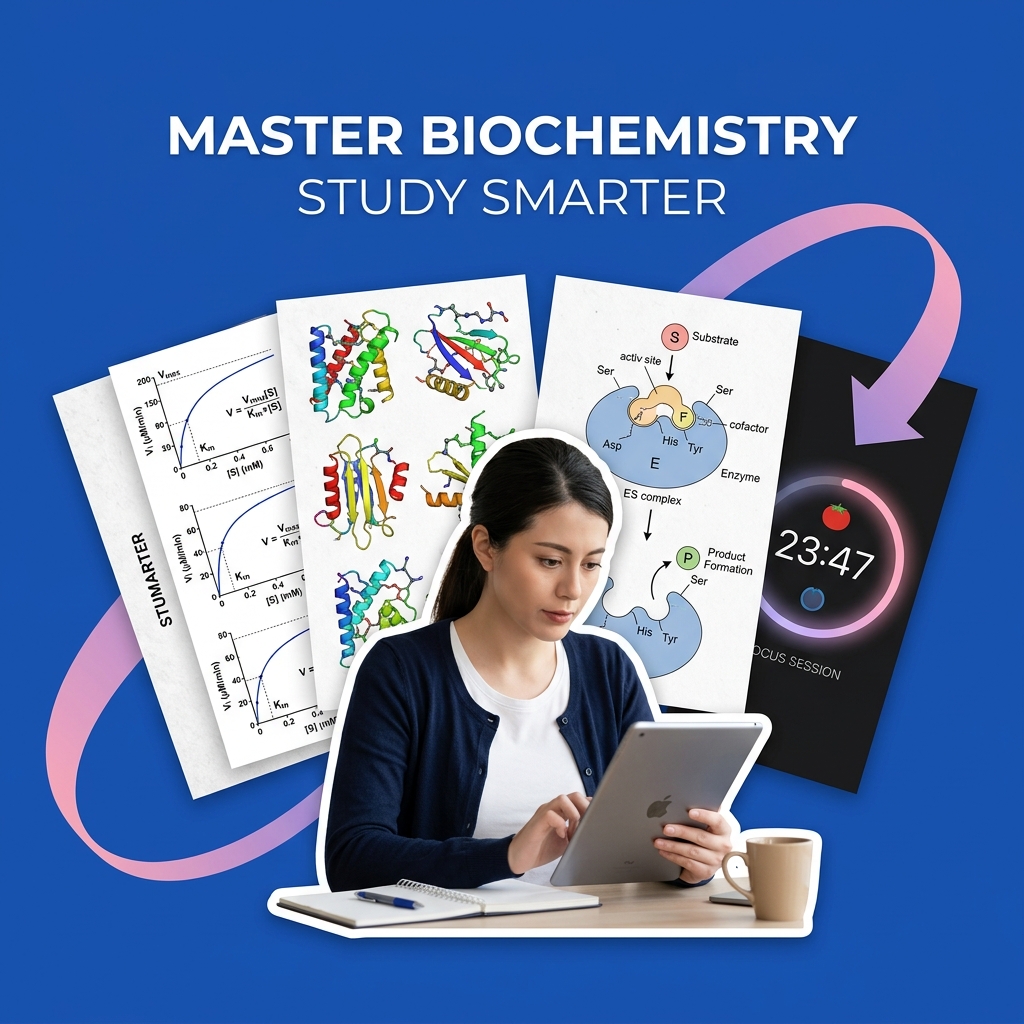
Biochemistry can feel overwhelming. You are expected to memorize hundreds of structures and pathways while simultaneously mastering quantitative equations for enzyme catalysis. When studying these complex systems, many students default to passive reading or copying solved kinetics problems directly from AI engines.
This guide outlines a safe, conceptual, and highly effective workflow to use AI as a Socratic biochemistry study coach without shortcutting your own learning.
Step 1: Brainstorming Enzyme Inhibition Concept Maps
Enzyme inhibitors (competitive, uncompetitive, and non-competitive) affect Vmax and Km in different ways. Instead of asking AI to define them, use AI to test your understanding of how these inhibitors alter the active site and substrate binding.
Use this prompt to set up a concept check:
I am studying enzyme inhibition (competitive, uncompetitive, and non-competitive). Please act as a Socratic biochemistry tutor. Ask me one question at a time about how a specific inhibitor type binds to the enzyme (or enzyme-substrate complex) and how that binding alters Vmax and Km. Do not give me the answers; wait for my explanation and guide me with hints.Step 2: Deriving Michaelis-Menten Graphs Step-by-Step
The Michaelis-Menten equation describes the rate of enzymatic reactions by relating reaction velocity v0 to substrate concentration [S].
Instead of asking the AI to plot or solve it for you, ask the AI to walk you through the assumptions of steady-state kinetics and the derivation steps.
Practice deriving the equation with this prompt:
I want to practice deriving the Michaelis-Menten equation and interpreting Lineweaver-Burk plots. Act as a Socratic guide. Walk me through the derivation step-by-step, starting with the initial reaction scheme. Ask me what the steady-state assumption means, and guide me through the algebraic steps with hints when I get stuck.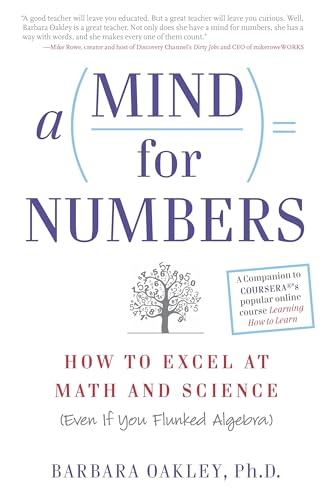
A Mind for Numbers: How to Excel at Math and Science
Dr. Barbara Oakley's actionable guide to unlocking analytical thinking. Perfect for students tackling STEM classes who want to beat procrastination and master complex formulas.
AI Study Pilot receives a small commission from qualifying Amazon purchases at no extra cost to you.Common mistakes
When studying biochemistry with AI, avoid these common traps:
- Copying metabolic pathways: Pasting a pathway diagram into an AI and asking it to write the steps down encourages passive reading. Instead, draw the pathway by hand, explain it to the AI, and ask it to audit your explanation.
- Skipping graph interpretation: Relying on AI to explain Lineweaver-Burk plots without trying to identify the axes, intercepts, and slopes yourself.
- Forgetting units: Kinetics equations require strict unit tracking (e.g., mM, micromol/min). Always check your dimensional analysis independently.
FAQ
- How can I use AI to study amino acid structures? Write out your own mnemonic devices for amino acid groups (nonpolar, polar, acidic, basic) and ask AI to challenge you with scenarios (e.g., "Which amino acids would you expect to find in the hydrophobic core of a folded protein?").
- Can AI check my kinetics calculations? Yes, but ask it to verify your steps rather than just giving the final number. Paste your starting values and your formula, and ask: "Is my setup for calculating catalytic efficiency (kcat / Km) mathematically correct?"
Final recommendation
Biochemistry is about understanding how molecular structures dictate biological function. Use a high-quality physical textbook alongside your digital tools to ensure you are grounding your study in peer-reviewed scientific sources.
Disclosure: AI Study Pilot may add affiliate links later. We recommend free-first tools where possible and never promise guaranteed grades or outcomes.