STEM study · Updated June 2026
How to Learn Genetics and Solve Pedigree and Punnett Square Problems With AI Safely
Learn how to use AI safely to master genetics concepts, understand inheritance patterns, and solve pedigree and Punnett square problems.
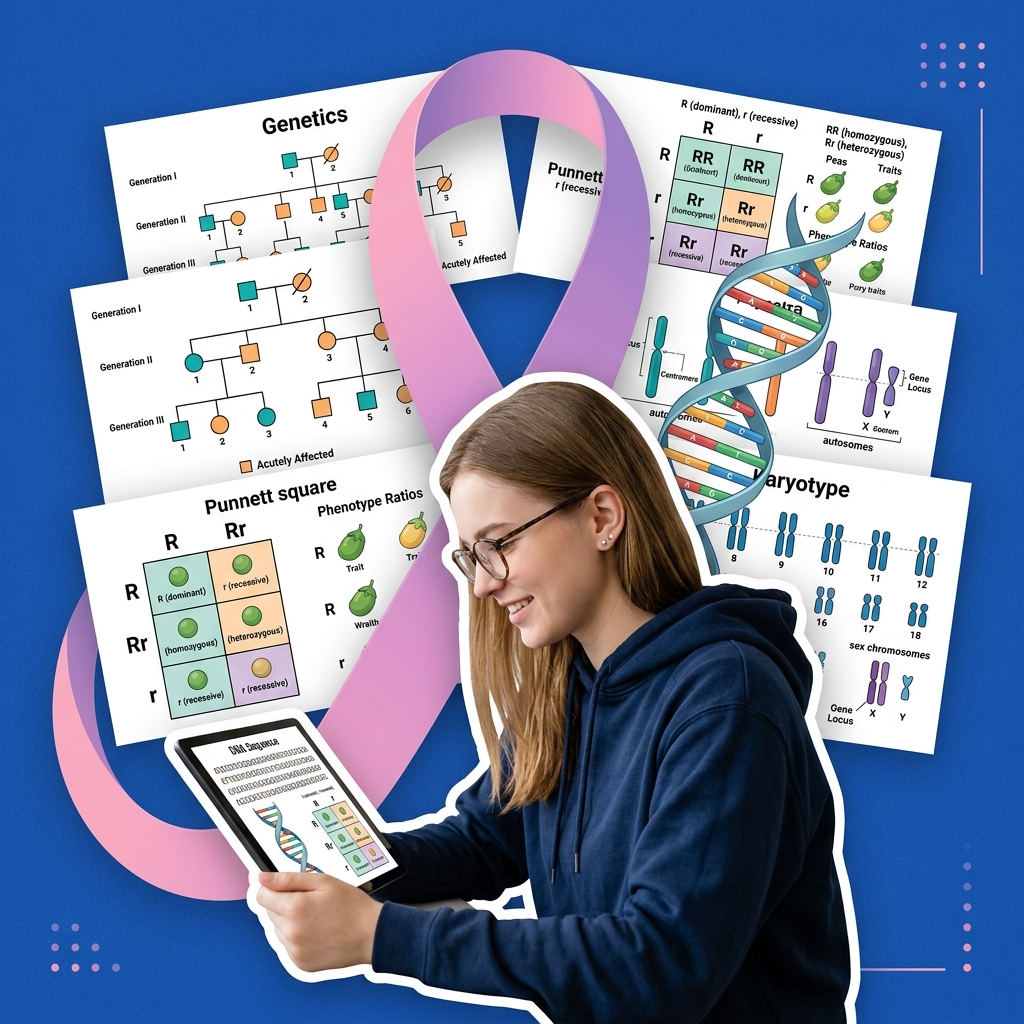
Genetics is a cornerstone of biology, pre-med, and agricultural science curricula. However, many students struggle with the transition from molecular concepts (like DNA replication and transcription) to the mathematical and analytical problem-solving required for classical Mendelian genetics.
Classical genetics exams rarely ask for simple definitions. Instead, they present you with word problems describing cross-breeding scenarios and ask you to calculate genotype ratios, predict phenotypes, draw Punnett squares, or determine the mode of inheritance from a pedigree chart (family tree).
AI tools can serve as excellent personal study coaches for genetics. Because genetics problems rely heavily on logical deduction and probability, you can use AI to break down complex inheritance rules, verify your problem-solving logic, and practice pedigree analysis safely.
A Safe, Conceptual Genetics Study Workflow
To master genetics problem sets without taking shortcuts that violate academic integrity, follow this three-step Socratic workflow:
1. Conceptual Deconstruction of Inheritance Patterns
Before trying to solve complex pedigree charts, you must master the differences between autosomal dominant, autosomal recessive, X-linked dominant, X-linked recessive, and mitochondrial inheritance patterns. Ask the AI to explain the distinguishing rules for each mode of inheritance in plain terms.
2. Socratic Punnett Square Validation
Instead of pasting a genetics word problem and asking for the final Punnett square or ratio, ask the AI to verify your parent genotypes first. If your parent genotypes are wrong, your entire Punnett square and final probability calculations will be incorrect.
3. Step-by-Step Pedigree Deduction
Pedigree charts are visual puzzles. If you are struggling to determine how a trait is inherited in a family tree, describe the key relationships in the chart to the AI and ask it to guide you through the process of eliminating impossible inheritance modes.
---
Genetics Prompts You Can Copy
Use these targeted templates to interact with AI as a genetics tutor:
For Genotype and Cross Analysis
I am studying Mendelian genetics. I have a word problem where a heterozygous tall pea plant (Tt) is crossed with a homozygous short pea plant (tt). Can you explain how to set up the parents' genotypes, and what the expected genotype and phenotype ratios would be? Walk me through the step-by-step logic, but do not draw the Punnett square grid yet.For Socratic Pedigree Analysis
I am analyzing a pedigree chart for a rare genetic trait. I notice that unaffected parents have an affected child, and the trait appears to affect both males and females equally. Can you explain which modes of inheritance can be ruled out based on this information, and why? Guide me through the elimination process.For Practice Variation
I just solved a dihybrid cross problem involving two independent traits: seed color (yellow/green) and seed shape (round/wrinkled). Can you generate a similar genetics practice problem involving a dihybrid cross of two independent traits in rabbits (e.g., fur length and eye color)? Do not provide the solution; just write the problem statement.---
Common Genetics Study Mistakes to Avoid
* Relying on AI for Visual Pedigrees: Large language models cannot "see" visual diagrams or pedigree charts directly in standard text formats. If you upload a PDF or image, always describe the connections (e.g., "Parent 1 and Parent 2 are unaffected, and they have three children: one affected daughter, one unaffected son, one unaffected daughter") to verify the AI has the correct data.
* Assuming 100% Arithmetic Accuracy: AI models can make simple calculation errors when translating ratios to percentages (e.g., mistaking a 9:3:3:1 ratio calculation). Always double-check the final fractional probabilities yourself.
* Skipping the Genotype Setup: The most common mistake in genetics is rushing to draw a Punnett square without clearly writing down your allele key (e.g., $A$ = dominant, $a$ = recessive) and the parents' genotypes. Always write these down first and verify them.
---
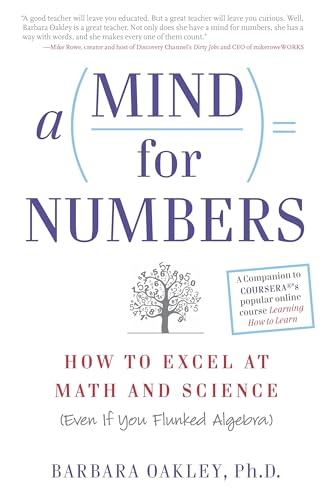
A Mind for Numbers: How to Excel at Math and Science
Dr. Barbara Oakley's actionable guide to unlocking analytical thinking. Perfect for students tackling STEM classes who want to beat procrastination and master complex formulas.
AI Study Pilot receives a small commission from qualifying Amazon purchases at no extra cost to you.FAQ
What is the difference between genotype and phenotype?
A genotype is the genetic makeup of an organism (the specific alleles it carries, like $Bb$), while a phenotype is the physical manifestation of that trait (like brown eyes). Two organisms can have the same phenotype but different genotypes (e.g., $BB$ and $Bb$ both display the dominant phenotype).
How do I recognize X-linked recessive inheritance in a pedigree?
In an X-linked recessive pedigree, the trait typically affects males far more frequently than females. Affected males do not pass the trait to their sons, but their daughters will be carriers, who can then pass the trait to 50% of their sons.
Can AI help me calculate gene mapping and recombination frequencies?
Yes. You can explain the number of offspring in a testcross (e.g., parental vs. recombinant classes) and ask the AI to explain the formula for calculating recombination frequency (recombinants divided by total offspring times 100) and mapping distance in centimorgans (cM).
Disclosure: AI Study Pilot may add affiliate links later. We recommend free-first tools where possible and never promise guaranteed grades or outcomes.