Computer science · Updated June 2026
Learn Compiler Design & Parsing Algorithms with AI Safely
Master lexical analysis, context-free grammars, and shift-reduce parsing tables using Socratic AI coaching to map syntax trees and write compilers safely.
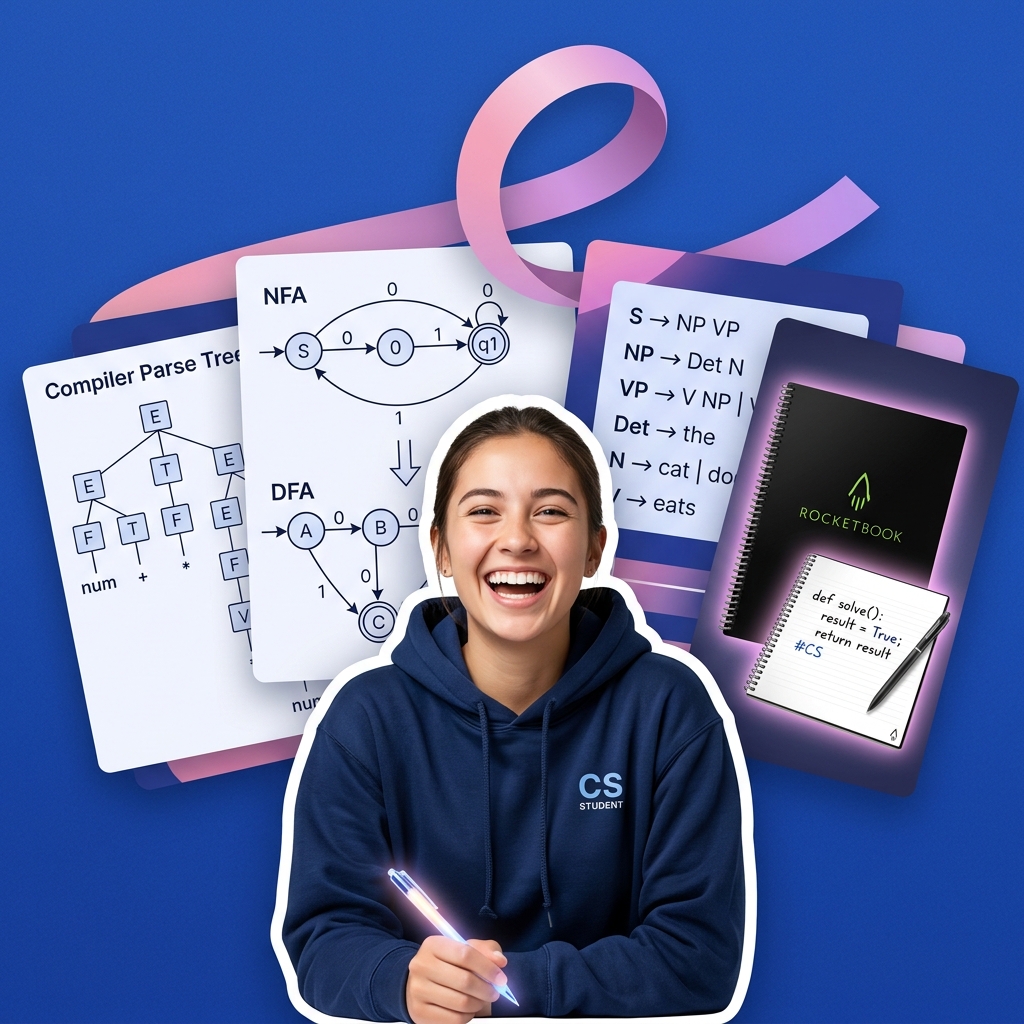
In computer science and software engineering, compiler design is one of the most intellectually rewarding and challenging subjects. A compiler is a translator that converts high-level programming code (like C++, Java, or Python) into low-level machine code or bytecode that a computer's processor can execute. The front-end of a compiler consists of a pipeline: a Lexical Analyzer (lexer) that groups characters into tokens, a Syntax Analyzer (parser) that structuralizes tokens into a Parse Tree based on a Context-Free Grammar, and a Semantic Analyzer that checks for type correctness. Constructing these components requires a solid grasp of formal language theory, finite automata, and parsing algorithms.
Because designing parsers, calculating FIRST and FOLLOW sets, and resolving shift-reduce conflicts in LR parsing tables are mathematically complex and visually intensive, students frequently ask AI models to write lexer and parser code (using tools like Lex/Yacc or Flex/Bison). However, letting AI generate your compiler front-end prevents you from mastering the tree structures, state transitions, and grammar optimizations required to design domain-specific languages, write efficient parsers, or pass compiler design courses. This guide outlines a safe, Socratic study workflow to use AI as a compiler design coach.
Step 1: Mapping Lexical Analysis & Finite Automata
The first stage of a compiler, lexical analysis, reads the source code character stream and groups it into meaningful units called tokens (like keywords, identifiers, and operators) using regular expressions. These expressions are compiled into Non-deterministic Finite Automata (NFAs), which are then converted to Deterministic Finite Automata (DFAs) for execution. Rather than letting AI write the state transition table, use it to check your state reduction logic.
Use this prompt to check your DFA construction logic Socraticly:
I am designing a lexer to recognize floating-point constants using a regular expression. I have sketched a state transition diagram for my Deterministic Finite Automaton (DFA). Act as a Socratic compiler design tutor. Do not draw the transition table or write the code. Ask me to list my DFA states, describe the transition on a decimal point from my start state, and evaluate whether my automaton handles edge cases like leading or trailing dots. Guide me.Step 2: Resolving Context-Free Grammar Ambiguity
The parser takes tokens and structures them into a syntax tree based on Context-Free Grammar (CFG) rules. A grammar is ambiguous if it can produce more than one parse tree for the same input string (for example, the classic "dangling else" problem or arithmetic precedence conflicts). Resolving ambiguity requires rewriting the grammar to define operator precedence and associativity.
Practice identifying and resolving grammar ambiguity Socraticly with this prompt:
I am analyzing the arithmetic grammar: E -> E + E | E * E | id. I know this grammar is ambiguous for the input 'id + id * id'. Act as a Socratic compiler tutor. Do not rewrite the grammar or draw the parse trees. Ask me to explain how two different parse trees can be generated, have me identify which operator has higher precedence, and prompt me to rewrite the grammar rules to enforce left-associativity and proper operator hierarchy. Guide me.Step 3: Constructing LL(1) and LR(1) Parsing Tables
Parsing algorithms are categorized as top-down (like LL(1) recursive descent) or bottom-up (like shift-reduce LR(1) parsers). To construct an LL(1) parser, you must calculate FIRST and FOLLOW sets for each non-terminal to determine which grammar rule to apply. To construct an LR(1) parser, you must build a state transition table of LR(1) items and resolve shift-reduce or reduce-reduce conflicts.
Audit your parsing table construction steps Socraticly with this prompt:
I am calculating the FIRST and FOLLOW sets for the grammar rules: E -> T E', E' -> + T E' | epsilon, T -> id. Act as a Socratic compiler theory coach. Do not compute the sets for me. Ask me to define the mathematical rules for calculating the FOLLOW set of E, guide me through computing FOLLOW(E) step-by-step, and check my intermediate calculations. Guide me Socraticly.
Rocketbook Smart Reusable Notebook
Eco-friendly, reusable physical notebook that digitizes and syncs your hand-written diagrams and notes directly to your favorite cloud storage for AI-assisted study.
AI Study Pilot receives a small commission from qualifying Amazon purchases at no extra cost to you.Common mistakes
Keep these compiler design pitfalls in mind:
- Allowing left-recursion in top-down parsers: Top-down LL(1) parsers will enter an infinite loop if a grammar has left-recursion (e.g., $A \rightarrow A \alpha$). You must eliminate left-recursion algebraically before building top-down parsers. AI models often generate left-recursive code when asked for top-down templates.
- Ignoring lookahead tokens: In shift-reduce parsing, the parser must look at the next token to decide whether to shift it onto the stack or reduce the stack contents using a grammar rule. Forgetting to track lookaheads leads to parser conflicts.
- Confusing parse trees with Abstract Syntax Trees (ASTs): A parse tree contains all grammar rules, including redundant punctuation and parentheses. An AST is a condensed representation containing only essential programming constructs (like operators and operands), which is much easier to evaluate.
FAQ
- What is the difference between LL(1) and LR(1) parsers? LL(1) parsers build the parse tree from the top down (start symbol to terminals) using one token of lookahead, while LR(1) parsers build it from the bottom up (terminals to start symbol) using shift-reduce operations and one lookahead token. LR(1) can parse a wider class of grammars. Prompt: "Socraticly quiz me on the structural differences between LL(1) and LR(1) parsers and ask me to explain why LR(1) is more powerful."
- What is a shift-reduce conflict? A shift-reduce conflict occurs in bottom-up parsing when the parser's state transition table cannot determine whether it should shift the next input token onto the stack or reduce the current stack contents using a rule. Prompt: "Socraticly guide me through analyzing a shift-reduce conflict in a nested if-else grammar and ask me to explain how lookahead resolves it."
- What are compiler compiler tools? Compiler-compilers (like Lex/Yacc, Flex/Bison, or ANTLR) are tools that automatically generate lexer and parser code in C/C++ or Java when given a regular expression specification and context-free grammar rules. Prompt: "Socraticly quiz me on the role of parser generators, how they translate CFG rules into action tables, and what advantages they offer over hand-written recursive descent parsers."
Final recommendation
Compiler design is the engineering of syntax and semantics. Do not rely on AI generators to write your lexer tokenizers or parser parse tables. Instead, sketch state diagrams and parse trees on paper, calculate your FIRST and FOLLOW sets step-by-step, and leverage Socratic AI prompt sessions to audit your grammar rules, left-recursion eliminations, and shift-reduce conflict resolutions.
Disclosure: AI Study Pilot may add affiliate links later. We recommend free-first tools where possible and never promise guaranteed grades or outcomes.