STEM study · Updated June 2026
How to Learn College Physics and Master Kinematics with AI Safely
Learn how to use AI safely to master physics kinematics, understand coordinate systems, and draft free-body diagrams conceptually.
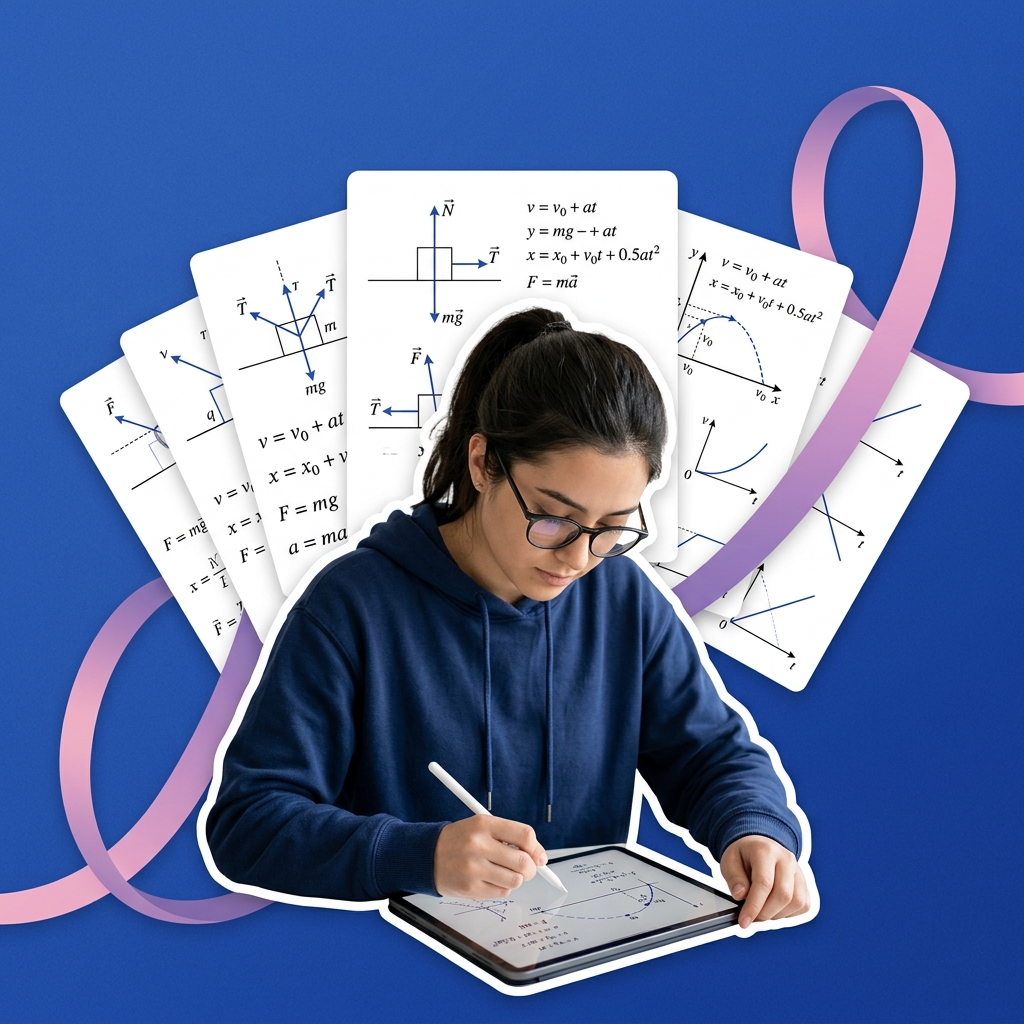
College physics—whether algebra-based for pre-meds or calculus-based for engineers—is one of the most intellectually demanding subjects on campus. The failure rate is high because many students attempt to study physics the same way they study biology: by memorizing slides and vocabulary terms.
In physics, memorization is a dead end. Physics exams test your ability to apply a tiny set of fundamental principles (like Newton's Laws or the Conservation of Energy) to an infinite variety of physical scenarios. If you do not understand the physical intuition behind an equation, you will struggle to apply it when the exam changes the angle of a ramp or adds friction to a pulley.
AI models are highly capable physics tutors. You can use an AI to explain physical concepts using intuitive analogies, generate guided step-by-step problem-solving roadmaps, and quiz you on vector addition or free-body diagram setups.
However, letting an AI solve your physics homework sets or write your laboratory reports is a violation of academic integrity. The key is to use the AI to build your conceptual understanding and guide your problem-solving frameworks, while doing the mathematical derivations yourself.
Conceptual physics workflow with AI
- Visualize the physical scenario: Learn how to represent forces and motions visually before writing any equations.
- Deconstruct the variables: Use AI to identify which variables are known, unknown, and implied (like acceleration due to gravity).
- Select the correct principles: Use AI to verify which fundamental law applies (e.g., Conservation of Momentum vs. Conservation of Energy).
- Practice step-by-step setup: Solve problems using qualitative reasoning before plugging in numerical values.
Focused and Diffuse Thinking in Physics Derivations
Physics requires a unique combination of mathematical precision and conceptual imagination. You must calculate decimal-point vector components while simultaneously imagining how a block slides down a friction-filled incline.
In A Mind for Numbers: How to Excel at Math and Science, Dr. Barbara Oakley describes two modes of thinking: the focused mode (highly analytical, concentrated thought) and the diffuse mode (relaxed, big-picture thinking). Mastering physics requires constantly switching between these modes.
To practice this, block out a dedicated study session using a visual study timer. Spend 25 minutes in a focused block deriving a kinematic equation or drawing out a free-body diagram. When the timer rings, take a 5-minute break. This allows your brain to enter the diffuse mode, where it can integrate the physical intuition behind the math you just derived.
The Kinematics Setup Prompt
To break down a complex kinematics word problem and learn how to structure its solution, use this prompt:
Act as a college physics professor. Explain the physics of [e.g., projectile motion of a ball kicked off a cliff at an angle] conceptually.

Please generate a study guide:
1. Explain the underlying physical principles (e.g., independent horizontal and vertical motions).
2. Provide a memorable real-world analogy.
3. List the kinematic equations that apply to this scenario.
4. Provide a mock word problem and ask me 3 guided questions to help me set up the variables and coordinate system. Do not solve the problem for me.
Step-by-Step Physics Review
Step 1 — Verify your free-body diagrams
Free-body diagrams (FBDs) are the foundation of mechanics. If your FBD is wrong, all subsequent math will be wrong. Upload a description of a physical setup and ask:
I am drawing a free-body diagram for a block sliding down a 30-degree incline with friction. What are all the forces acting on the block, and in which direction do their vectors point relative to the incline?Step 2 — Set up coordinate axes
Choosing the right coordinate system can make a difficult problem simple. Ask the AI:
For a projectile motion problem, how does my choice of coordinate origin affect the signs of initial position, velocity, and acceleration? Explain using a simple example.Step 3 — Run conceptual physics quizzes
Test your physical intuition with qualitative conceptual questions (which frequently appear on multiple-choice sections of physics exams). Prompt the AI:
Ask me 3 qualitative physics conceptual questions about [e.g., Work and Kinetic Energy]. Do not show the answers immediately. I will respond to each, and you will evaluate my understanding.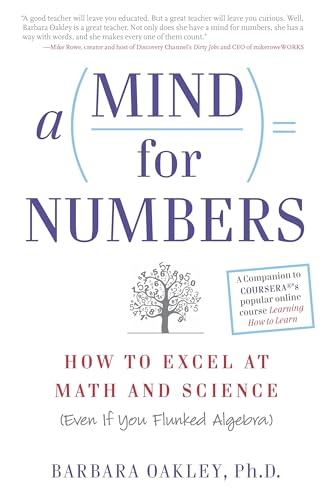
A Mind for Numbers: How to Excel at Math and Science
Dr. Barbara Oakley's actionable guide to unlocking analytical thinking. Perfect for students tackling STEM classes who want to beat procrastination and master complex formulas.
AI Study Pilot receives a small commission from qualifying Amazon purchases at no extra cost to you.Common mistakes
* Plugging in numbers too early: Always solve for your target variable algebraically first. This prevents rounding errors and allows you to check if your units balance.
* Confusing velocity and acceleration: AI can help you understand that a velocity of zero does not mean acceleration is zero (e.g., at the peak of a projectile's flight). Always clarify the physical forces acting at a specific instant.
* Letting AI solve homework sets: If you let AI solve your physics problems, you will experience the "illusion of competence." You will think you understand it because the solution looks simple, but you will freeze on the exam. Use AI strictly as a conceptual tutor.
Disclosure: AI Study Pilot may add affiliate links later. We recommend free-first tools where possible and never promise guaranteed grades or outcomes.