Computer science · Updated June 2026
How to Learn Computer Architecture and Master Assembly Language with AI Safely
Master computer architecture and assembly instruction tracing using Socratic AI coaching to map registers, ALU operations, and memory states safely.
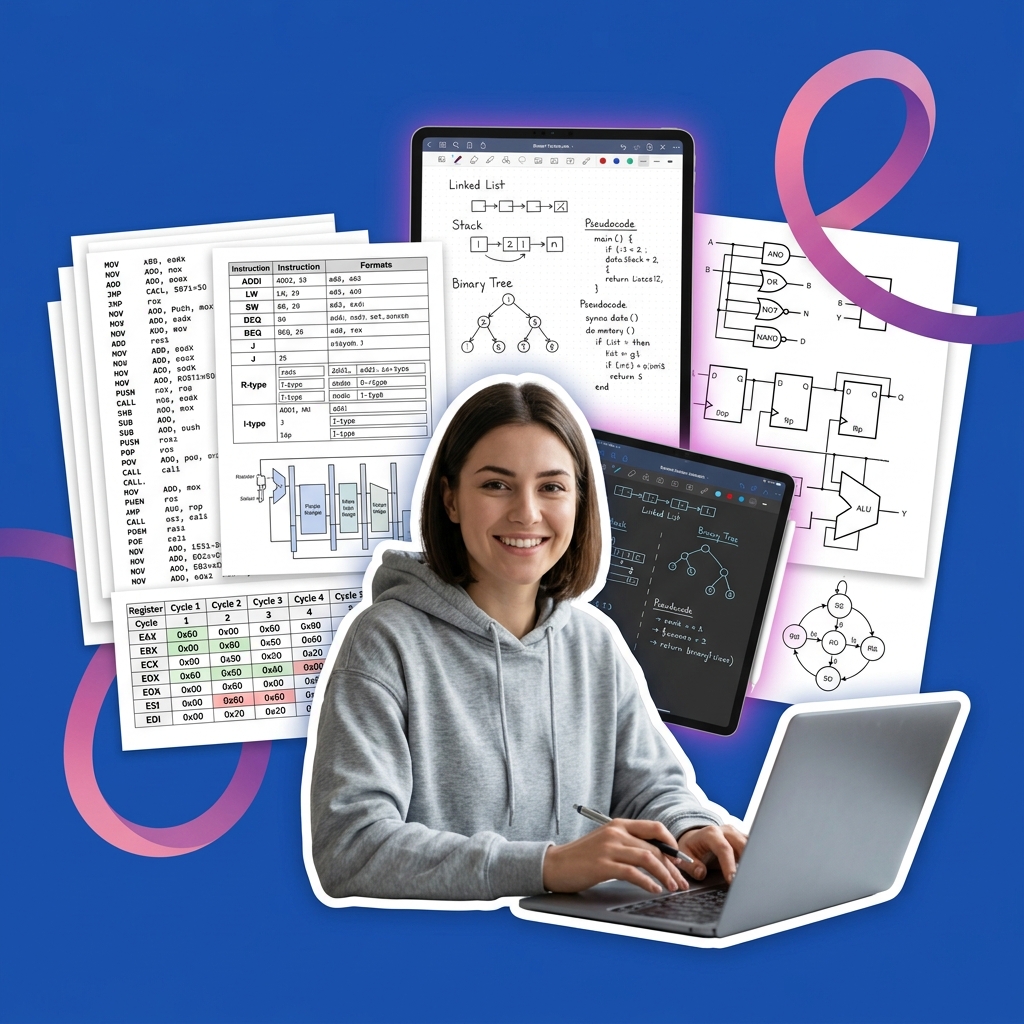
In computer science, computer architecture and organization serve as the bridge between software logic and physical hardware. Understanding how a CPU executes instructions, manages memory, and controls registers requires a shift from high-level languages like Python or Java to low-level assembly language (such as x86, ARM, or MIPS). Tracing instructions step-by-step through execution cycles can be highly frustrating due to the meticulous detail required. To save time on lab assignments, many students paste assembly programs or circuit diagrams into AI models, asking them to write the code or list register states.
However, bypasses like this prevent you from developing the diagnostic skills needed to debug systems, optimize performance, and design compiler architectures. In low-level programming, understanding why a register changes is far more important than just having the final state. This guide outlines a safe, conceptual study workflow to use AI as a Socratic tutor to master computer architecture and assembly instruction tracing.
Step 1: Mapping CPU Datapaths and Digital Logic Circuits Socraticly
A key part of computer architecture is understanding how components like the ALU, program counter (PC), registers, and multiplexers are wired together. Rather than asking AI to draw a datapath diagram or solve logic gates, use Socratic prompts to audit your conceptual layout.
Verify your datapath understanding with this prompt template:
I am analyzing a single-cycle CPU design. Specifically, I am tracking how an R-type instruction (like ADD) moves through the multiplexers and ALU. Act as a Socratic computer architecture tutor. Do not explain the datapath or state the control signals. Ask me to describe the path of the instruction from memory, how the register file outputs are selected, and what the ALUSrc control signal should be. Evaluate my answers and guide me with hints.Step 2: Tracing Assembly Instruction Sequences Socraticly
In assembly language, programs manipulate registers directly. To debug a program, you must build a register trace table showing the hex or binary values of each register (e.g., $t0, $t1, eax, ebx) after each instruction.
Check your instruction trace Socraticly with this prompt:
I am tracing a short MIPS assembly sequence:
ADDI $t0, $zero, 5
SLL  $t1, $t0, 2
ANDI $t2, $t1, 15
Act as a Socratic assembly language tutor. Do not execute the program or state the final values of the registers. Ask me to explain the effect of the ADDI instruction, what mathematical operation SLL performs, and what final binary value is stored in $t2. Evaluate my answers step-by-step and provide hints if I make a mistake.
Step 3: Understanding Memory Hierarchy and Cache Mapping
The CPU uses a memory hierarchy (L1/L2/L3 caches, main memory) to speed up execution. Calculating index bits, tag bits, and cache hits/misses for direct-mapped, fully associative, or set-associative caches is a frequent exam topic.
Practice cache mapping equations with this prompt:
I am calculating the bits for a direct-mapped cache. The system has 32-bit byte-addressed memory, a cache size of 64 KB, and a block size of 64 bytes. Act as a Socratic architecture coach. Do not perform the calculations or state the bit counts. Ask me to explain how to calculate the number of blocks in the cache, how many bits are needed for the block offset, and how to determine the index and tag bits. Guide me step-by-step.
Rocketbook Smart Reusable Notebook
Eco-friendly, reusable physical notebook that digitizes and syncs your hand-written diagrams and notes directly to your favorite cloud storage for AI-assisted study.
AI Study Pilot receives a small commission from qualifying Amazon purchases at no extra cost to you.Common mistakes
When using AI for low-level systems coursework, watch out for these errors:
- Miscalculating offset addressing: AI models often make arithmetic mistakes with relative jump offsets in branches (e.g., BEQ) or load/store instructions (e.g., LW $t0, 4($s0)). Always calculate address offsets manually by converting hex addresses to byte differences. Check your calculations with: "Verify my manual calculation of the target address for a MIPS jump instruction. Ask me questions Socraticly."
- Assuming standard syntax: Assembly syntaxes vary widely between x86 (Intel vs AT&T syntax), ARM, and MIPS. AI models often generate code mixing up source and destination operands (e.g., AT&T uses
mov src, destwhile Intel usesmov dest, src). Specify your exact assembly dialect in Socratic prompts. - Relying on AI to trace stack pointers: Managing the stack pointer ($sp / esp) during function calls and leaf procedures is highly error-prone. AI models often lose track of push/pop operations. Draw a stack diagram on paper or in a smart notebook, and use Socratic prompts to audit your alignment logic.
FAQ
- How can I use AI to study pipelining and hazards? Pipelining overlaps instruction execution, introducing structural, data, and control hazards. Ask the AI: "Guide me Socraticly through identifying a data hazard in a MIPS sequence without forwarding. Ask me to identify the instructions causing the stall."
- Can AI help me understand virtual memory translation? Yes. Virtual memory translates logical addresses to physical ones using Page Tables and TLBs. Prompt: "Socraticly quiz me on what happens during a TLB miss vs a page fault. Ask me to outline the steps the hardware takes."
- How do I verify assembly logic designs? Ask the AI to compare assembly implementations conceptually (e.g., loops using conditional branches vs shift logic) rather than asking it to write the code directly.
Final recommendation
Computer architecture requires meticulous instruction-level logic. Sketch logic gate schematics, map register transitions in tables, trace stack frames manually, and use Socratic AI checkpoints to audit your cache equations, MUX signals, and instruction flows.
Disclosure: AI Study Pilot may add affiliate links later. We recommend free-first tools where possible and never promise guaranteed grades or outcomes.