Computer Science · Updated June 2026
How to Learn Big O Notation and Master Time Complexity Analysis With AI Safely
Master asymptotic bounds, worst-case runtime estimation, recursive recurrence relations, and Big O notation using Socratic AI coaching to build computer science intuition safely.
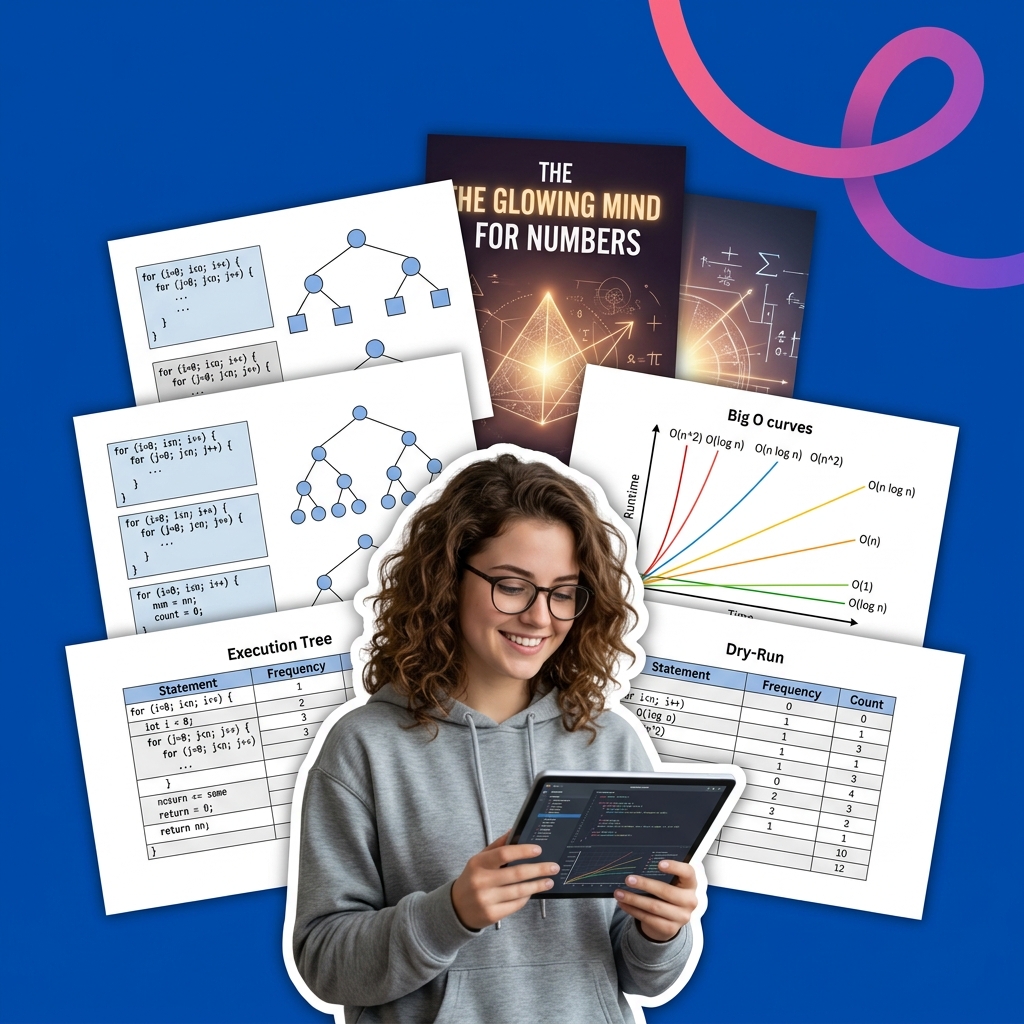
In computer science, Big O notation is the mathematical language used to describe the asymptotic behavior and efficiency of algorithms as the input size $n$ grows toward infinity. It establishes a theoretical upper bound on the execution time (time complexity) or memory storage (space complexity) required by a program, allowing developers to compare different approaches independent of hardware, programming language, or compiler optimizations.
Understanding runtime growth curves is fundamental for software engineering:
- $O(1)$ (Constant Time): Execution time remains unchanged regardless of input size (e.g., retrieving an item from an array index or hash map).
- $O(\log n)$ (Logarithmic Time): The problem size is halved at each step (e.g., binary search).
- $O(n)$ (Linear Time): Time scales in direct proportion to input size (e.g., finding the maximum value in an unsorted list).
- $O(n \log n)$ (Linearithmic Time): Typically found in efficient sorting algorithms (e.g., Merge Sort, Quick Sort).
- $O(n^2)$ (Quadratic Time): Common in nested loops over the same collection (e.g., Bubble Sort, Insertion Sort).
- $O(2^n)$ (Exponential Time): Calculations double with each additional input (e.g., naive recursive Fibonacci).
Because analyzing code loops and deriving recurrence relations can be mathematically challenging, students frequently ask AI models to calculate the Big O complexity of their code or explain code optimization patterns directly. However, letting AI calculate the runtime for you prevents you from developing the mental tracing patterns needed to spot performance bottlenecks during whiteboarding interviews or code reviews. This guide outlines a Socratic workflow to utilize AI as an algorithm analysis coach.
Step 1: Tracing Iterative Loops Socraticly
To determine the time complexity of an iterative function, you count the number of basic operations executed as a function of the input size $n$. When loops are nested or have dynamic bounds, identifying the exact loop execution frequency requires careful mathematical summation.
Using AI to solve these loop complexities directly deprives you of learning how to calculate arithmetic series or analyze dependent bounds.
Use this Socratic prompt to check your loop analysis logic:
I am analyzing the time complexity of a function with nested loops where the inner loop's bound depends on the outer loop's index: for i from 1 to n, and for j from 1 to i. Act as a Socratic computer science tutor. Do not calculate the total operations or give me the Big O notation. Ask me to express the number of inner loop executions as a summation. Prompt me to expand this summation and find the dominant term. Guide me.Step 2: Formulating Recurrence Relations Socraticly
Recursive algorithms (like Divide and Conquer) cannot be analyzed by simply counting nested loops. Instead, you must express their runtime using a recurrence relation—such as $T(n) = 2T(n/2) + O(n)$ for Merge Sort—and solve it using recursion trees or the Master Theorem.
Allowing AI to expand recursion trees for you prevents you from visualizing how subproblem divisions and combining steps balance to determine the overall asymptotic runtime.
Use this prompt to master recursive recurrences Socraticly:
I am trying to solve the recurrence relation T(n) = 3T(n/2) + n for a divide-and-conquer algorithm. Act as a Socratic algorithms coach. Do not solve the recurrence or state the Master Theorem case. Ask me to identify the values of a, b, and f(n), and prompt me to compare n^(log_b(a)) with f(n) to determine which term dominates the growth. Guide me.Step 3: Auditing Space Complexity Socraticly
A common pitfall is focusing solely on time complexity while ignoring space complexity (the auxiliary memory consumed by the algorithm). For instance, a recursive function might have a time complexity of $O(n)$, but if the recursion stack depth reaches $n$, the space complexity is also $O(n)$, which could trigger stack overflow errors on large inputs.
Use this Socratic prompt to check your memory allocation and call stack footprint:
I am optimizing a deep recursive function that traverses a binary tree of height h. Act as a Socratic computer science tutor. Do not write code or calculate the space complexity for me. Ask me to explain what happens to the call stack during recursion, and prompt me to deduce how tree height limits or increases the maximum stack depth. Guide me.
A Mind for Numbers: How to Excel at Math and Science
Dr. Barbara Oakley's actionable guide to unlocking analytical thinking. Perfect for students tackling STEM classes who want to beat procrastination and master complex formulas.
AI Study Pilot receives a small commission from qualifying Amazon purchases at no extra cost to you.Common mistakes
Be on the lookout for these classic pitfalls when analyzing algorithm performance:
- Ignoring non-dominant terms during optimization: Students often spend hours optimizing a segment of code that runs in $O(1)$ time, while leaving a bottleneck running in $O(n^2)$ untouched. Big O notation teaches us to focus entirely on the term that grows fastest as $n \to \infty$. Ask AI: "Quiz me Socraticly on identifying the dominant term in complex polynomial runtimes and why constant factors are ignored. Guide me."
- Confusing Best, Worst, and Average Cases: Big O notation is a general upper bound, but it is frequently confused with the worst-case scenario. For example, Quick Sort has a best-case time complexity of $O(n \log n)$, but a worst-case of $O(n^2)$. Students must specify whether they are analyzing worst-case $O$, average-case $\Theta$, or best-case $\Omega$.
- Overlooking built-in library functions: Using library functions like
contains(),indexOf(), or list slicing inside a loop can quietly turn an apparently linear $O(n)$ algorithm into a quadratic $O(n^2)$ disaster, because many built-in methods are sequential searches. Ask AI: "Socraticly quiz me on the hidden time complexities of standard list operations in Python/Java. Guide me."
FAQ
- What is the difference between Big O, Big Omega, and Big Theta? Big O ($O$) represents the asymptotic upper bound (worst-case growth rate), Big Omega ($\Omega$) represents the asymptotic lower bound (best-case growth rate), and Big Theta ($\Theta$) represents the tight asymptotic bound (when the upper and lower bounds match). Prompt: "Act as a Socratic mathematics tutor. Quiz me on the formal mathematical definitions of O, Omega, and Theta notation. Guide me."
- Why is O(log n) efficiency so highly valued? Logarithmic runtime is exceptionally efficient because doubling the input size $n$ only increases the operations by a small constant. For example, searching a list of 1,000,000 items using binary search ($O(\log n)$) takes at most 20 comparisons. Prompt: "Socraticly guide me to deduce why tree-based data structures leverage logarithmic growth and how balancing trees preserves this behavior. Guide me."
- How does space-time complexity trade-off work? Many optimizations involve trading memory to save execution time. For example, sorting an array in-place (Heapsort) uses $O(1)$ auxiliary space but is slightly slower in practice than Merge Sort, which uses $O(n)$ auxiliary space to achieve faster, stable sorting. Prompt: "Quiz me Socraticly on the space-time trade-off between lookup tables, memoization arrays, and recursive calculations. Guide me."
Final recommendation
Asymptotic analysis is the bridge between mathematics and software engineering. Do not let AI evaluate your loop bounds, calculate your summations, or write your optimization scripts. Instead, map out your code blocks, track your call stacks, compute your recurrence relations manually, and use Socratic AI triggers to check your mathematical assumptions and boundary limits.
Disclosure: AI Study Pilot may add affiliate links later. We recommend free-first tools where possible and never promise guaranteed grades or outcomes.