Computer Science · Updated June 2026
How to Learn Dijkstra's Algorithm and Master Graph Shortest Paths with AI Safely
Master weighted graph representations, priority queue execution, relaxation steps, and Dijkstra's algorithm dry-runs using Socratic AI coaching to build computer science intuition safely.

In computer science and discrete mathematics, Dijkstra's algorithm is the classic greedy algorithm used to find the shortest paths between nodes in a weighted graph, which may represent road networks, routing tables, or state spaces. For a graph with non-negative edge weights, the algorithm finds the shortest path from a single source node to all other nodes.
Dijkstra's algorithm operates by maintaining three key data structures:
- Distance Array (
dist): Stores the current shortest distance from the source node to every other node. Initially,dist[source] = 0and all other entries are set to infinity (\(\infty\)). - Priority Queue (
PQ): Stores active nodes paired with their current distances, sorting them so that the node with the minimum distance is always extracted first. - Visited/Settled Set (
visited): Keeps track of nodes for which the shortest path from the source has been finalized.
The core step is relaxation: for the current node \(u\), the algorithm inspects each of its unvisited neighbors \(v\). If the distance to \(u\) plus the weight of the edge between \(u\) and \(v\) is less than the current recorded distance to \(v\), we update (relax) the distance:
\[\text{if } dist[u] + weight(u, v) < dist[v] \implies dist[v] = dist[u] + weight(u, v)\]
Because tracing Dijkstra's algorithm step-by-step is algebraically meticulous, students frequently ask AI models to trace the algorithm or write the implementation (in Java, Python, or C++) directly. However, letting AI write the code or compile the trace tables prevents you from understanding how the priority queue optimizes the greedy choice, which is crucial for analyzing the algorithm's time complexity (\(O((V + E) \log V)\) using a binary heap). This guide outlines a Socratic workflow to utilize AI as a graph algorithms coach.
Step 1: Mapping Graph Representations Socraticly
Before running Dijkstra's algorithm, you must represent the graph in memory. The two standard representations are:
- Adjacency Matrix: A 2D array where cell $(u, v)$ stores the edge weight. Easy to query, but space-inefficient (\(O(V^2)\)) for sparse graphs.
- Adjacency List: An array of lists where list \(u\) contains pairs of neighboring nodes and their edge weights. Highly space-efficient ($O(V + E)$) for sparse graphs.
Use this Socratic prompt to check your graph representation logic:
I am designing a routing algorithm for a large, sparse network of 10,000 routers. Act as a Socratic computer science tutor. Do not write code or choose the representation for me. Ask me to compare adjacency matrices and adjacency lists in terms of space complexity and query time. Prompt me to deduce which representation is optimal for running Dijkstra's algorithm on a sparse graph. Guide me.Step 2: Formulating Relaxation & Greedy Choices Socraticly
The efficiency and correctness of Dijkstra's algorithm rely on the greedy choice: at each step, we extract the node with the minimum distance from the priority queue and relax its neighbors.
Using AI to trace the queue states and distance arrays directly prevents you from understanding how edge weights restrict or expand the search horizon.
Use this prompt to master relaxation steps Socraticly:
I am tracing Dijkstra's algorithm on a small directed graph. I have extracted node A (dist = 3) from the priority queue. A has two outgoing edges: to B (weight = 2) and to C (weight = 6). The current distance array is [A: 3, B: 7, C: 8]. Act as a Socratic algorithms coach. Do not write out the updated distance array. Ask me to explain the condition for relaxing an edge, and prompt me to apply it step-by-step to the neighbors of A. Guide me.Step 3: Auditing Edge Weights & Time Complexity Socraticly
A major limitation of Dijkstra's algorithm is that it does not work correctly on graphs with negative edge weights. If a graph contains negative weights, you must use other algorithms (like Bellman-Ford).
Use this Socratic prompt to check your algorithm limitations and performance auditing:
I am analyzing an algorithm for finding shortest paths in a graph that represents stock price changes (which can be negative). Act as a Socratic computer science tutor. Do not solve the problem or recommend algorithms. Ask me to explain why Dijkstra's greedy assumption fails when negative edge weights are present, and prompt me to trace a simple 3-node counterexample. Guide me.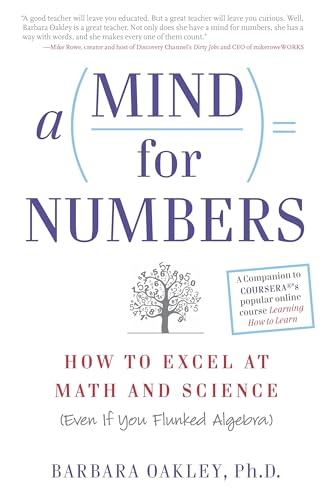
A Mind for Numbers: How to Excel at Math and Science
Dr. Barbara Oakley's actionable guide to unlocking analytical thinking. Perfect for students tackling STEM classes who want to beat procrastination and master complex formulas.
AI Study Pilot receives a small commission from qualifying Amazon purchases at no extra cost to you.Common mistakes
Keep an eye out for these classic pitfalls when studying graph search:
- Using an unoptimized Priority Queue: Tracing Dijkstra's algorithm with a simple array instead of a binary heap results in a time complexity of \(O(V^2)\). While fine for small graphs, it is unusable for large networks. AI models regularly output \(O(V^2)\) array implementations without highlighting the performance penalty.
- Updating the priority queue incorrectly: In code, when an edge is relaxed, the node's priority in the queue must be updated. Since standard library queues do not always support
decrease_keyefficiently, developers often insert duplicate entries with the new distance. Students must learn to ignore outdated duplicates during extraction. - Assuming Dijkstra works on all directed cyclic graphs: Dijkstra works perfectly on cyclic graphs as long as there are no negative edge weights. However, students often confuse it with DAG-shortest path algorithms that use topological sorting, which do require acyclic graphs. Ask AI: "Quiz me Socraticly on the difference between running shortest path on a general graph using Dijkstra versus a DAG using topological sorting. Guide me."
FAQ
- Why does Dijkstra's algorithm fail on negative cycles? Even if the graph has no negative cycles, negative edges break the greedy assumption that once a node is visited, its shortest path has been found. If there is a negative cycle, you can traverse it infinitely to decrease the path cost to \(-\infty\). Prompt: "Socraticly quiz me on how negative cycles affect path definitions and why Bellman-Ford can detect them. Guide me."
- *How does A search relate to Dijkstra's algorithm?* A search is an extension of Dijkstra that uses a heuristic function \(h(n)\) (estimating the distance to the goal) to guide the search, reducing the number of nodes explored. When $h(n) = 0$, A is identical to Dijkstra. Prompt: "Act as a Socratic AI expert. Quiz me on the relationship between Dijkstra's algorithm, A search, and heuristic admissibility. Guide me."
- Can Dijkstra be run from all nodes simultaneously? Yes, this is the all-pairs shortest path problem. While you can run Dijkstra \(V\) times (\(O(V \cdot E \log V)\)), for dense graphs it is often better to use the Floyd-Warshall algorithm, which uses dynamic programming (\(O(V^3)\)). Prompt: "Socraticly guide me to compare running Dijkstra V times versus running Floyd-Warshall for all-pairs shortest paths. Guide me."
Final recommendation
Dijkstra's algorithm is a masterclass in greedy optimization and heap-based priority queues. Do not delegate your graph traces or coding loops to AI. Instead, sketch your node networks, write out your priority queue state queues, compute your relaxations manually step-by-step, and leverage Socratic AI sessions to audit your complexity boundaries, queue duplicates, and negative edge logic.
Disclosure: AI Study Pilot may add affiliate links later. We recommend free-first tools where possible and never promise guaranteed grades or outcomes.