Computer Science · Updated June 2026
How to Learn Minimum Spanning Trees and Master Kruskal's and Prim's Algorithms with AI Safely
Master Kruskal's algorithm, Prim's algorithm, union-find data structures, priority queues, and minimum spanning tree proofs using Socratic AI coaching safely.

In graph theory and computer science, a Minimum Spanning Tree (MST) is a subset of the edges of a connected, edge-weighted undirected graph that connects all the vertices together, without any cycles, and with the minimum possible total edge weight. MSTs are fundamental in designing efficient networks, including telecommunications, electrical grids, computer networks, and transportation systems, and are also used as subroutines in approximation algorithms for NP-hard problems (like the Traveling Salesperson Problem).
The two classic greedy algorithms used to find an MST are:
- Kruskal's Algorithm: A forest-growing greedy algorithm that sorts all edges in non-decreasing order of weight and adds them one by one to the MST, as long as the added edge does not form a cycle.
- Prim's Algorithm: A tree-growing greedy algorithm that starts from an arbitrary root vertex and repeatedly grows the tree by adding the cheapest edge that connects a vertex in the tree to a vertex outside the tree.
Both algorithms rely on greedy choices that are proven correct by the Cut Property: for any cut of a graph (a partition of the vertices into two disjoint sets), the minimum weight edge that crosses the cut must belong to all MSTs of the graph.
Because implementing cycle detection (using Disjoint Set Union) and priority queues is complex, students often ask AI models to write Kruskal's and Prim's code or draw MST steps directly. However, relying on AI to solve these graph partitions and tracing steps prevents you from developing the deep algorithmic thinking and spatial visualization skills required to pass technical coding interviews. This guide outlines a Socratic workflow to utilize AI as a graph theory and algorithm coach.
Step 1: Mapping Kruskal's and Prim's Algorithmic Decisions Socraticly
Although both algorithms find a minimum spanning tree, they build it using completely different paradigms. Kruskal's algorithm works globally by considering edges anywhere in the graph, while Prim's algorithm works locally by expanding a single, contiguous tree.
Asking AI to run the algorithms step-by-step or draw the intermediate graphs for you removes the active tracing practice necessary to understand how edge selection behaves under different graph densities.
Use this Socratic prompt to practice tracing Kruskal's and Prim's algorithms:
I am tracing Kruskal's and Prim's algorithms on a weighted, undirected graph with 6 vertices and 9 edges. Act as a Socratic computer science tutor. Do not trace the steps or give me the final MST. Ask me to list the edges sorted by weight to start Kruskal's. Then, ask me to explain how Prim's algorithm chooses its first edge starting from a root vertex of my choice. Guide me through each step.Step 2: Formulating Data Structures (Union-Find and Priority Queues) Socraticly
To run efficiently, Kruskal's and Prim's algorithms require specialized data structures:
- Disjoint Set Union-Find (DSU): Used by Kruskal's algorithm to quickly check if adding an edge will form a cycle. It supports
find(to identify which subset a vertex belongs to) andunion(to merge two subsets) operations. Optimizations like union by rank and path compression reduce the amortized time complexity per operation to nearly constant ($O(\alpha(V))$). - Priority Queue (Min-Heap): Used by Prim's algorithm to quickly extract the minimum weight edge connecting the current tree to a new vertex.
Allowing AI to write the DSU or priority queue implementation for you prevents you from learning how memory representation impacts algorithmic efficiency.
Use this prompt to master DSU and Priority Queue designs Socraticly:
I am implementing Kruskal's algorithm and need to write a Disjoint Set Union (DSU) data structure with path compression. Act as a Socratic coding assistant. Do not write any code or show DSU classes. Ask me to explain how path compression works conceptually during the find operation, and prompt me to write the find function step-by-step under your guidance.Step 3: Auditing Correctness and MST Proofs Socraticly
The correctness of greedy MST algorithms rests on mathematical proofs. The core theorem is the Cut Property. If you cannot explain why a greedy choice is safe, you will struggle to modify these algorithms for variants like maximum spanning trees, bottleneck spanning trees, or dynamic graph environments.
Use this Socratic prompt to check your understanding of MST proofs:
I am trying to prove the correctness of Prim's algorithm using the Cut Property. Act as a Socratic graph theory professor. Do not write out the proof. Ask me to define what a cut of a graph is, and prompt me to explain how Prim's algorithm defines a cut at each step of its execution. Guide me to connect this cut definition to the choice of the minimum weight edge crossing it.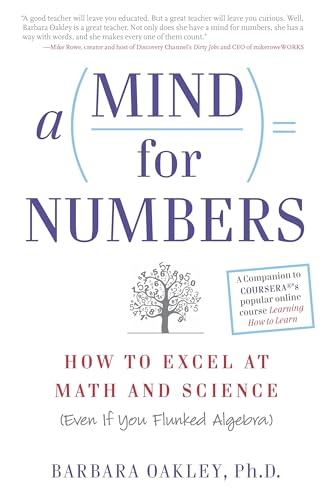
A Mind for Numbers: How to Excel at Math and Science
Dr. Barbara Oakley's actionable guide to unlocking analytical thinking. Perfect for students tackling STEM classes who want to beat procrastination and master complex formulas.
AI Study Pilot receives a small commission from qualifying Amazon purchases at no extra cost to you.Common mistakes
Be on the lookout for these classic pitfalls when studying minimum spanning trees:
- Ignoring Cycle Detection in Kruskal's: Students sometimes add edges in sorted order without verifying if both endpoints are already in the same connected component. This creates cycles, violating the tree property. Always check if
find(u) != find(v)before performingunion(u, v). Ask AI: "Quiz me Socraticly on edge redundancy and cycle detection in Kruskal's algorithm. Guide me." - Confusing Prim's with Dijkstra's: Prim's and Dijkstra's algorithms look very similar because they both grow a set of vertices using a priority queue. However, Prim's selects the vertex closest to the growing tree (minimizing individual edge weight), whereas Dijkstra's selects the vertex closest to the source vertex (minimizing cumulative path distance). Ask AI: "Socraticly quiz me on the distinction between edge relaxation in Dijkstra's vs edge selection in Prim's. Guide me."
- Assuming Uniqueness: An MST is only guaranteed to be unique if all edge weights in the graph are unique. If there are duplicate weights, multiple valid MSTs can exist (though they will all have the same total weight). Ask AI: "Quiz me Socraticly on graph conditions that produce multiple spanning trees and how tie-breaking affects Kruskal's algorithm. Guide me."
FAQ
- What are the time complexities of Kruskal's and Prim's? Kruskal's runs in $O(E \log E)$ or $O(E \log V)$ time, primarily due to sorting the edges. Prim's runs in $O(E \log V)$ time when implemented with a binary heap, but can be optimized to $O(E + V \log V)$ using a Fibonacci heap. Prompt: "Act as a Socratic algorithms tutor. Quiz me on how graph density (sparse vs dense graphs) determines whether Kruskal's or Prim's is more efficient. Guide me."
- How do MST algorithms handle negative edge weights? Unlike Dijkstra's algorithm, which fails on negative edge weights, both Kruskal's and Prim's algorithms handle negative weights perfectly. The Cut Property remains valid regardless of whether weights are positive, negative, or zero. Prompt: "Socraticly guide me to explain why adding a constant to all edge weights preserves the MST, but squaring all edge weights might not. Guide me."
- What is the difference between a Minimum Spanning Tree and a Shortest Path Tree? A Minimum Spanning Tree minimizes the total weight of the entire structure connecting all vertices. A Shortest Path Tree (computed by Dijkstra's from a source) minimizes the path distance from the source to every other vertex individually. The paths in an MST are not necessarily the shortest paths between vertices. Prompt: "Socraticly quiz me on a simple graph example where the MST is different from the Shortest Path Tree from a specific source. Guide me."
Final recommendation
Minimum Spanning Trees are a beautiful showcase of greedy algorithms in action. Do not delegate your DSU implementations, cycle check code, or heap operations to AI. Instead, draw your graph structures, sort your edges, trace your cuts manually, and leverage Socratic AI sessions to audit your complexity analyses, disjoint set rankings, and cut proofs.
Disclosure: AI Study Pilot may add affiliate links later. We recommend free-first tools where possible and never promise guaranteed grades or outcomes.