Computer Science · Updated June 2026
How to Learn Multi-Threading and Master Concurrency and Deadlocks with AI Safely
Master thread execution, race conditions, mutual exclusion (mutexes), semaphores, and deadlock prevention strategies using Socratic AI coaching safely.

In systems programming and software engineering, Multi-Threading and Concurrency are the techniques used to execute multiple sequences of instructions (threads) in parallel, maximizing CPU core utilization and application responsiveness. However, concurrent programming introduces a whole family of complex, non-deterministic bugs—such as race conditions and deadlocks—that are notoriously difficult to reproduce, debug, and solve.
Tackling concurrent systems requires mastering several fundamental concepts:
- Thread: The smallest unit of execution within a process. Multiple threads in a single process share the same memory space (heap), but have their own individual call stacks.
- Race Condition: A bug that occurs when the output of a program depends on the relative timing or interleaving of thread execution, particularly when two threads read and write to the same shared memory location simultaneously.
- Mutual Exclusion (Mutex): A locking mechanism used to ensure that only one thread can access a critical section of code or shared resource at any given time.
- Semaphore: A synchronization variable that acts as a counter, controlling access to a pool of shared resources (binary semaphores act like mutexes).
- Deadlock: A state where two or more threads are blocked forever, each waiting for a resource that is held by another thread in the group.
Because writing thread-safe code is mentally taxing and requires visualizing concurrent execution pathways, students frequently ask AI models to write multi-threaded code, add synchronization locks, or resolve deadlock warnings directly. However, letting AI add synchronization locks for you prevents you from understanding thread interleaving and lock ordering, which are essential for avoiding performance bottlenecks (like lock contention) or permanent freezes. This guide outlines a Socratic workflow to utilize AI as a concurrency systems coach.
Step 1: Mapping Race Conditions Socraticly
A race condition occurs when shared variables are modified without proper synchronization. A classic example is a bank account transfer or an integer counter incremented by multiple threads simultaneously. Because the increment operation (count++) is not atomic at the CPU level (it consists of a read, modify, and write), threads can interleave and overwrite each other's updates.
Using AI to write thread-safe counters or insert locks directly deprives you of learning how to trace instruction interleaving and identify critical sections.
Use this Socratic prompt to check your race condition analysis:
I am analyzing a function where two threads increment a shared counter 10,000 times each without synchronization. Act as a Socratic systems programming tutor. Do not write code or solve the race condition. Ask me to break down the "count++" statement into its low-level assembly or CPU steps. Prompt me to trace a specific interleaving sequence where the final value of the counter is 1 instead of 2. Guide me.Step 2: Formulating Synchronization and Lock Granularity Socraticly
To fix race conditions, you protect critical sections using synchronization primitives like mutexes. However, wrapping too much code inside a lock (coarse-grained locking) destroys concurrency, turning your parallel program back into a slow, sequential one. Conversely, using too many individual locks (fine-grained locking) increases overhead and heavily elevates the risk of deadlocks.
Allowing AI to place locks or choose synchronization blocks for you prevents you from understanding lock scope and resource partitioning.
Use this prompt to master lock granularity Socraticly:
I am designing a thread-safe HashTable where multiple threads insert and retrieve key-value pairs. Act as a Socratic concurrency coach. Do not write the synchronized classes or lock implementations. Ask me to compare locking the entire HashTable object versus locking individual hash buckets. Prompt me to analyze the trade-offs in terms of thread throughput and deadlock risks. Guide me.Step 3: Auditing Deadlocks and Resource Allocation Graphs Socraticly
A deadlock occurs only when all four of Coffman's conditions are met simultaneously:
- Mutual Exclusion: At least one resource must be held in a non-shareable mode.
- Hold and Wait: A thread holding allocated resources can request additional resources.
- No Preemption: Resources cannot be forcibly taken from a thread holding them.
- Circular Wait: A closed chain of threads exists, where each thread holds a resource requested by the next thread.
Use this Socratic prompt to check your deadlock analysis and prevention strategies:
I have a program where Thread 1 locks Resource A and requests Resource B, while Thread 2 locks Resource B and requests Resource A. The program freezes. Act as a Socratic computer science tutor. Do not rewrite the locking logic. Ask me to sketch a resource allocation graph of this system, and prompt me to identify Coffman's "Circular Wait" condition. Ask me to explain how enforcing a strict lock acquisition order prevents this deadlock. Guide me.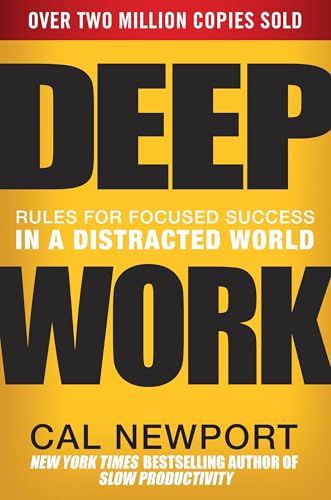
Deep Work: Rules for Focused Success in a Distracted World
Cal Newport's guide on cultivating intense, distraction-free concentration. Essential reading for students looking to master difficult subjects in less time.
AI Study Pilot receives a small commission from qualifying Amazon purchases at no extra cost to you.Common mistakes
Be on the lookout for these classic pitfalls when writing multi-threaded systems:
- Double-Checked Locking Pitfalls: Developers often attempt to optimize object instantiation using double-checked locking without declaring variables as
volatile(or using memory barriers). This leads to threads accessing partially-initialized objects due to compiler instruction reordering. Ask AI: "Quiz me Socraticly on Java's memory model, instruction reordering, and why the volatile keyword is necessary for thread-safe singletons. Guide me." - Overlooking Thread Pool Exhaustion: Creating a new thread manually for every incoming request (e.g.,
new Thread().start()) consumes massive memory and incurs heavy context-switching overhead. Production systems must use thread pools, but if tasks block indefinitely on external resources, the pool will exhaust, freezing the entire application. - Ignoring Starvation and Livelocks: While avoiding deadlocks is crucial, you must ensure threads do not experience starvation (where a thread is perpetually denied resources) or livelocks (where threads actively change states in response to each other but make no forward progress). Ask AI: "Socraticly quiz me on the difference between deadlock, livelock, and thread starvation using a real-world analogy. Guide me."
FAQ
- What is the difference between a process and a thread? A process is an independent execution unit with its own virtual address space, memory, and file handles. A thread is a path of execution within a process; multiple threads of the same process share the process's memory space, which allows fast data sharing but requires synchronization. Prompt: "Act as a Socratic operating systems tutor. Quiz me on the architectural differences between processes and threads, focusing on context-switching overhead and memory boundaries. Guide me."
- Why is lock ordering the most common deadlock prevention strategy? By enforcing a global rule that all threads must acquire locks in the exact same order (e.g., lock Resource A before Resource B, always), it becomes mathematically impossible to form a circular wait condition. Prompt: "Socraticly guide me to prove how total lock ordering breaks the circular wait condition. Guide me."
- How do atomic variables achieve lock-free synchronization? Atomic variables (like
AtomicIntegerin Java orstd::atomicin C++) utilize CPU-level instructions like Compare-And-Swap (CAS). CAS performs lock-free updates by comparing the current value of a memory location to a expected value; if they match, it updates the location to a new value in a single, uninterrupted hardware operation. Prompt: "Quiz me Socraticly on the difference between pessimistic locking (mutexes) and optimistic lock-free synchronization (CAS loops). Guide me."
Final recommendation
Writing thread-safe, concurrent code is one of the highest levels of software craftsmanship. Do not delegate your synchronization structures, lock scopes, or deadlock resolutions to AI. Instead, draw your thread execution timelines, map your resource allocation graphs, design your lock acquisition hierarchies manually, and leverage Socratic AI sessions to audit your lock granularity, memory boundary leaks, and concurrent thread limits.
Disclosure: AI Study Pilot may add affiliate links later. We recommend free-first tools where possible and never promise guaranteed grades or outcomes.