Control Systems · Updated June 2026
How to Learn PID Controller Tuning and Feedback Loops with AI Safely
Master proportional, integral, and derivative terms, closed-loop feedback systems, tuning parameters ($K_p$, $K_i$, $K_d$), and stability audits using Socratic AI coaching safely.

In control systems engineering—which spans electrical, mechanical, chemical, and aerospace disciplines—the PID (Proportional-Integral-Derivative) Controller is the workhorse of industrial automation. A PID controller continuously calculates an error value \(e(t)\) as the difference between a desired setpoint and a measured process variable, and applies a correction based on proportional, integral, and derivative terms.
The three terms in a PID controller work together to adjust the control output:
- Proportional (\(K_p\)): Produces an output value that is proportional to the current error value. A high proportional gain results in a large change in output for a given error, speeding up the response but potentially causing system overshoot and instability.
- Integral (\(K_i\)): Integrates the error over time, summing past errors. This term accelerates the movement of the process towards the setpoint and eliminates the residual steady-state error that occurs with a pure proportional controller.
- Derivative (\(K_d\)): Determines the rate of change of the error, predicting future error behavior. This term acts as a damper, slowing the controller's response when the error is changing rapidly, which reduces overshoot and improves system stability.
Tuning these parameters (\(K_p\), \(K_i\), \(K_d\)) is a balancing act. If you tune them incorrectly, the system can oscillate wildly, overshoot the setpoint, or respond too slowly.
Because analyzing step response graphs and tuning control loops involves complex differential equations and Laplace transforms, students often ask AI models to provide the exact tuning parameters or solve Laplace systems directly. However, relying on AI to compute these coefficients prevents you from developing the practical, intuitive understanding of feedback systems required to design drones, automate manufacturing lines, or stabilize thermal systems. This guide outlines a Socratic workflow to utilize AI as a control systems coach.
Step 1: Mapping the Effects of PID Parameters Socraticly
Tuning a controller requires understanding how each parameter affects the system's step response (rise time, overshoot, settling time, and steady-state error).
Asking AI to tune your parameters or analyze a step response chart directly removes the active tracing practice necessary to understand how parameter adjustments balance system response.
Use this Socratic prompt to study parameter adjustments:
I am tuning a closed-loop temperature control system using a PID controller. The system currently reaches the setpoint quickly but has large oscillations and high overshoot. Act as a Socratic control systems tutor. Do not tell me what values to change. Ask me to identify which of the three terms (proportional, integral, or derivative) acts as a damper to reduce overshoot, and prompt me to explain its effect on system stability.Step 2: Visualizing Steady-State Error and Integral Windup Socraticly
The integral term is crucial for eliminating steady-state error, but it introduces a major hazard: integral windup. When a large change in setpoint occurs, or the actuator becomes saturated (e.g., a valve opens 100% and cannot open any further), the integral term keeps accumulating error over time, causing a massive build-up ("windup"). When the setpoint is finally reached, the accumulated integral term causes the system to overshoot wildly.
Allowing AI to write anti-windup algorithms or explain system responses directly prevents you from learning how to troubleshoot physical system constraints.
Use this prompt to master steady-state error and windup Socraticly:
I am observing a physical DC motor control loop where the controller output saturates at maximum voltage, causing massive overshoot due to integral accumulation. Act as a Socratic engineering coach. Do not write code or provide the formula for anti-windup. Ask me to explain what happens to the integral term when the actuator limit is reached, and prompt me to outline a conceptual logic rule to temporarily halt or limit integral accumulation.Step 3: Auditing Closed-Loop Stability Socraticly
The ultimate goal of control system design is stability. Using mathematical tools like the Routh-Hurwitz Criterion, Bode plots, or Root Locus analysis, engineers audit the closed-loop transfer function to ensure the system does not enter unstable, runaway oscillation states.
Use this Socratic prompt to check your stability calculations:
I have derived the closed-loop transfer function of a third-order system and need to determine the range of proportional gain Kp for which the system remains stable. Act as a Socratic control systems professor. Do not solve the transfer function or determine the range. Ask me to explain how the denominator of the transfer function relates to system stability, and prompt me to set up a Routh-Hurwitz table based on this characteristic equation.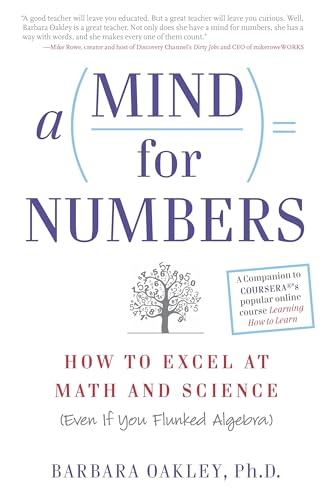
A Mind for Numbers: How to Excel at Math and Science
Dr. Barbara Oakley's actionable guide to unlocking analytical thinking. Perfect for students tackling STEM classes who want to beat procrastination and master complex formulas.
AI Study Pilot receives a small commission from qualifying Amazon purchases at no extra cost to you.Common mistakes
Be on the lookout for these classic pitfalls when studying control loops:
- Excessive Derivative Gain: While derivative gain (\(K_d\)) reduces overshoot, it is highly sensitive to noise. If a sensor signal is noisy, the derivative term (which measures the rate of change of noise) will produce massive, erratic output changes, causing the actuator to jitter and wear out. Always filter noisy sensor inputs before applying derivative control. Ask AI: "Quiz me Socraticly on the interaction between sensor noise and derivative control. Guide me."
- Over-relying on Trial-and-Error Tuning: Students often tune control loops by randomly adjusting \(K_p\), \(K_i\), and \(K_d\) until it "looks right." This is inefficient and dangerous for physical hardware. Always start with a formal method, such as Ziegler-Nichols tuning, or identify the transfer function of the plant before tuning. Ask AI: "Socraticly quiz me on the Ziegler-Nichols closed-loop tuning method and how to determine critical gain and period. Guide me."
- Ignoring Actuator Saturation: In textbook problems, actuators are assumed to have infinite range. In the real world, valves can only open so far, and amplifiers can only supply so much voltage. Ignoring these physical limits in simulations leads to designs that fail on physical hardware. Ask AI: "Quiz me Socraticly on how actuator saturation changes the behavior of a theoretical linear control loop. Guide me."
FAQ
- How does a PID controller relate to Laplace transforms? The time-domain equation of a PID controller is converted to the s-domain (Laplace domain) to analyze transfer functions:
\[G_c(s) = K_p + \frac{K_i}{s} + K_d s\]
This form allows engineers to multiply the controller transfer function directly with the plant transfer function to find the system's open-loop and closed-loop behavior. Prompt: "Act as a Socratic mathematics tutor. Quiz me on how integrating and differentiating in the time domain translate to algebraic operations in the s-domain. Guide me."
- What is the difference between feedback and feedforward control? Feedback control (like PID) reacts to the error after it occurs. Feedforward control measures disturbances before they affect the system and preemptively adjusts the control output to prevent the error from happening. Prompt: "Socraticly guide me to compare the stability and design complexity of a combined feedback-feedforward system. Guide me."
- When should I use a PI controller instead of a full PID controller? Many industrial processes, like flow control or liquid level systems, are highly responsive and noisy. In these systems, the derivative term is omitted to avoid amplifying noise, and a PI controller is used. Prompt: "Quiz me Socraticly on why temperature systems benefit from derivative control, while liquid flow loops typically omit it. Guide me."
Final recommendation
PID controllers are the bridge between theoretical mathematics and physical motion. Do not delegate your step response analyses, Laplace conversions, or parameter tuning calculations to AI. Instead, draw your feedback block diagrams, analyze your stability criteria manually, and leverage Socratic AI sessions to audit your Routh-Hurwitz boundaries, anti-windup protections, and analog filter selections.
Disclosure: AI Study Pilot may add affiliate links later. We recommend free-first tools where possible and never promise guaranteed grades or outcomes.