Math & data science · Updated June 2026
Learn Eigenvalues & Eigenvectors with AI Safely
Master eigenvalues, eigenvectors, and diagonalizing matrices using Socratic AI coaching to build deep linear algebra intuition without shortcutting calculations.

In linear algebra, eigenvalues and eigenvectors are fundamental concepts that describe how a linear transformation affects vectors in a vector space. When a square matrix \(A\) acts on a vector \(v\), the vector is typically rotated and scaled. However, for certain special vectors, the direction remains unchanged—they are only scaled by a scalar factor \(\lambda\). These special vectors are eigenvectors, and the scaling factors are their corresponding eigenvalues, related by the classic equation:
\[Av = \lambda v\]
This simple relation forms the basis of principal component analysis (PCA), structural vibration analysis, quantum mechanics state analysis, and page-ranking algorithms.
Because computing characteristic polynomials, solving for roots, and finding null spaces of large matrices can be algebraically tedious, students frequently ask AI to solve their entire homework sets or run Python NumPy scripts. While using code or solvers to bypass these steps saves time, it prevents you from developing the geometric and algebraic intuition necessary to interpret what eigenvectors represent (such as invariant directions under shear or scaling). This guide provides a Socratic workflow to utilize AI as an active study partner to master eigenvalues and eigenvectors safely.
Step 1: Finding the Characteristic Equation Socraticly
To find the eigenvalues of a square matrix \(A\), you must solve the equation \((A - \lambda I)v = 0\) for non-zero vectors \(v\). This implies that the matrix \((A - \lambda I)\) must be singular (non-invertible), which leads to the characteristic equation:
\[\det(A - \lambda I) = 0\]
Rather than asking AI to compute the determinant of a \(3\times3\) matrix for you, use it to check your determinant expansion steps and sign distributions.
Use this prompt to check your characteristic equation derivation:
I am finding the characteristic equation for the matrix A = [[2, 1], [1, 2]]. Act as a Socratic linear algebra tutor. Do not calculate the determinant or write the final polynomial. Ask me to write the matrix (A - \lambda I) first, explain how to set up the determinant equation, and guide me step-by-step through the algebraic expansion to find the polynomial. Guide me.Step 2: Computing Eigenvalues Socraticly
The characteristic equation is a polynomial in \(\lambda\) of degree \(n\) (for an \(n \times n\) matrix). The roots of this polynomial are the eigenvalues of \(A\). Solving this equation involves factoring polynomials, which can range from quadratic equations to high-degree factoring. Instead of asking AI to factor the polynomial for you, use it to guide your factoring technique (such as grouping, rational root theorem, or synthetic division).
Use this prompt to check your eigenvalue factorization logic:
I have the characteristic polynomial \lambda^3 - 5\lambda^2 + 8\lambda - 4 = 0 and I need to find the eigenvalues. Act as a Socratic algebra coach. Do not solve for the roots or factor the equation. Ask me to test a rational root to find the first eigenvalue, explain how to perform synthetic division or polynomial long division to reduce it to a quadratic, and help me factor the remaining terms. Guide me.Step 3: Finding Eigenspaces and Eigenvectors Socraticly
Once you have found the eigenvalues, you must find the corresponding eigenvectors. For each eigenvalue \(\lambda_i\), the eigenvectors are the non-zero vectors in the null space (kernel) of the matrix \((A - \lambda_i I)\). This is called the eigenspace. Finding the eigenspace involves solving a homogeneous system of linear equations \((A - \lambda_i I)v = 0\) using Gaussian elimination. Using AI to reduce the matrix for you prevents you from understanding how row reduction maps to vector scaling.
Use this prompt to find eigenvectors Socraticly:
I have the matrix A = [[3, 1], [1, 3]] and its eigenvalue \lambda = 2. I need to find the eigenvectors corresponding to this eigenvalue. Act as a Socratic linear algebra tutor. Do not solve the system or write down the eigenvector. Ask me to write the system (A - 2I)v = 0, guide me through row reducing the resulting matrix, and ask how to express the solution in parametric vector form to find the basis of the eigenspace. Guide me.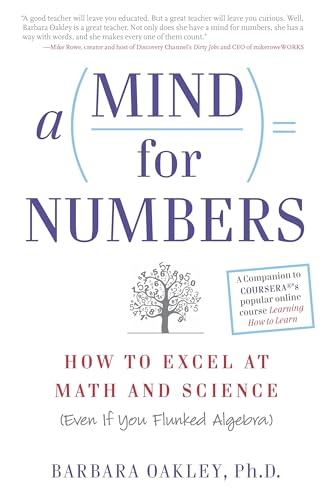
A Mind for Numbers: How to Excel at Math and Science
Dr. Barbara Oakley's actionable guide to unlocking analytical thinking. Perfect for students tackling STEM classes who want to beat procrastination and master complex formulas.
AI Study Pilot receives a small commission from qualifying Amazon purchases at no extra cost to you.Common mistakes
Keep an eye out for these classic pitfalls when studying eigenvalues and eigenvectors:
- Sign errors in matrix subtraction: Subtracting \(\lambda\) along the main diagonal of \(A\) frequently leads to arithmetic sign mistakes, especially when diagonal elements are already negative. Ask AI: "Quiz me Socraticly on setting up (A - \lambda I) for matrices with negative diagonal entries and how to distribute the signs when taking the determinant. Guide me."
- Forgetting the zero vector is not an eigenvector: Eigenspaces are vector spaces, meaning they include the zero vector. However, by definition, eigenvectors must be non-zero vectors. The zero vector itself cannot point in an invariant direction because it has no direction.
- Confusing algebraic and geometric multiplicity: The algebraic multiplicity of an eigenvalue is its multiplicity as a root of the characteristic polynomial. The geometric multiplicity is the dimension of its eigenspace (number of linearly independent eigenvectors). If geometric multiplicity is strictly less than algebraic multiplicity for any eigenvalue, the matrix is "defective" and cannot be diagonalized. Use AI to study this: "Prompt me Socraticly to explain the difference between algebraic and geometric multiplicity, and ask me to determine if a given 2x2 shear matrix is diagonalizable. Guide me."
FAQ
- What is the geometric meaning of an eigenvector? Geometrically, an eigenvector of a transformation is a vector whose direction is unchanged by that transformation. The eigenvalue tells you how much it is stretched, shrunk, flipped, or kept the same. Prompt: "Socraticly quiz me on how eigenvectors represent axes of rotation, expansion, or shearing in a 2D plane. Guide me."
- Can a matrix have complex eigenvalues? Yes. If a matrix represents a rotation, it has no real eigenvectors because all real vectors change direction. Its characteristic polynomial will have complex roots (eigenvalues), representing scaling and rotation in a complex vector space. Prompt: "Act as a Socratic tutor. Quiz me on why a pure rotation matrix in 2D has complex eigenvalues and how that relates to vector directions. Guide me."
- Why is diagonalization important? Diagonalizing a matrix (\(A = PDP^{-1}\)) decouples the linear system, making it trivial to calculate matrix powers (\(A^k = PD^kP^{-1}\)), which is critical for solving systems of differential equations or calculating Markov chain state transitions. Prompt: "Socraticly quiz me on the steps to diagonalize a matrix and how eigenvectors form the change-of-basis matrix P. Guide me."
Final recommendation
Eigenvalues and eigenvectors form the backbone of advanced linear algebra and spectral theory. Avoid letting AI calculate determinants or row reduce matrices for you. Instead, write down your linear systems, solve the polynomial equations on paper, and leverage Socratic AI sessions to audit your arithmetic, check your eigenspace bases, and build geometric intuition.
Disclosure: AI Study Pilot may add affiliate links later. We recommend free-first tools where possible and never promise guaranteed grades or outcomes.