Test prep · Updated June 2026
How to Prep for the GRE and Master Vocabulary and Math Sections With AI Safely
Master GRE quantitative reasoning, verbal context clues, and analytical writing structures with Socratic AI feedback and active recall.
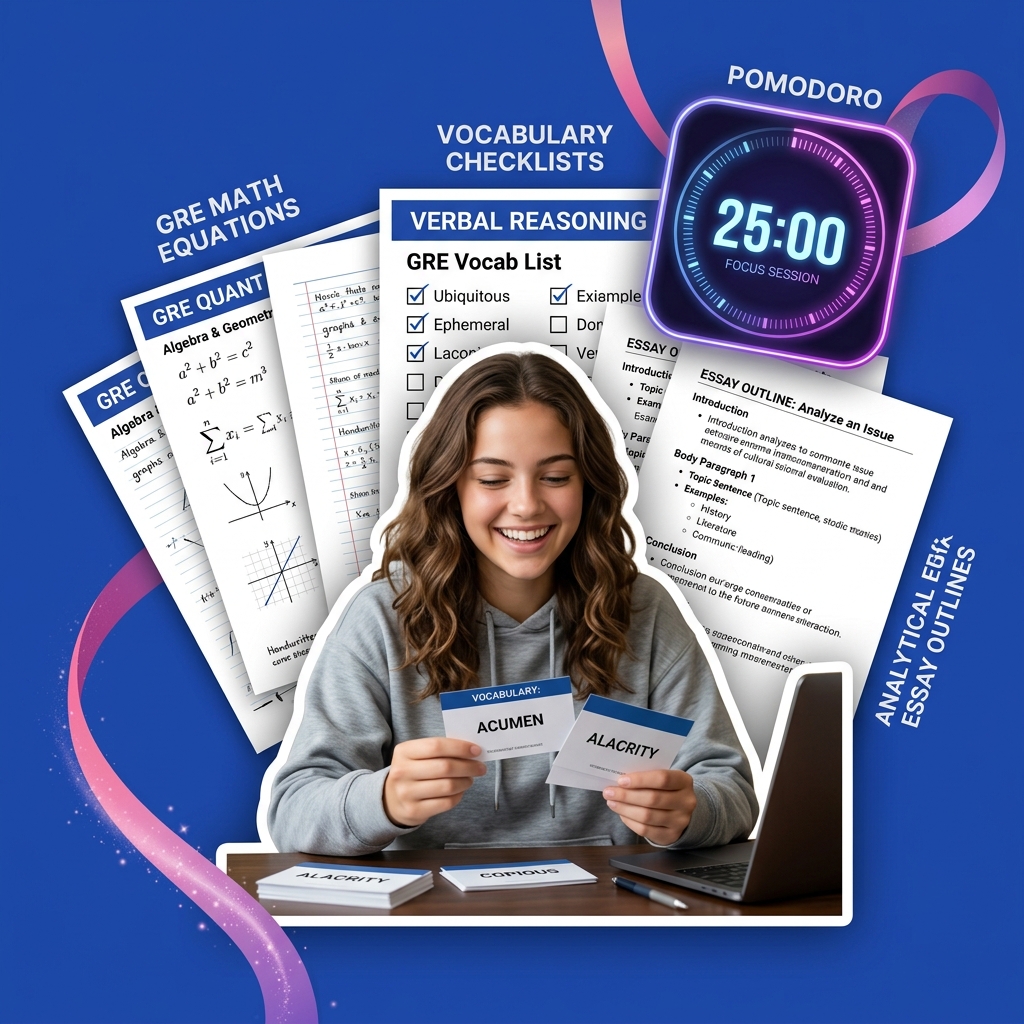
Preparing for the Graduate Record Examination (GRE) is a critical step for students applying to graduate school. The exam measures your skills in verbal reasoning, quantitative reasoning, and analytical writing. Because of the vast amount of vocabulary and mathematical concepts tested, many candidates resort to memorizing static word lists or copying math solutions directly from AI engines.
However, passive studying does not translate to high scores on a timed, adaptive test. This guide outlines a safe, active-learning study workflow to turn AI into a Socratic study coach to master GRE math formulas, dissect vocabulary context clues, and practice essay writing.
Step 1: Active Recall for High-Yield GRE Vocabulary
The GRE Verbal section heavily tests your ability to interpret complex sentence structures and identify precise word relationships (Text Completion and Sentence Equivalence). Instead of passively reading definitions, use AI to practice contextual usage.
Set up an active recall drill using this prompt:
I am preparing for the GRE and reviewing high-yield vocabulary words (such as ephemeral, mercurial, and capricious). Act as a Socratic tutor. Provide me with a fill-in-the-blank sentence that tests one of these words using strong context clues. Do not tell me the list of words. Ask me to identify the missing word and explain my reasoning based on the context. Evaluate my response and guide me with hints.Step 2: Socratic Math Practice and Concept Drills
The Quantitative Reasoning section tests arithmetic, algebra, geometry, and data analysis. The difficulty lies in recognizing the quickest conceptual approach to a problem, rather than performing long calculations.
Use this prompt to practice math problem-solving:
I am reviewing GRE geometry concepts (specifically circles, inscribed angles, and coordinate geometry). Act as a Socratic math coach. Present me with one GRE-style quantitative comparison or multiple-choice question. Do not provide the solution or explain the steps. Ask me to explain my first step in solving it, evaluate my logic, and guide me to the correct answer with hints.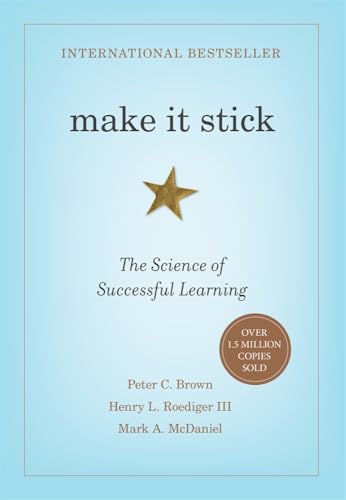
Make It Stick: The Science of Successful Learning
The gold standard for cognitive science learning. Learn how active recall, spaced repetition, retrieval practice, and varied study schedules dramatically improve retention over passive re-reading.
AI Study Pilot receives a small commission from qualifying Amazon purchases at no extra cost to you.Common mistakes
When prepping for the GRE with AI, avoid these common traps:
- Copying Analytical Writing essays: Asking AI to write your Analytical Writing (Issue task) essay will prevent you from developing the timed outlining skills needed on the actual exam. Always draft your own essay and use AI only for feedback on organization and thesis strength.
- Relying on AI for quantitative calculations: Large language models can sometimes make simple calculation errors. Always verify math logic and verify your answers using official ETS materials or prep guides.
- Ignoring the time limit: The GRE is a timed exam. Using AI to explain steps slowly is helpful during early review, but you must practice timed sections under test conditions to build stamina.
FAQ
- How can I use AI to improve my Analytical Writing score? Write an essay responding to an official GRE prompt under a 30-minute timer. Paste your essay and the prompt into the AI, and ask: "Evaluate my essay structure and the strength of my supporting examples. Suggest three specific ways I can make my argument more persuasive."
- Can AI help me learn GRE math shortcuts? Yes! Paste a problem and ask: "Is there a faster conceptual shortcut (like plugging in numbers or checking units) to solve this problem instead of doing algebraic derivation?"
Final recommendation
Preparing for the GRE is about building retrieval strength and mental stamina. Use physical study gear to stay focused during long mock exams, limit digital distractions by studying in a clean environment, and ground your study plan in spacing and active practice.
Disclosure: AI Study Pilot may add affiliate links later. We recommend free-first tools where possible and never promise guaranteed grades or outcomes.