Law studies · Updated June 2026
How to Read and Brief Law Case Studies With AI Safely
Master the IRAC method, identify legal holdings, and break down complex appellate decisions with Socratic AI feedback without shortcutting reading.
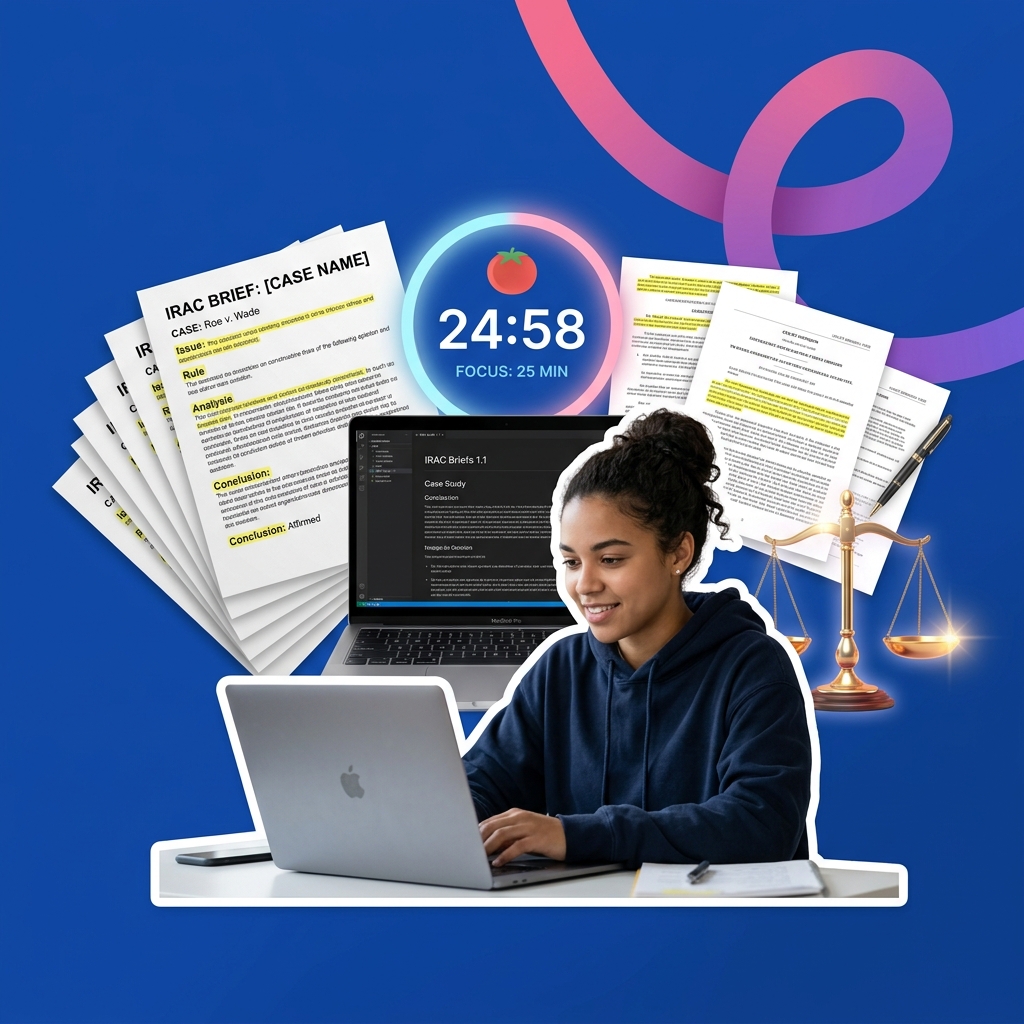
Reading legal opinions is one of the most time-consuming aspects of law school and undergraduate pre-law courses. Casebooks are filled with dense, archaic language and complex appellate reasoning. To survive the heavy reading load, many students are tempted to paste entire court opinions into AI engines to generate quick summaries.
However, bypass reading opinions prevents you from developing the critical analytical skills needed for cold calls and final exams. This guide outlines a safe, source-grounded workflow to use AI as a Socratic legal coach to help you analyze case law, master the IRAC method, and draft your own case briefs.
Step 1: Breaking Down Court Opinions with Socratic Prompts
A standard case brief requires identifying the Issue, the relevant Rule of Law, the Application/Analysis, and the final Conclusion/Holding (the IRAC method). Instead of asking AI to write the brief, use it to test your understanding of each component.
Set up a Socratic case review with this prompt:
I am briefing the Supreme Court case [Case Name, e.g., Pennoyer v. Neff]. I want to practice identifying the key elements myself. Act as a Socratic law professor. Ask me one question at a time to help me define:
1. The key procedural posture and facts.
2. The legal issue the court is addressing.
3. The rule of law applied.
4. The court's reasoning and holding.
Do not provide the answers; evaluate my responses and guide me with hints.
Step 2: Practicing Cold Calls and Hypotheticals
Law school classes rely heavily on the Socratic method, where professors challenge students with hypothetical scenarios to test the limits of a legal rule. You can use AI to simulate this environment and prepare for class.
Set up a mock cold-call session using this prompt:
I am studying the concept of Personal Jurisdiction and the minimum contacts test from International Shoe Co. v. Washington. Act as a Socratic law professor. Present me with a realistic hypothetical business dispute scenario and ask me to determine whether the court has jurisdiction, applying the legal rules we just established. Wait for my analysis, challenge my assumptions, and guide me with hints.
Deep Work: Rules for Focused Success in a Distracted World
Cal Newport's guide on cultivating intense, distraction-free concentration. Essential reading for students looking to master difficult subjects in less time.
AI Study Pilot receives a small commission from qualifying Amazon purchases at no extra cost to you.Common mistakes
When studying law with AI, avoid these common traps:
- Relying on AI for local case rules: Appellate and district courts frequently have differing regional rules. AI models are trained on general data and may hallucinate specific state or local court rules. Always check the official jurisdiction reporter.
- Copying pre-made briefs: Copying an AI-generated case brief is no different than reading "canned" briefs. It does not train your brain to spot critical facts, procedural history, or dissenting arguments.
- Neglecting policy arguments: Law school exams often ask you to discuss the policy implications of a ruling. AI can summarize historical consensus, but you must synthesize your own cohesive policy positions.
FAQ
- How can I use AI to study for legal exams? Use AI to generate hypothetical fact patterns based on your class syllabus. Try to issue-spot the hypothetical on your own, write out your outline, and ask AI to evaluate your issue-spotting checklist.
- Can AI check my case brief formatting? Yes! You can paste your draft case brief and ask: "Is my case brief structured logically according to the IRAC format? Suggest areas where my analysis of the court's reasoning could be tighter."
Final recommendation
Becoming a successful legal thinker requires active, structured engagement with primary sources. Use physical casebooks and handwritten outlines during your study blocks to improve your focus, and treat your digital tools as feedback loops rather than shortcuts.
Disclosure: AI Study Pilot may add affiliate links later. We recommend free-first tools where possible and never promise guaranteed grades or outcomes.